
In This Article
- Is an MBA still valuable in the age of AI?
- The value of an MBA
- Core MBA skills that AI can’t replace
- The rise of AI in modern business sectors
- How MBAs are adapting to AI
- How an MBA can increase your professional value in today’s increasingly AI-driven business landscape
- Leverage MBA and AI to secure your future
Pursuing a Master of Business Administration (MBA) has traditionally been a common route for many professionals across diverse industries to achieve their long-term career goals. However, with the rapid rise of emerging technologies like artificial intelligence (AI), does this qualification still hold the same relevance in today’s business landscape? What does the future of MBA programs look like in an AI‑driven world?
This article explores whether an MBA can adequately prepare you for the changing world of work. We delve into the enduring benefits of an MBA, the impact of AI on higher education and key MBA skills that AI can’t replicate. You’ll also gain insights into how universities in Australia are integrating AI into their MBA programs and how this business degree can elevate your professional standing in an increasingly AI-driven business environment.
Is an MBA still valuable in the age of AI?
The short answer: Absolutely. An MBA remains highly valuable in the age of AI, as the qualification is designed to equip you with the skills to bridge business and leadership insights with AI’s technical strengths, enabling you to drive organisational growth.
An MBA has long been recognised as a worthwhile investment for business professionals looking to advance their careers. The advantages of this postgraduate degree would remain relevant for as long as businesses exist, making the qualification valuable even when industries evolve through technological advancements like AI.'
While this emerging technology has great potential in transforming operations, it still relies on human reasoning to be leveraged effectively. An MBA can help you build the leadership and strategic skills needed to provide that insight. By combining both human expertise with machine capabilities, you can be well‑prepared to navigate technological disruption and thrive in the future of work.
The value of an MBA
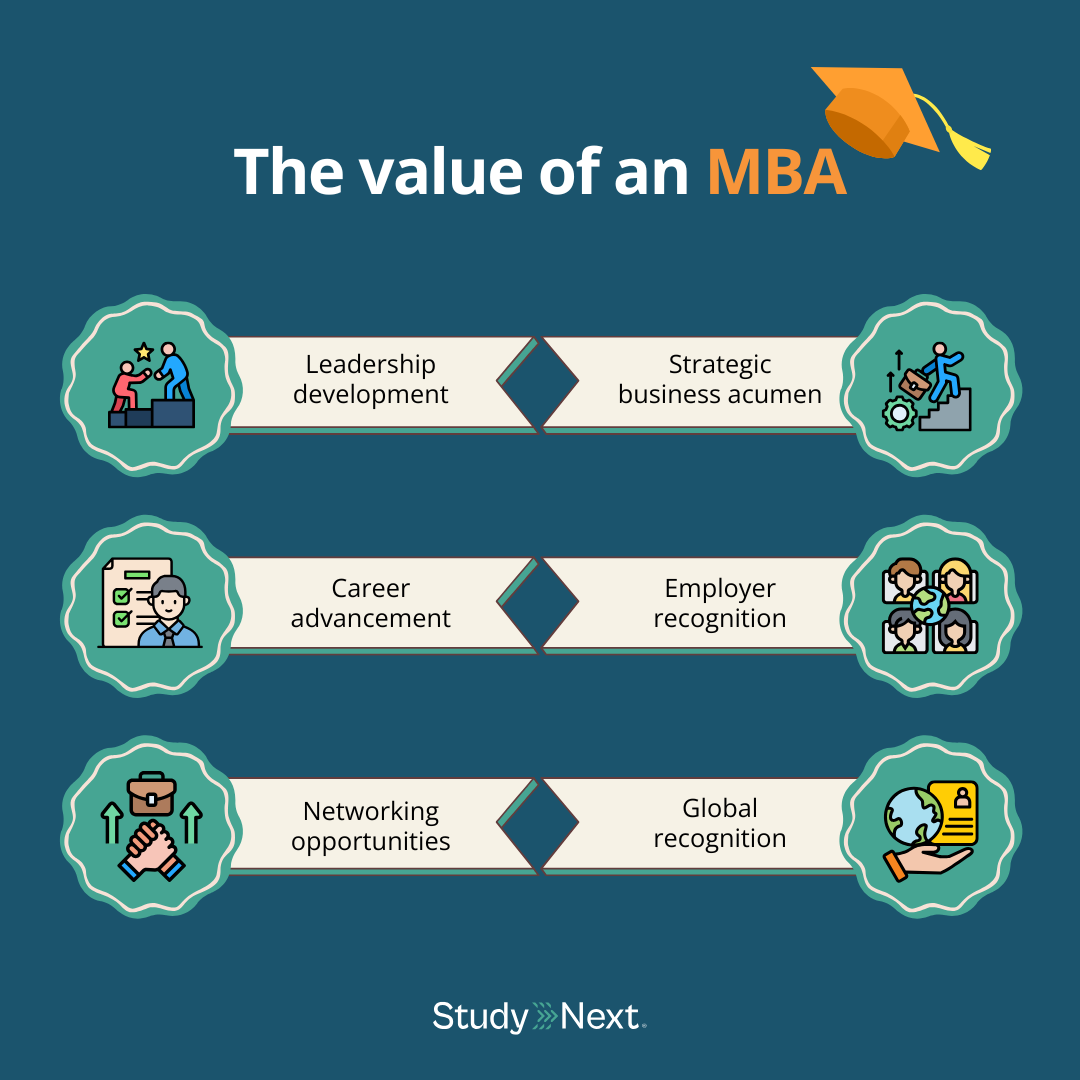
As the business landscape continues to evolve, an MBA remains a trusted qualification for enhancing your leadership skills and career prospects. The credential also provides great employer recognition, networking opportunities, career resources and international recognition. These elements further reinforce an MBA’s enduring importance for the future. Learn more below:
-
Leadership development
MBA programs are designed to cultivate leadership competencies that will remain essential throughout your career. The ability to lead teams and businesses through complex challenges will always be vital in any business environment. Obtaining this qualification signals that you've invested in developing the strategic vision, people leadership capabilities and cross-functional business acumen required to guide organisations towards long-term success. -
Strategic business acumen
MBA programs generally cover a range of core business functions, including finance, marketing and operations, enabling you to understand how these areas are connected to support organisational success. By building this cross-functional knowledge, you’ll be better equipped to develop holistic strategies, make informed decisions and address complex challenges in today’s rapidly evolving business environment. Developing your business acumen also allows you to identify opportunities and risks within organisations. These competencies are likely to remain highly valuable across industries, especially for those aiming to enter senior executive roles. -
Career advancement
An MBA has consistently proven its value for decades as a respected business qualification that helps many professionals from a wide range of industries transition into leadership and management roles. Acquiring this postgraduate credential demonstrates your readiness for more senior positions, which may open the door to more career opportunities and increase your earning potential. -
Employer recognition
The Graduate Management Admission Council (GMAC)’s Corporate Recruiters Survey in 2024 found that two-thirds of employers worldwide view full business degrees, including MBAs, as more effective for employee success compared to micro-credentials. This preference hasn’t changed since it was first measured in 2022. In today’s era, where continuous upskilling is encouraged, professionals may opt for short courses and micro‑credentials to update or learn new skills. However, this survey finding demonstrates how many employers still prefer comprehensive business degrees that provide depth and long‑term leadership development over shorter, focused credentials. This reinforces the continued relevance of a business degree, like an MBA, as a strategic investment for professional growth. -
Networking opportunities
Pursuing an MBA connects you with a diverse community of professionals. By engaging with your peers, lecturers and industry experts during your learning journey, you can build a solid professional network that can last throughout your career. As business environments undergo changes over time, your MBA connections from diverse fields may provide valuable industry insights and professional opportunities that can help you navigate these shifts with confidence. -
Global recognition
MBA programs are widely regarded with international prestige, as their curricula are structured to equip professionals with essential skills and knowledge that transcend industries, geographical borders and shifting market conditions. Some courses even feature units or specialisations that focus on international business. Even as the global economy shifts, this credential can offer you greater career mobility, enabling you to pursue opportunities both locally and abroad.
Core MBA skills that AI can’t replace
The uniquely human skills that can be developed throughout an MBA course, including leadership, communication, emotional intelligence, strategic thinking, ethical decision-making and adaptability, can’t be replicated by AI. Although the technology can serve as a tool for professionals, it doesn’t have the capacity and human intellect to demonstrate these competencies on its own. Learn more below:
Leadership
Strong leadership is one of the most critical human skills in the age of AI. The skill involves inspiring teams, taking charge of projects, navigating complex dynamics and making informed decisions that consider stakeholder interests. MBA programs are designed to build these capabilities through case studies, team projects and practical learning that simulate real-world challenges. While AI can be used by leaders to inform judgment and calculate business risks, it lacks the human insight needed to lead people and business ventures towards success.
Communication
To be an effective communicator, it’s important to understand how to deliver information clearly to your audience. The ability to read the room, present your arguments persuasively and adjust how you speak based on real-time feedback are key skills that you can strengthen during your MBA journey. This can be done by engaging with your classmates and faculty members, giving presentations and completing written assignments. Although AI can assist with drafting text, it cannot replicate the charisma and authenticity that make human communication impactful.
Emotional intelligence
Emotional intelligence (EQ) refers to the ability to recognise and manage your emotions and those of others. This is an essential skill for a business professional, as it allows you to engage with diverse stakeholders with compassion and respect different perspectives. MBA courses can help strengthen this capability by offering opportunities to collaborate with peers, participate in networking events and other interpersonal situations. This allows you to better understand various communication styles and non-verbal cues like tone of voice and body language, which requires human intellect that AI lacks. While AI can analyse patterns in data, it doesn’t have the ability to examine complex human emotions or respond with genuine empathy.
Strategic thinking
According to the GMAC’s 2024 Corporate Recruiters Survey, strategic thinking is the most essential skill global employers expect to have continued importance in the next five years, surpassing IT expertise and proficiency with AI tools. This highlights the importance of analysing complicated issues and developing effective action plans to solve them. Strategic thinking also involves identifying threats and opportunities to optimise business performance. The MBA curriculum often focuses on this skill in many of its units, allowing you to improve your ability to think strategically in diverse business environments. Unlike AI, which depends purely on data, strategic thinking incorporates human judgment and contextual knowledge that the technology cannot replicate.
Ethical decision-making
As more organisations are adopting AI into their everyday functions, it increases the need for human insight and ethical judgment to leverage this technology responsibly. Many MBA programs emphasise corporate responsibility and sustainability as an effort to produce values-driven graduates who can make decisions that balance business profit with social impact. With various ethical concerns surrounding AI, including data privacy, fairness and environmental repercussions, AI isn’t equipped to make the final call in ethical decision-making. The responsibility lies with people to use their human reasoning to properly assess ethical dilemmas.
Adaptability
Being adaptable is crucial to staying competitive in today’s job market, as it allows you to adjust to changes that happen within the business world. Pursuing an MBA can help improve this skill by immersing you in real-world business situations through case studies, projects and simulations, offering a safe environment to experiment with different approaches to solve challenges. This skill is unlikely to be replaced by AI, as the technology is limited to processing available data. It lacks the intuitive decision-making ability that humans use to address problems, even when there’s insufficient information.
The rise of AI in modern business sectors
AI technologies have been reshaping businesses across diverse industries at a rapid pace by streamlining processes, boosting operational efficiency and helping organisations gain a competitive edge. According to Amazon Web Services’ Unlocking Australia’s AI Potential 2025 report, 1.3 million Australian businesses now leverage AI. The adoption rate reached 50 per cent in 2025, growing from 43 per cent in the previous year. This represents a year-on-year growth rate of 16 per cent, which demonstrates how AI is quickly becoming a mainstream component of business operations.
AI can be used to enhance diverse business functions. Companies can utilise predictive AI to forecast market trends, deploy chatbots and virtual assistants to improve customer service or use machine learning algorithms to personalise marketing strategies. To find more information about how AI is leveraged in business, you can check out this article.
Staying ahead in today’s business landscape requires you to understand the changes shaping it, including rapid technological innovations like AI. As AI adoption accelerates across industries, business leaders need both technical knowledge and strategic insight to integrate AI effectively. An MBA can help equip you with this crucial perspective by preparing you to evaluate and harness emerging opportunities through a business lens. You’ll learn how to consider factors such as return on investment, organisational readiness and the ethical implications of emerging technologies. Rather than simply understanding what AI can do, you'll explore when and how it should be deployed to create meaningful business value and enhance performance.
How MBAs are adapting to AI
In response to the rapid growth of AI across industries and the increasing demand for professionals with AI-related competencies, many universities in Australia are now embedding AI in business courses and MBA programs through specialisations, core units or electives. This helps prepare graduates who have both strong leadership capabilities and AI‑ready skills needed in today’s business landscape.
Deakin University’s Master of Business Administration features an Artificial Intelligence for Business specialisation, making it a strong example of an MBA with an AI focus. In this stream, you’ll take on units such as People Analytics, Artificial Intelligence Strategies and Enterprise Applications, Machine Learning in Business and Responsible Artificial Intelligence. Throughout your studies, you’ll learn how to design AI strategies tailored to specific businesses and industries, apply machine learning techniques that support business decision-making and assess the social and ethical challenges associated with AI technologies.
The AGSM Master of Business Administration at the University of New South Wales offers a wide range of electives focused on future-ready skills, such as the AI Strategy unit. Blending theoretical foundations with case studies and practical projects, this elective aims to provide the strategic insights and tools needed to incorporate AI into business strategies. This unit also helps you gain an understanding of AI’s transformative role in supporting innovation and boosting operational efficiency.
One of the core units of the University of Sydney’s Master of Business Administration is Business Transformation Through Analytics and AI, which focuses on how you can build a strategic roadmap for applying analytics and AI in real-world business contexts. You can gain insights into how digital transformation can be implemented within organisations to maximise opportunities, enhance customer outcomes and balance risk and reward.
In Torrens University Australia’s Master of Business Administration, you can take Artificial Intelligence and Its Responsible Use in Business as an elective. This unit delves into how emerging technologies, such as machine learning, deep learning and natural language processing, can be applied ethically in business. You’ll examine how AI shapes the business analysis life cycle, from defining business requirements and obtaining data sources to deploying AI models and assessing their performance. This unit also provides insights into responsible AI principles, including fairness, privacy and safety in analytics outcomes.
Besides specialisations and course units targeted to learners, some universities are adopting AI at a broader institutional level. In 2025, La Trobe University announced a collaboration with OpenAI to embed AI into key courses set for 2026, including the launch of Australia’s first AI MBA. As part of this partnership, La Trobe will also introduce ChatGPT Edu across the entire university, offering free access to advanced AI tools for all staff and students by 2027. This initiative emphasises the importance of building an AI‑ready higher education community that prepares learners and faculty with essential skills for the future of work.
How an MBA can increase your professional value in today’s increasingly AI-driven business landscape
In a business landscape transformed by AI advancements, an MBA can help enhance your professional value by improving employability, increasing adaptability and expanding leadership prospects in technology industries. The qualification can also prepare you to build future-ready teams and guide organisations through technological disruptions. Discover more below:
Enhance employability with AI-ready skills
AI literacy is rapidly becoming a baseline expectation for business professionals in today’s workforce. According to the Corporate Recruiters Survey by GMAC in 2024, 63 per cent of corporate recruiters worldwide expect business graduates to utilise AI for obtaining knowledge and developing new business skills, while 62 per cent want them to use AI to craft business strategies and make decisions. This finding reflects the growing reality that AI has become integral to various aspects of business operations.
Completing an MBA program that incorporates AI literacy into its curriculum can help prepare you to meet these employer expectations. Developing this readiness enables you to stand out in the job market, which may lead to enhanced employability, faster career progression and access to leadership roles, especially within organisations undergoing digital transformation.
Increase adaptability in evolving markets
MBA courses often provide hands-on exposure to a wide range of business challenges, helping you develop the skills needed to design viable solutions and identify opportunities for growth. These learning experiences enable you to enhance your strategic mindset and problem-solving abilities, allowing you to adapt and respond effectively to dynamic business situations. Adaptability is a valuable quality to have, especially as markets continue to change under the influence of different factors, including economic shifts, geopolitics and technological advancements like AI. By completing this qualification, you’ll be equipped with the business acumen needed to address diverse business issues and move your organisation forward.
Expand leadership opportunities in tech-driven industries
While technical proficiency is highly valued in the technology sector, employers in this industry still look for leaders who can achieve business results by guiding and managing people effectively. The Department of Industry, Science and Resources’ 2025 report on Australia’s artificial intelligence ecosystem highlights that even AI‑related job postings often emphasise non-technical competencies, such as communication, management and leadership.
This employer demand for leadership skills in tech creates significant opportunities for MBA graduates. Since MBAs are structured to boost your leadership capabilities and prepare you to navigate technological advancements, gaining this qualification can help position you for a variety of leadership roles across diverse sectors, including tech-driven industries. Tech companies that are prioritising AI integration need leaders who can make strategic decisions about AI investments, ensure ethical AI deployment and identify opportunities for AI-driven innovation.
Build and lead future-ready organisations
As an MBA graduate, you can play a pivotal role in helping an organisation optimise its collaboration between AI and humans by combining your business expertise with an AI-ready mindset. This may involve championing AI adoption in the workplace, managing resistance to change and building teams that can leverage technology, including AI, effectively in business operations. MBA programs help to equip you with the right skills to take on these responsibilities, empowering you to help your organisation thrive when faced with digital disruptions.
Leverage MBA and AI to secure your future
So, if you’re asking, “Is an MBA valuable in today’s world?”, the answer is yes. In an era of rapid technological advancements, an MBA can still serve as a lasting investment for your career growth and leadership development. By combining the strengths of an MBA and AI technologies, you can future-proof your career and better position yourself as a leader in the digital age. Get started today and explore a wide range of MBA courses available in Australia.