
In This Article
- What is a small business?
- Emerging trends shaping small businesses in 2026
- 15 small business ideas in Australia to explore in 2026
- How to start a small business in Australia
- How to finance your small business
- Government resources for small businesses
- Marketing ideas for small business owners
- What tools and software do small businesses need?
- When to scale your small business
- Set your small business up for success with further education

People often start small businesses to create an additional income stream, enjoy the autonomy of being their own boss or turn a personal passion into a profitable venture.
If you're seeking inspiration for your entrepreneurial journey, we've compiled 15 ideas for a small business to consider. Beyond ideas, you'll also learn how to start your business, secure funding, leverage government resources and implement effective marketing strategies, along with the tools and software you may need along the way. These insights can help you prepare to take the first steps towards building a successful small business.
What is a small business?
In Australia, a small business is defined as a company with fewer than 20 employees, according to the Australian Bureau of Statistics. These enterprises form the backbone of Australia's economy, representing an overwhelming 97.3 per cent of all businesses in 2025. The Australian Small Business and Family Enterprise Ombudsman reported a total of 2,656,469 small businesses in 2025, recording an increase of 66,874 compared to the previous year. This figure demonstrates consistent growth in the sector and highlights Australia’s conducive environment for entrepreneurial talent.
Emerging trends shaping small businesses in 2026
In 2026, small businesses can aim to boost their competitiveness by leveraging trends like artificial intelligence (AI) integration, sustainability, authenticity and social commerce. These trends can help them strengthen overall performance by enhancing operational efficiency, brand visibility and profitability. Find out more below:
AI integration
AI technologies are rapidly transforming diverse functions within businesses, including automating workflows, personalising customer experiences and analysing data. LinkedIn’s How Small Businesses Can Win in 2026 report in 2025 revealed that over 55 per cent of small business leaders in Australia believe AI has made launching and managing a business easier today. 79 per cent of small business marketers agree that the technology will help smaller brands compete more effectively. With many AI tools widely accessible, small businesses can leverage them to level the playing field against larger competitors without significant technological investments.
Sustainability
Ethical consumption and sustainability are increasingly shaping consumer choices in Australia. According to Monash Business School’s Retail Sustainability Spotlight survey in 2024, 46 per cent of Australian shoppers consider sustainability as an important factor in retail purchases, and 42 per cent of them are willing to pay more for ethically produced goods. With this ongoing trend, small businesses that embed sustainability into their products, services and operations can better align with consumer expectations and stand out in a values-driven marketplace.
Authenticity and trustworthiness
In a market saturated with similar offerings from different brands, consumers may be more likely to gravitate towards businesses that feel genuine and trustworthy. This trust can come from relatable voices promoting the brand, such as employees, content creators, ambassadors and industry experts. LinkedIn’s How Small Businesses Can Win in 2026 report revealed that 87 per cent of Australian small business marketers are investing in community-driven content. By encouraging active participation from audiences rather than relying solely on brand messaging, small businesses can build organic visibility that can foster greater trust.
Social commerce
In 2025, Australians spent an average of 41 hours online each week, with nearly half of that time dedicated to social media, according to We Are Social and Meltwater’s 2026 Global Digital Report. The report also revealed that six in ten Australians turn to social platforms when researching brands. These findings present an opportunity for small businesses to promote offerings directly on platforms like TikTok, Instagram and Facebook. By creating shareable content and enabling in-app purchases through platforms like TikTok Shop and Instagram Shop, businesses can streamline the buying process and drive more conversions without requiring customers to leave the application.
15 small business ideas in Australia to explore in 2026
You can find a wide range of good small business ideas to consider, from creative business ideas like custom arts and crafts and content creation to product-based ventures like eco-friendly goods and artisanal food and beverages. Many of these ideas allow you to draw on your own skills and passions. Take a look at each small business idea below, along with the essentials you’ll typically need to get started:
Creative business ideas
Custom arts and crafts
This business involves creating and selling handmade items such as jewellery, ceramics, woodwork or home decor through online platforms or local markets. To keep this type of business profitable and sustainable, your pricing should carefully factor in materials, time and overhead costs.
What you’ll need: You’ll typically need a designated workspace to work on your crafts. If you’re planning to sell online, you need to choose appropriate selling platforms, such as Etsy, or host your own website to display and market your products.
Event planning
Event planners coordinate and manage occasions, ranging from weddings and corporate functions to conferences, parties and community gatherings. Many professionals begin with smaller events and gradually build a portfolio.
What you’ll need: You may need specific permits or licenses depending on your location or event. This business typically requires strong vendor networks, so it’s crucial for you to have excellent skills in communication, negotiation and crisis management.
If you’re looking to improve your negotiation skills, consider completing CPA Australia’s Negotiation and Influence for Success four-hour short course. Conducted online, you'll learn various negotiation techniques to reach mutually beneficial agreements. You’ll also discover different influencing strategies to build consensus while effectively sharing your perspective and insights.


Learn about various sources of power in the workplace, different influencing styles and strategies and barriers to influence.
Content creation
Becoming a content creator has increasingly become a popular career path in today’s digital world. It generally involves producing content for businesses, including photography, videography, podcast production or social media content. Many content creators specialise in a niche, such as food, health and fitness or fashion and beauty. They may also work with brands that align with their image to help businesses reach targeted audiences.
What you’ll need: Your portfolio and number of followers on social media can play a big role in landing clients. To produce content, you may need relevant tools like a professional camera and editing software.
Product-based business ideas
Eco-friendly products
This business involves creating or sourcing environmentally sustainable products, including zero-waste alternatives such as cloth shopping bags, beeswax food wraps and bamboo toothbrushes. With growing consumer demand for eco-conscious choices, offering sustainable options can help you tap into this market.
What you'll need: While not mandatory, you can consider obtaining certifications from recognised organisations like B Corp and Fair Trade to demonstrate your business’s commitment to sustainability.
Handmade fashion items
If you have a passion for fashion, you can design and produce clothing, bags or accessories and sell them through online platforms, local markets, pop-up stores or retail partnerships. Many small fashion businesses start with limited collections and expand as demand grows. Collaborating with other artisans or using sustainable materials can help differentiate your brand and appeal to ethically minded customers.
What you'll need: If you’re producing the fashion goods yourself, you need to have excellent fashion design and sewing skills. This also requires you to have proper equipment, including sewing machines and mannequins, and a dedicated workspace.
Artisanal food and beverage products
This business focuses on selling specialty food and drink items such as baked goods, preserves, sauces or craft beverages. You can market your offerings at farmers’ markets, specialty retailers, food trucks or online. Offering customisable gift boxes or seasonal limited-edition products may also help attract customers.
What you'll need: You’re required to have a Food Safety Supervisor certificate if you’re preparing the food or drinks yourself. If you’re selling alcoholic beverages, you need to have an appropriate alcohol license from your state government. A commercial kitchen that complies with food safety regulations is also necessary for handling your products.
Small business ideas from home
Meal preparation
Meal preparation businesses focus on preparing pre-cooked or pre-portioned meals for clients' weekly consumption. Many providers also offer specialised options to cater to diverse dietary preferences and needs, such as vegan, gluten-free or keto-friendly meals.
What you'll need: As this is a food-related business, you’re required to obtain a Food Safety Supervisor certificate to demonstrate your ability to prepare meals safely. Since you’re cooking from home, your kitchen must be properly equipped to meet hygiene standards and prevent contamination.
Fitness services
You can transform your home into a fitness studio and provide classes like yoga, pilates or high-intensity interval training. Services can be delivered in person or online. You can also expand your reach by offering recorded sessions or subscription-based virtual programs.
What you'll need: Certification is required, depending on the type of fitness service you provide. For example, if you want to become a yoga instructor, you need to complete a 200- or 500-hour Yoga Teacher Training course certified by the Yoga Alliance or a 350-hour program accredited by Yoga Australia. You’ll also need suitable fitness equipment for your classes, such as yoga mats, weights or reformer machines.
Tutoring
A tutoring business can cover various types of support for students, including academic guidance in specific subjects, test preparation, music lessons or foreign language instruction. This can be operated entirely from home or online. With proper training, you can also specialise in helping students with ADHD or dyslexia, allowing you to offer tailored services and charge higher rates.
What you'll need: You need to have deep expertise in your teaching area. While you don’t need a formal permit to operate, you’re required to obtain a Working with Children Check if you’re planning to tutor minors. You’ll also need specialised training to ensure you’re equipped to teach students with unique learning needs, if that’s the focus of your niche.
Digital-based business ideas
E-commerce
Running an e-commerce business means selling products online, whether you manufacture your own goods, resell items or use dropshipping. This business model enables you to reach customers from diverse locations, including other countries, and allows them to shop anytime. It also reduces overhead costs compared to managing a physical store.
What you’ll need: Strong knowledge of e-commerce platforms like Shopify, Amazon or eBay is essential. Digital marketing skills, such as search engine optimisation (SEO), are also vital to make sure your offerings stand out in the market.
Online courses
An online course business involves creating and selling educational content, templates or other digital products based on your expertise. Topics can range from career-focused skills to hobbies and personal interests. While this model offers great passive income potential, it requires significant upfront effort to produce high-quality content.
What you'll need: You’ll need expertise in your teaching area to make sure your courses are engaging and current. If your courses include pre-recorded video lectures or tutorials, you’ll need a proper recording setup and editing software to produce professional content. You’ll also need a platform to upload your courses, such as Coursera, Udemy or edX.
Digital marketing
Digital marketing businesses provide services like SEO, pay-per-click advertising, social media management and email marketing to individuals and companies. By delivering measurable results and helping brands reach their target audiences more effectively, these businesses play a vital role in driving growth in today’s digital-first landscape.
What you'll need: To provide digital marketing services, you should have expertise in marketing automation platforms, analytics tools, social media management software and more. Having relevant digital marketing certifications, such as Google Ads, HubSpot or Meta Social Media Marketing, can serve as evidence of your capabilities.
If you want to enhance your digital marketing expertise, the University of Melbourne offers an online Digital Marketing Strategy and Leadership short course. Delivered over six weeks, you’ll learn how to strategically craft and execute digital marketing campaigns, covering essential areas like organic and paid media channels, content marketing and social media. This course is suitable for both digital marketers and business professionals looking to deepen their understanding of digital marketing.

Build customer-led digital strategies that connect channels, campaigns and performance with broader business goals.
Professional services business ideas
Business consulting
Business consultants provide professional advice to help clients improve performance, solve specific challenges or achieve strategic goals. This role may involve examining existing business models, recommending appropriate technological investments or developing change management plans during major organisational transitions. There are many niches to explore in this field, including management consulting, sustainability consulting or strategy development.
What you’ll need: You should have deep expertise in your chosen field, backed by years of industry experience. Building a strong network and portfolio of successful case studies can also help increase your credibility and attract clients.
Pursuing a postgraduate business course, such as a Master of Business Administration, can boost your business acumen. This qualification can provide you with the strategic framework and cross-functional business knowledge needed to advise clients. For example, Deakin University’s Master of Business Administration delves into core principles of business, giving you the tools to navigate modern business challenges and trends. This program’s curriculum is also designed to encourage you to think in new ways, solve complex issues and strengthen your strategic decision-making, which are key capabilities in business consulting.


Strengthen your strategic and enterprise-level thinking to lead people, navigate complex business challenges and create sustainable value across organisations and industries.
Financial planning
As a financial planner, you assist individuals and businesses in managing their financial health and work towards fulfilling their financial objectives. Depending on your area of specialty, you may provide advice on different financial areas, including investments, retirement planning and debt management.
What you’ll need: To provide financial advice legally in Australia, you must have an accredited bachelor’s degree, complete a professional year with an organisation that holds an Australian Financial Services (AFS) license and pass the financial advisor examination administered by the Australian Securities and Investments Commission. If you want to operate independently, you’ll need to have your own AFS license.
You can explore postgraduate courses in financial planning if you’re looking to strengthen your expertise in this field. For example, Victoria University offers a Master of Financial Planning, which aims to refine your competencies in providing appropriate and regulation-compliant financial planning advance. Through units like Behavioural Finance for Financial Advisers, Corporate Finance, Financial Plan Construction and Client Management and Principles of Financial and Investment Planning, this degree equips you with advanced knowledge and understanding of today’s financial planning sector.


Develop advanced knowledge in financial planning, investment, superannuation, risk, taxation and client advice while building professional and ethical capabilities for the financial planning sector.
Accounting
Accountants deliver a wide range of financial services, including maintaining records, preparing tax returns and reconciling accounts. With demand for accountants expected to grow by 9.2 per cent within the next five years in Australia, this profession presents valuable opportunities for small business owners to support clients in managing their finances.
What you’ll need: Having a degree in accounting or finance can help increase your credibility when seeking clients. If you plan to offer tax advice as part of your service, you must be registered with the Tax Practitioners Board as a tax agent or become a qualified tax-relevant provider.
Advancing your qualifications with a master’s degree can be a great way to enhance your accounting skill set. One of the programs you can consider pursuing is Monash University’s Master of Accounting, which is designed to help you develop specialised skills in accounting, financial accounting, information systems, forensic accounting, auditing and management accounting. This one-year course also provides a fast-track pathway to obtaining professional recognition with the Chartered Institute of Management Accountants, which may further strengthen your credibility with potential clients.
How to start a small business in Australia
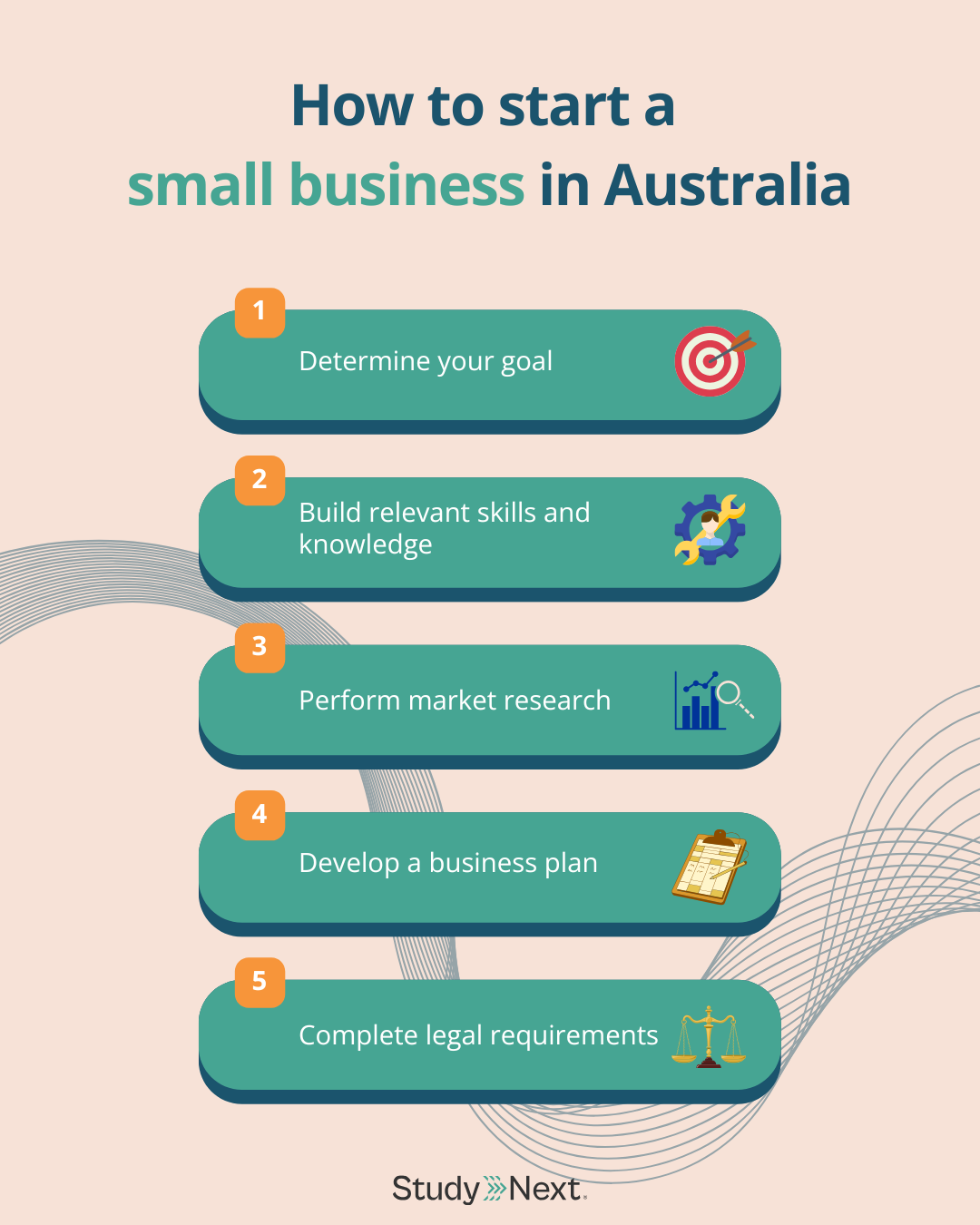
Launching a small business in Australia typically begins by defining your goals, followed by developing the right expertise, conducting thorough market research and creating a strong business plan. You’ll also need to meet the necessary legal requirements. Discover the key steps in detail below:
1. Determine your goal
The first step in starting a business is understanding why you want to pursue this entrepreneurial path. Identify the main purpose of your venture, whether it’s to achieve financial independence, pursue your passion or fill an existing gap in the market. Defining your goal can help shape the direction of your business and keep you motivated when you face challenges. Having a clear objective can also make it easier to communicate your vision to potential investors, partners and customers.
2. Build relevant skills and knowledge
Starting a small business doesn’t just require strong knowledge of the products or services you’re offering. You need other essential skills to manage a business and keep it sustainable, such as financial management, marketing and customer service. Many aspiring entrepreneurs develop these capabilities through hands-on professional experience and formal education, including postgraduate programs and short courses.
If you’re looking to quickly upskill in a specific area, you can consider completing a short course. For example, if you want to improve your skills in delivering value to your customers, the University of Queensland offers a Leading Customer Experience Transformation short course. Conducted in person over two days, you’ll explore strategies for building customer-focused organisations. You’ll also obtain practical tools and expert insights into value creation and measuring consumer satisfaction.


Acquire knowledge to design and implement customer-centric strategies, blending human insights with innovation to enhance brand loyalty and improve business performance.
For those aiming to enhance marketing expertise with data insights, RMIT University’s Marketing Analytics and Insights is designed to equip you with practical marketing analytics skills. Delivered online over six weeks, you’ll learn how to leverage tools like Google Analytics, Tableau and Adobe Analytics to analyse marketing performance. You’ll also learn to generate customer insights, execute personalisation strategies and turn data into actionable marketing plans.


Elevate your marketing career with hands-on experience in marketing analytics and use data to solve real-world business problems.
If you’re seeking a more comprehensive learning experience while furthering your qualifications, you can pursue a postgraduate entrepreneurship course. These programs cover diverse topics that are essential for starting and growing their business. For example, Australian Catholic University’s Graduate Certificate in Innovation and Entrepreneurship equips you with the tools to transform your ideas into viable business opportunities. You can tailor your studies by choosing electives in marketing or information technology, as well as benefit from the university’s business incubator and consultation services.


Develop knowledge and skills to commercialise creative ideas, learn about financing, business management and problem-solving, which will enable you to develop and manage high-growth ventures.
You can also consider studying the Graduate Diploma in Entrepreneurship at the University of New South Wales. This program delivers an immersive learning experience designed to sharpen your entrepreneurial skills and transform ideas into real-world solutions. You'll study core units including Identifying Opportunities, Business Model and Lean Startup Methodologies as well as Startup Placement, building the expertise needed to start, scale and sustain your venture.


Turn entrepreneurial ideas into viable ventures through an immersive startup incubator that combines practical experience, mentoring and industry connections.
The University of Melbourne’s Master of Entrepreneurship delves into the latest concepts and methods to develop new products and services that create value and drive revenue growth. Through direct engagement with corporate entrepreneurs during your studies, you'll gain the expertise to start your own business, drive innovation within established companies or support the growth of emerging ventures.
Looking for more courses for aspiring small business owners? Check out this article.


Facilitates your career as an agent of change, either within a new venture or an established organisation.
3. Perform market research
Conducting market research is crucial to building a strong business strategy. It generally involves studying your target audience to understand their needs, preferences and purchasing behaviour. This process also typically includes analysing market trends and existing competitors to find market gaps and discover opportunities to differentiate your offerings. Market research is necessary as it enables you to understand demand before committing to the venture, reducing business risks. With these insights, you can customise your products or services to meet customer expectations and keep your business competitive.
4. Develop a business plan
A business plan serves as your blueprint, guiding decisions and helping you stay focused in the long run. It should outline your business profile, products and services, marketing strategy, operating plan and more. A well-prepared plan enables you to clarify your business direction, especially to investors, lenders and other important stakeholders. Preparing a business plan also allows you to think critically about challenges you may encounter, helping you anticipate risks, plan for growth and allocate resources effectively.
To find more information on how to write a business plan, you can refer to this article.
5. Complete legal requirements
Before launching, it’s essential to ensure your business meets all legal obligations. This includes registering your business name, choosing the right business structure, such as sole proprietorship, partnership or company and obtaining necessary licenses or permits. These steps keep you compliant with the law, protect your brand, help you meet tax requirements and establish credibility with customers and investors.
In Australia, most businesses need to obtain an Australian Business Number to identify themselves to the government, other businesses and the public. You’ll also need a Tax File Number for your business. If your annual turnover is predicted to exceed $75,000, you must register for the Goods and Services Tax. If your small business operates under a name other than your own, you need to register that name with the Australian Securities and Investments Commission.
Beyond registrations, you may need specific licenses and permits to carry out daily operations. Depending on the nature of your business, you may need food safety certifications, permits to operate from certain premises or professional licenses if you’re offering regulated services.
Consulting with legal or financial professionals can help you navigate complex regulations and ensure full compliance. Once your business is legally established, you can direct your efforts towards growing your company.
How to finance your small business
Financing your small business involves understanding the startup and running costs of your business, exploring different funding avenues and learning how to get a small business loan if this is the right option for you. Discover more below:
Understanding startup and running costs
Starting a business comes with a wide range of expenses that vary depending on your business model, structure and industry. Common expenses include supplies, equipment, insurance, business name registration and professional services like legal or accounting support. You’ll need to cover these initial expenses before your business begins generating revenue. Identifying them early allows you to plan ahead and secure enough financing to improve your chances of long-term success.
Besides setup costs, it’s also important to consider running costs, which are the ongoing expenses required to keep your business operating daily. These may include employee wages, rent and utilities. Since revenue may take time to stabilise, you’re advised to have enough funds to cover at least six months of operating expenses when you first launch. This buffer can provide financial security, enabling you to focus on growth without the immediate pressure of cash flow shortages.
Exploring different funding options
Choosing the right funding option is one of the most important steps in building a sustainable business. It typically depends on your industry, growth objectives and risk appetite. For businesses, funding can generally be divided into debt finance and equity finance, each with its own benefits and challenges.
- Debt finance: This involves borrowing money that must be repaid with interest. Common examples include bank loans, mortgages and credit cards. While debt finance allows you to retain full ownership and profits of your business, emerging entrepreneurs may sometimes find it difficult to secure loans without strong financial records or a detailed business plan. Repayments can also strain cash flow if your business doesn’t have a steady revenue stream.
- Equity finance: For this funding option, you would be raising money by selling a share of your business. This external investment can come from family and friends, angel investors, venture capitalists or through crowdfunding efforts. Equity finance enables you to avoid debt and repayment pressures, giving you more breathing room in the early stages of your business. However, it does require you to give up a portion of control and share profits with your investors.
Applying for a business loan
Once you’ve assessed your funding needs, the next step is to evaluate which financial product best suits your circumstances. Opting for a loan is a common route for many entrepreneurs. Different loan types come with varying costs, interest rates and tax implications. Comparing your options can help you find the most suitable terms and avoid unnecessary financial strain. You can also consult a business advisor or accountant before making a decision.
Before approaching a lender, it’s important to be prepared with a strong business plan. The plan should demonstrate how the funds will be used, how much you need to borrow, the repayment timeline and the expected financial impact. You’ll also need to prepare financial documentation to support your application. This may include financial reports, ratio calculations and cash flow forecasts. This can help give lenders a clear picture of your ability to make repayments.
It’s important to explore all available financing avenues. While banks are a common source of loans, specialist lenders and alternative financing arrangements may offer more flexibility. By considering your options and preparing thoroughly, you can increase your chances of approval and set your business on a stable path for growth.
Government resources for small businesses
Small businesses in Australia can benefit from a wide range of support from the government, including toolkits, free online courses, grants and mentoring services. You can also get consultations to handle different aspects of your business, including financial management and cybersecurity. Below are some examples of existing government resources:
- Small business toolkit: Provided by the Australian Competition and Consumer Commission, this toolkit aims to help small business owners understand their rights and responsibilities when managing customers, suppliers and competitors. Covering areas like fair trading, pricing and promotion, it helps ensure that your business is compliant with the Competition and Consumer Act 2010 and Australian Consumer Law.
- Free online training and courses: The government offers free short courses through the Fair Work Ombudsman and Australian Taxation Office to upskill business owners. You can find modules covering essential topics like record‑keeping, hiring staff, managing performance and workplace compliance.
- Grants finder tool: Available on the official government business portal, business owners can use this tool to identify grants, funding and support programs across different industries and regions. It also highlights grants for specific communities, such as Aboriginal and Torres Strait Islander-owned businesses.
- Debt management helpline: The government-funded Small Business Debt Helpline, run by Financial Counselling Australia, provides advice to businesses struggling with financial difficulties. This helpline helps owners explore ways to manage debt and consider recovery options.
- Mentoring service: The Small Business Mentoring Service connects entrepreneurs with mentors who provide low-cost guidance on diverse aspects of small business. Many mentors have either owned a small business or worked in companies with strong small business connections. This firsthand experience equips them to offer practical advice on navigating challenges and growing sustainably.
- Cybersecurity consultation: Partially funded by the government, the Small Business Cyber Resilience Service provides free support for small businesses to strengthen their cybersecurity efforts and recover from cyber incidents. You can get tailored recommendations on specific actions and tools based on your small business's circumstances and capabilities.
Marketing ideas for small business owners
As a small business owner, you can explore a variety of marketing approaches, such as building local and online visibility, using creative guerrilla tactics, supporting meaningful causes, offering referral rewards and engaging with freely accessible communities. Unlike larger companies with big budgets for elaborate campaigns, small businesses often have to rely on cost-effective strategies that deliver strong results without heavy financial investment. Here are some ideas you can consider:
Establish local visibility
Participating in local events and farmers’ markets helps small businesses connect directly with their community and build visibility. You can also collaborate with nearby businesses for cross-promotions, allowing you to expand your reach and share marketing expenses. If you have a physical store, it’s important to set up your free Google Business Profile so you can be discovered on Google. This profile should be optimised regularly with updated hours, photos and customer reviews to increase the chances of your business appearing in search results, making it easier for customers to find you.
Build a strong online presence
Besides focusing on offline marketing efforts, establishing a strong online presence is increasingly essential in today's digital-first marketplace. Social media offers cost-effective tools to engage customers. You can host giveaways, participate in online trends, encourage user-generated content and collaborate with micro-influencers to reach your intended customers and build your follower base. Posting content consistently can also keep your brand visible and help grow your audience organically.
Deploy creative guerrilla marketing
Unconventional campaigns can make a big impact for small businesses. For example, one of the most memorable marketing campaigns in 2025 came from beauty brand Nude by Nature, which promoted its new mascara by featuring a parked Range Rover in broad daylight that was painted with the word “CHEATER”. Attached to the car was a QR code that playfully urged passersby to throw away their old mascara for the brand’s new Lash Affair product. These unconventional strategies tend to stand out because they break away from traditional marketing approaches, making them memorable for customers.
Support meaningful causes
Aligning your business with a social or environmental cause can reflect your genuine values and resonate strongly with ethically conscious customers. Donating a portion of profits to local charities or supporting community initiatives shows that your business values more than just making money. This also enables you to make a genuine difference in your community and create positive social impact through your business venture.
Offer referral rewards
Word-of-mouth remains one of the most trusted forms of marketing, especially for small businesses trying to establish themselves in the market. Rewarding customers with discounts or freebies for successful referrals demonstrates your appreciation for their loyalty and encourages them to share positive experiences, driving organic growth.
Engage with communities
Niche small businesses can connect with highly targeted audiences through online communities. Engaging in LinkedIn groups, Reddit forums and Facebook Groups allows you to share expertise, answer questions and build relationships with potential customers. These platforms offer opportunities to establish authority and grow your reach at no cost.
What tools and software do small businesses need?
Small businesses generally use a wide range of tools and software for different purposes, such as managing customer relationships, accounting, project management, collaboration and marketing. Many companies are also adopting AI-powered tools to elevate their operational efficiency. The right tools can help businesses streamline operations, improve customer relationships and inform decision-making. Discover some of the common types of tools and software small businesses may leverage below, along with examples:
| Software type | Purpose | Examples |
|---|---|---|
| Customer relationship management | Helps manage customer interactions, track leads and nurture business relationships. |
|
| Accounting and finance | Handles tasks like bookkeeping, invoicing, payroll and tax preparation, while providing visibility of a business’s financial health. |
|
| Project management | Organises tasks, sets deadlines and monitors progress to ensure projects are delivered on time. |
|
| Communication and collaboration | Enables team communication through messaging, video calls, shared documents and other mediums. |
|
| Marketing | Helps design and produce content for marketing campaigns through visuals, videos and social media assets. |
|
| AI integration | Automates repetitive tasks, analyses business data and generates useful insights for decision-making and strategy. |
|
When to scale your small business
Small business owners should consider scaling their business when they have consistent demand for their offerings and the financial resources needed to support expansion. Strong demand can emerge as a result of your product or service gaining traction, whether through personal recommendations or viral attention, which builds a consistent momentum over time. Your business may also experience growth if your products fill a specific market gap or your competitors exit the market, allowing you to capture more customers.
Before scaling, you should ensure that your business is doing more than just surviving in the market. A company that’s ready to grow should be able to operate smoothly without requiring your daily involvement as the owner. Other strong indicators that your organisational foundation is solid include consistently high customer satisfaction and reliable cash flow that allows reinvestment without compromising daily operations.
Another helpful way to know when to expand is to check your business goals, whether it’s to increase profitability, expand into new markets or increase operational capacity. By aligning your objectives with your current business performance, you’ll be more equipped to decide whether it’s the right time to scale.
Set your small business up for success with further education
With the steady rise of small businesses in Australia, paired with numerous resources provided by the government, now could be an excellent time to pursue your entrepreneurial ambitions and put your business ideas into action. It’s important to be prepared with the knowledge and skills needed to successfully launch and scale your venture.
Depending on your learning goals and capacity, you can explore diverse courses centred on entrepreneurship to strengthen your competencies. Kickstart your journey today and discover diverse postgraduate entrepreneurship programs and short courses available in Australia.
Our experienced Education and Careers Consultant, Catriona, can assist you in choosing a short course or postgraduate degree. Explore the courses available in the StudyNext catalogue to see what piques your interest and book a call to discuss your suitability.