In This Article
- Is Gen Z disrupting the traditional workforce or redefining it?
- What do other generations think of Gen Z employees?
- Which traditional workplace norms are being challenged by Gen Z?
- 6 ways Gen Z is redefining the way we work
- Redefining ambition: how Gen Z's career goals challenge traditional success
- Redefining workplace standards: what does Gen Z expect from their employers?
- Redefining collaboration: how Gen Z employees and leaders can meet in the middle
- The future of work through the lens of Gen Z
- Navigate the evolving workforce better with postgraduate study

By 2030, Gen Z will make up one-third of the Australian workforce, positioning them to bring significant changes to the workplace. Other generations and the media often portray their work approach as disruptive, but is that really the case?
In this article, we explore whether Gen Z employees disrupt or redefine the way we work. With insights from an intergenerational expert, we examine how other generations perceive Gen Zs, which traditional workplace norms they're challenging and how their values are reshaping today's workforce. We also delve into how Gen Z's ambition may take a different form, what they often prioritise when seeking employment opportunities and what the future of work may look like with their influence.
So, is Gen Z disrupting the traditional workforce or redefining it?
The short answer: Gen Z is redefining today’s workforce by challenging traditional norms, focusing on wellness and working towards career success on their own terms.
Although Gen Z’s approach to redefining the workforce may seem disruptive on the surface to some, particularly to other generations that are accustomed to traditional norms, it is far more nuanced. Many of their methods are shaped by factors like their upbringing, rising living costs and rapid technological changes. Given these realities, it’s understandable that they look for new ways to advance, which often involves moving away from conventional practices and pursuing their own vision of career success. In doing so, they may also push organisations to reexamine how they operate and evolve according to shifting workforce expectations, which may ultimately contribute to a broader redefinition of how we work.
What do other generations think of Gen Z employees?
In recent years, there’s been plenty of discussion about working with Gen Z employees, particularly regarding their approach to work, which often diverges from what other generations are accustomed to. Many Gen Z characteristics and work attitudes receive media attention, which can influence how others perceive them and sometimes lead to them being viewed as disruptive or difficult to work with.
Florence Potter, founding director of No Umbrellas, facilitates interactive workshops which have recently been focusing on bridging generational gaps in the workplace. According to her experience, it’s not uncommon to hear Gen Z labelled with terms like “lazy”, “entitled”, “snowflake generation” or “unreasonable”. She thinks that media outlets play a big role in fuelling these sentiments. “The media takes snippets of research and then rolls with it.” When these portrayals become normalised, they can lead other generations to form assumptions about Gen Z’s work ethic, even before they have any direct experience working with them.
However, Florence notes that this isn’t the first generation facing this kind of scrutiny from the media. Millennials and Gen X workers also had their fair share of scrutiny when they entered the workforce. In 2008, millennials were dubbed the “me generation” and were called “entitled”. In 1994, Gen X also faced similar allegations. Florence believes that this pattern has less to do with generational identity and more to do with the working youth. “It’s younger people entering the workforce and going, ‘Can we do it differently than how our parents did it?’”
Which traditional workplace norms are being challenged by Gen Z?
With Gen Z entering the workforce, many are challenging conventional ideas such as measuring productivity by hours spent at the office, treating flexibility as a perk, blurring the boundaries between work and personal life and having long tenures out of loyalty. Find out how these traditional workplace norms are being questioned below:
Rethinking what it means to be productive
Productivity is traditionally measured by visibility, which often means getting your work done in the office. However, many Gen Z employees are challenging this notion and redefining what it means to be productive at work. Rather than focusing on hours clocked in, they prioritise output and efficiency. Florence observes that this mindset frequently surfaces in her workshops. “Gen Z is pushing back against the expectation of sitting at your desk and being present in an office between 9am and 5pm.”
Redefining flexibility as a standard, not a perk
Unlike other generations who may view flexibility as a perk in a post-pandemic world, many Gen Zs think differently. “Flexibility is a baseline expectation because that’s what Gen Z experienced during Covid-19,” Florence comments. Many of them began their careers at a time when remote work and flexible arrangements became the norm. Since they’ve witnessed and experienced firsthand that productivity doesn’t depend on being in an office, they may regard flexible work as a default.
Establishing firmer work-life boundaries
In today’s interconnected business world, the boundaries between professional and personal life have become increasingly blurry. Digital tools have enabled people to work anywhere and be constantly available beyond working hours. Even when they’re not actively working, they may still remain connected to their job in some capacity. Florence shares that someone may check their emails late at night even if they’re not going to reply. This constant connectivity has made work a seamless part of everyday life for many professionals.
However, Florence expresses that Gen Z workers want to be more intentional about drawing a clear line between work and personal time. “Gen Z doesn’t want work and life to be the same. They want to put barriers and focus on working to live, not living to work.” Because of this principle, many of them choose to log off from work at 5pm and focus on their personal pursuits, whether it’s going to the gym, training for a marathon or working on their side hustle, to embrace a lifestyle that isn’t solely shaped by their professional identities.
Reexamining loyalty in the modern workplace
Traditionally, long tenures at an organisation were seen as proof of loyalty, commitment and stability. However, this narrative is progressively shifting, especially among Gen Z employees. Florence says organisations nowadays can’t expect loyalty from employees if they don’t offer stability in return. “Gen Zs have grown up watching people being made redundant, losing their jobs and being seen as a number.”
While it may seem like Gen Z workers have a loyalty issue on the surface, they’re actually practising a more pragmatic approach to career-building. Many of them value growth and career progression, so if they don’t see a clear future in their roles, they may consider moving on. Rather than staying in a stagnant role out of obligation, they may proactively seek workplaces and roles where their contributions are valued and their development is supported.
6 ways Gen Z is redefining the way we work
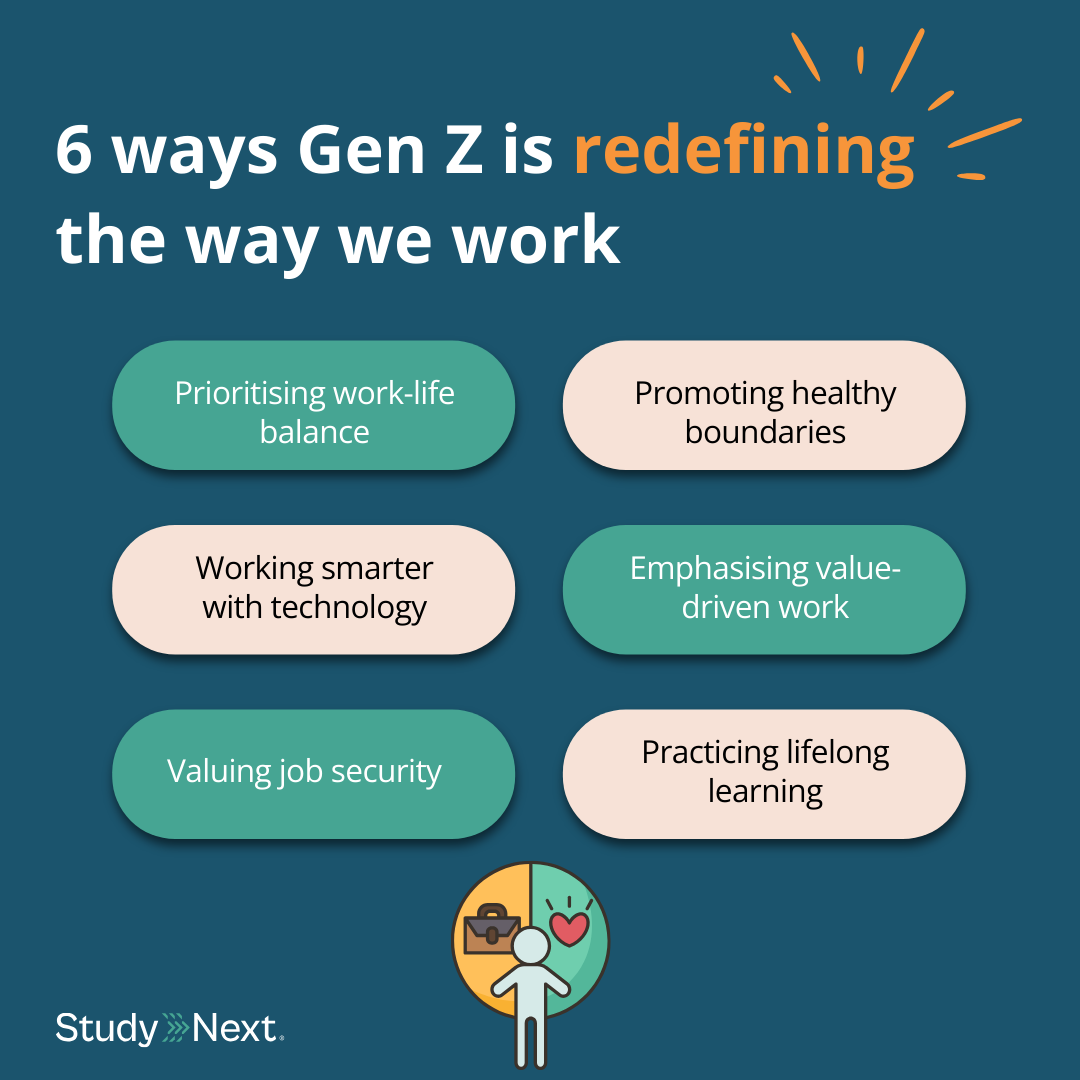
Gen Z professionals are redefining the modern workplace in various ways, including prioritising work-life balance, establishing healthy boundaries at work and using technology to work smarter. They also emphasise purpose-driven work, value job security and embrace lifelong learning. Explore how these Gen Z workforce trends are reshaping the way we work below:
Prioritising work-life balance
Achieving work-life balance isn’t something only Gen Z workers aspire to. Employees across generations recognise the value of maintaining a healthy balance between their professional and personal lives. However, working towards it may be challenging, especially when older generations expect their younger colleagues to endure the same gruelling work hours they once did. As Florence observes, “From Baby Boomers through Gen Z, we see a lot of ‘When I was your age, I had to work really long hours. I had to put the hours in to get to where I am now, so should you.’” This mindset can unintentionally perpetuate a cycle where overworking is normalised and even glorified. When each generation feels obligated to match the hustle of their predecessor, pursuing work-life balance can be difficult.
However, the challenges younger people face today can be vastly different from those of previous generations. With the rising cost of living, what they can afford is different from what it was back then. These financial constraints have made Gen Z more intentional about prioritising work-life balance. If buying a house feels financially unattainable, they might prefer to invest in what is within their reach, which is their wellbeing and life outside of work. For many, this often means prioritising more affordable experiences, such as travelling, that can enrich their lives while staying within their means. This may also reflect a generational shift where success may no longer just be measured by possessions, but by the freedom to enjoy life outside of work.
Promoting healthy boundaries
Gen Z workers often receive flak in the media, society and workplaces for setting firm boundaries around their health and work-life balance. While these boundaries are usually framed as self-care by these younger professionals, they may sometimes be perceived as entitlement by other generations, especially by those who were conditioned to prioritise productivity at the expense of their personal wellbeing. For example, a Gen Z employee may choose to leave the office at 5pm consistently because they’re only paid to work until then. However, this may cause resentment among older colleagues who are accustomed to ending their work day later, having worked in environments where it wasn’t encouraged or culturally acceptable to leave work on time.
While this may seem disruptive on the surface, it reflects Gen Z’s willingness to advocate for what they believe is healthy. They’re also putting Australia’s ‘right to disconnect’ laws into practice. Introduced in 2024, this legislation allows employees to refuse work contact outside of working hours and recognises that mental health among workers is a national concern.
Rather than conforming to traditional workplace expectations, many of them choose to honour their boundaries and draw a clear line between work and their personal lives. This signals a broader cultural shift where the fear of being judged by people at work may carry less weight than sticking to your personal values. By setting an example, such as leaving work on time or not contacting colleagues outside of business hours, they can encourage healthier and more human-centred ways of working.
Working smarter with technology
Gen Zs are widely known as the first generation of digital natives, having grown up with the internet as a part of their lives. Having constant online access allows them to research things online to find answers and solutions, which can build a proactive mindset. This challenges the common stereotype of Gen Zs being ‘lazy’ as many of them are driven by efficiency, thanks to living in the age of automation and digital innovation.
Their technological proficiency also enables them to optimise workflows in their career. According to Randstad’s The Gen Z Workplace Blueprint: Fast Moving, Future Focused report in 2025, nearly half of Australian Gen Z workers are leveraging artificial intelligence (AI) to problem-solve at work. Similarly, Deloitte's Global 2025 Gen Z and Millennial Survey found that 80 per cent of Gen Zs and millennials believe that generative AI saves them time and improves their work output. These findings suggest how this generation is utilising emerging tech to work smarter.
Even with all of their exposure to technology, what often sets Gen Zs apart is how mindful they are when engaging with it. Rather than using it blindly, many of them explore its potential and push its boundaries. Based on her conversations with Gen Z students, Florence notes that while they recognise AI is capable of doing a lot of things well, it also has a lot of shortcomings. “It’s awesome, but it doesn't come up with anything new. It's just remixing stuff,” they told her. Having this critical awareness is vital, especially as AI raises complex issues like data privacy, ethics and environmental impact. Gen Z’s ability to combine digital skills with thoughtful usage can make them valuable employees within an organisation.
Their digital expertise also enables them to play a key role in promoting stronger intergenerational work relationships. Traditionally, mentoring has always followed a top-down approach, with guidance from older to younger employees. Now, with evolving demands impacting modern workplaces, Gen Zs have the capability to guide their senior colleagues, especially when it comes to technology.
Florence emphasises the importance of handling these interactions with curiosity, respect and empathy. For example, rather than expressing frustration when asked by a more senior colleague to export a PDF, Gen Z workers can offer to teach them how to do it. They can also encourage older coworkers to explore AI tools in a supportive and engaging way. By leading with inclusivity and understanding, Gen Z professionals can not only help workplaces adopt smarter digital practices, but they can also bridge generational divides. This allows them to contribute to a more collaborative and future-ready workforce.
Emphasising value-driven work
Purpose can play a significant role in how Gen Z workers build their careers. According to Deloitte’s Global Gen Z and Millennial Survey in 2025, 94 per cent of Australian Gen Zs prioritise meaningful work, often pursuing roles that are committed to sustainability and align with their personal values. Meanwhile, 52 per cent of them have left a job because it lacked purpose. For many Gen Z employees, purpose is no longer a perk, but a core motivator that keeps them engaged in the workplace. While fair compensation remains a top priority, they want more than just a paycheck. This often involves understanding why their work matters. As Florence puts it, “Gen Z wants to know what they’re working towards. What’s the point? They’re the generation that asks, ‘Why are we doing this?’”
This growing emphasis on value-driven work among Gen Z workers can put pressure on organisations to rethink how they should function. In today’s business world, they need to go beyond surface-level branding and actually embed their values into daily operations and leadership decisions. To reflect their genuine commitment, they may invest in green initiatives, implement effective diversity, equity and inclusion policies or ensure supply chains are ethical. It’s no longer good enough to claim support for these causes as Gen Zs expect transparency and action. By holding their workplaces accountable, they can push companies to evolve, which can lead to a more engaged workforce ready to make an impact.
Valuing job security
In today’s economic landscape, shaped by the rising cost of living and financial uncertainties, job security has become a core priority for many Gen Zs. While the media often portrays them as job hoppers who lack commitment and are quick to switch jobs as they please, job mobility data from the Australian Bureau of Statistics (ABS) tells a different story. Compared to millennials and Gen X when they were in their early careers, Gen Z workers actually change jobs less frequently. As Florence explains, “Currently, Gen Zs are job hopping at 11 per cent. Back in 2010, millennials were job hopping at 15 per cent. If you jump back to 1994, Gen X workers were job hopping at 21 per cent, which is almost double the rate of Gen Z.”
Rather than being a generational trait, job hopping is more of a reflection of a common life stage, where a young person explores different roles to discover what aligns with their interests and long-term goals. “When you’re in your 20s, you’re figuring out what job you want, what area you want to be working in, what your values and motivators are, so you’re going to move jobs,” Florence explains. She observes that Gen Zs switching jobs less than their predecessors may point to deeper concerns, such as rising living costs, job insecurity and the fear of being jobless.
Through her work with No Umbrellas, Florence has seen firsthand how Gen Z’s outlook is shaped by uncertainty. “We have done sessions with university graduates who don’t think they’re going to get a job, don't think it's going to be a good job, don't think they can afford a house and don't think they can become financially prosperous.” Unlike previous generations who entered the workforce with optimism and excitement to gain financial independence, many Gen Z workers are entering with a heavier outlook. “That hopeful mindset has shifted a lot. Many conversations we’ve had are about wanting security and stability,” she shares.
With many Gen Zs joining the workforce during Covid-19 disruptions and ongoing inflation, it’s understandable why they are more cautious. Their desire for stability also challenges the stereotype of them as restless job hoppers. Instead, they look for workplaces that can offer not just fair pay, but also clear career pathways and a sense of security. This emphasis on job security can also prompt organisations to reexamine how they can attract talent and retain their workforce, especially during periods of economic uncertainty. By improving how they can support their employees, they can build greater resilience for the future.
Practising lifelong learning
To stay agile in an increasingly competitive Australian job market, many Gen Z professionals embrace continuous learning as a core part of their career strategy, whether by gaining experience through on-the-job training, taking online courses or furthering their education with postgraduate study. Besides deepening expertise in a chosen field, the postgraduate experience can offer benefits that extend beyond academic credentials. Florence believes that postgraduate study can help Gen Zs improve their critical thinking and decision-making skills, while also demonstrating to employers their commitment to lifelong learning. “Employers will see your eagerness and desire to expand your mind and think of things differently.”
Beyond academic development, studying a postgraduate course can also help Gen Z build their professional network. Florence notes that they can connect and learn with professionals from various backgrounds. “Postgraduate study is great because it can expose you to people of different ages and areas of expertise. You can get professionals from different jobs coming together and creating a space for that cross-pollination of ideas.”
Rather than sticking to the traditional path of climbing the corporate ladder, many Gen Zs are embracing non-linear career paths that can evolve based on their interests, goals and market demands. Their attitude towards continuous learning empowers them to upskill, pivot and explore new jobs and industries without being locked into a single career trajectory. This flexible approach could redefine what it means to be a valuable employee in today’s workforce. Instead of just measuring an employee’s worth by long tenures and linear career progression, organisations can begin to put more weight on their capacity to grow, adapt and respond to change.
Redefining ambition: how Gen Z's career goals challenge traditional success
Gen Z’s ambition to achieve career success often takes a different shape compared to previous generations, shaped by economic realities and a tendency to zig-zag across careers. Many of them also choose to pursue multiple income streams to achieve financial stability. A common perception of Gen Z employees is that they lack ambition, but this view may be misplaced. Just because their ambition doesn’t mirror the more linear career paths of their predecessors, it doesn’t mean they don’t have one. Instead, it has only evolved into a different, more flexible form. Discover more below:
Responding to economic pressures
Gen Z’s ambition can be impacted by ongoing economic developments. Rising living costs and financial pressures are pushing many of them to explore different ways to earn rather than relying on a single source of income, which many of their older colleagues may have been able to do. According to Deloitte's Global 2025 Gen Z and Millennial Survey, 55 per cent of Australian Gen Zs cite cost of living as their top concern, with 64 per cent living paycheck to paycheck. Claiming that they lack ambition can be heavily misplaced when many of them constantly worry about their financial situation.
Zig-zagging careers
Nowadays, it’s becoming increasingly common for young professionals to pursue a zig-zag career path rather than just sticking to one field. As Florence observes, “We see zig-zagging careers all the time, like people moving into marketing after working in banking or accountants deciding they want to become chefs. I believe that this kind of sporadic nature is the direction we’re moving towards.” By pursuing flexible, non-linear career paths instead of climbing a rigid corporate hierarchy, many Gen Zs show their willingness to explore new opportunities in search of what best aligns with their goals, whether it’s self-fulfilment, financial aspirations or other life priorities.
Pursuing multiple income streams
Recent data also highlights Gen Z’s interest in diversifying their income. A Robert Half study in 2024 found that 54 per cent of Australian Gen Zs are the most likely to pursue an additional source of income. This trend is reinforced by ABS data in June 2025, which reported that workers aged 20 to 24 years old were most likely to hold multiple jobs. These findings suggest that in today’s economic climate, a single job may not always be sufficient for young people to sustain themselves.
When it comes to exploring different income streams, many Gen Zs display a strong inclination towards entrepreneurship. Business management platform MYOB discovered in its 2024 research that 75 per cent of Gen Zs in Australia either have started, or would consider starting, their own business. 52 per cent of them think there are enough resources available to turn a great business idea into reality. Florence also believes that starting a business now is cheaper than it’s ever been. “In the past, you may have thought that you had to buy a building and have an office. Now, you just need Squarespace.”
This reflects Gen Z’s ambition in adapting and securing financial stability on their own terms, often in ways that differ from other generations, especially those who are able to sustain themselves on a single income stream.
Redefining workplace standards: what does Gen Z expect from their employers?
To pursue a rewarding career, Gen Zs typically look for employers who offer competitive pay, job security, work-life balance and flexibility. They also prioritise professional development and career growth, along with a healthy workplace culture that supports mental health, transparency and social impact. These factors can help them remain motivated at work and contribute meaningfully while taking care of their needs, especially in today’s increasingly tough economic landscape.
For organisations, understanding what Gen Z prioritises can help them rethink and adapt their workplace practices to better support their employees. Learn more below:
- Competitive pay: Gen Z workers value fair compensation that reflects their skills and contributions, while accounting for other factors like market demand and inflation.
- Job security: According to Australia’s Top 100 Gen Z Employers 2024 report by Workplacer, job security ranks as the number one employer value for Australian Gen Zs. In an unpredictable economy, job stability is important for them to ensure a steady source of income.
- Work-life balance: Rejecting the hustle culture of previous generations, many Gen Zs are more intentional about prioritising their personal wellbeing and time outside of work. This can help them remain productive at work sustainably.
- Flexibility: Flexible work options like remote work and flexible hours can provide more autonomy to Gen Zs over their schedules, allowing them to work in ways that suit their lifestyle.
- Professional development and career growth: Gen Zs are more likely to stay committed to their role if their organisation offers opportunities, such as mentorship, upskilling and training, that allow them to grow.
- Mental health support: Known for their advocacy in drawing healthy boundaries at work, Gen Zs value employers who actively support employees’ mental health, whether by offering mental health days, normalising open conversations about mental health or discouraging contact outside of working hours.
- Transparency: Just as Gen Zs are open about their expectations and needs, they often expect the same from their employers. Transparency in salaries, clear feedback and authentic leadership are important to building trust.
- Social impact: Gen Zs typically want to know how their work contributes to positive change. When employers clearly demonstrate how they are committed to making the world a better place, it can give Gen Z workers a sense of purpose and motivation to contribute to business goals.
Redefining collaboration: how Gen Z employees and leaders can meet in the middle
Business leaders and Gen Z employees can contribute to building a stronger workforce by fostering open communication. Many intergenerational differences are rooted in making assumptions about each other. For example, when a younger colleague consistently leaves work on time, they may be seen as less dedicated. Similarly, an older colleague who lacks exposure to emerging technology may be unfairly perceived as being resistant to change.
For business leaders, Florence suggests asking more curious questions to challenge their assumptions about Gen Z team members. Instead of relying on their preconceived notions, they should have an open dialogue with younger employees to understand their perspectives better and offer their support in the workplace. “Open up space for a more curious conversation. Recognise that an individual’s motivation and way of working might be different from yours, but that doesn't mean it's wrong,” she suggests.
Florence recalls an interaction with a senior leader in one of her workshops, who initially appeared disengaged. Over the course of the four-hour workshop, she worked with them to better understand their challenges in managing younger employees. By the end of it, they came up to her and said, “I need to stop treating them the way I want to be treated and start treating them the way that they want to be treated, don’t I?” This shift in perspective shows how empathy and respect can impact workplace relationships positively, which may lead to better collaboration across generations.
On Gen Z’s side, it can be daunting for them to navigate the workforce with the pressures and stereotypes they face today. Florence encourages them to seek advice and ask questions, even when they feel they should already know the answers. “You’re just entering the workforce. This is a new business that you haven't worked in before. You don't need to know this. You're allowed to ask questions,” she states.
When business leaders and Gen Z employees commit to open communication, curiosity and empathy, they can contribute to redefining the workforce by creating stronger and more inclusive workplaces. By fostering dialogue that encourages support and guidance, organisations can bridge generational gaps while promoting greater collaboration, which is essential for success in today’s evolving business landscape.
The future of work through the lens of Gen Z
As previously discussed, the desire to change how things work isn’t unique to Gen Zs, but is more commonly seen among young people entering the workforce, regardless of their generation. However, Gen Z professionals have the potential to break the cycle of conforming to traditional work values if their approach to work is considered with curiosity and an open mind by other generations. Many younger professionals show a reluctance to sacrifice their wellbeing in pursuit of career success. While working towards financial stability is a top concern in today’s economy, they also often place high importance on personal health, believing the two can coexist without compromise.
If this mindset is embraced across generations in the workforce, organisations may feel the need to update their work practices to better support employees. When employees feel supported, they're more likely to remain motivated and engaged, which can enhance performance while promoting the sustainable growth necessary for companies to stay resilient in today’s business environment.
Rather than viewing Gen Z's approach as disruptive, recognising it as a redefinition of work culture could help pave the way for more productive and human-centred workplaces for all generations.
Navigate the evolving workforce better with postgraduate study
As the workforce continues to evolve, it’s important to be proactive in your professional development to stay competitive in the job market. One way is to embrace lifelong learning, which can include pursuing postgraduate study to enhance your qualifications and credibility. For Gen Z professionals, many universities offer postgraduate courses with specific units designed to strengthen the essential skills needed to thrive in today’s business landscape.
For example, if you’re looking to enhance your communication skills in business contexts, CQUniversity’s Graduate Certificate in Management features the Effective Business Communications core unit. In this unit, you’ll gain insights into various key concepts in communication, such as culture, media choice, channels and competence, while building your skills in becoming an effective communicator in presentations, meetings and other interpersonal environments. For Gen Z employees, mastering communication skills is particularly valuable, as modern workplaces often involve working together with colleagues across diverse ages and backgrounds.


Develop practical management skills through flexible online study, building expertise in business communication, marketing and people management while preparing for postgraduate business study.
If you want to better navigate the complexities of workplace dynamics, the Master of Business Administration at Australian Catholic University offers Organisational Dynamics and Behaviour as a core unit. This unit explores emerging issues in organisational dynamics by covering topics like power and politics, organisational culture, the impact of individual and group behaviours on organisational performance and conflict management. Understanding these influences enables you to learn how to conduct yourself respectfully in professional settings, adapt more effectively in any workplace and build stronger collaboration across diverse generations.


Advance your career and become a well-rounded management professional with an MBA that puts ethics and sustainability at the forefront.
If you’re aspiring to be an agent of change in today’s workforce, the University of New South Wales’ AGSM Graduate Certificate in Change Management can help you develop the skills needed to succeed. The Approaches to Change core unit focuses on theories and principles that can guide you in implementing change effectively. You’ll be given the tools to identify what needs to be changed, determine the best course of action, commit to executing change and manage resistance. For Gen Z professionals, these skills are especially valuable in bridging generational differences. Having an open mindset towards change empowers you to find common ground and help colleagues adapt to the rapid technological shifts shaping the modern business landscape.

Build the capability to lead organisational change through a program that combines strategic thinking, leadership and practical implementation skills for practising managers.
Ready to elevate your skills with advanced study? Get started today by exploring a wide variety of postgraduate business courses offered by top Australian universities.