
In This Article
- What are career development goals?
- Why should you set career development goals in 2026?
- 8 career development goals to set in 2026
- Which career development goals suit you best?
- Tips to achieve your career development goals effectively
- 2026 career growth plan template
- Advance your business career with postgraduate study

Whether you're just entering the workforce or are well-established within your field, setting meaningful career development goals is important. Having clear milestones helps you focus on what truly matters and progress with purpose in your professional journey. But what kind of goals should you set?
This article explores eight career development objectives to inspire your path forward. You’ll also learn how to identify which goals best align with your ambitions and what you can do to complete them effectively. We’ve also included a 2026 career growth plan template to help you get started with your new goals.
What are career development goals?
Career development goals are specific objectives you set to advance professionally, whether through building experience, gaining skills, changing careers or taking on a more senior role. These goals can provide you with direction as you navigate your career journey, with each successful milestone serving as tangible evidence of your professional growth.
Setting short-term career growth goals can help you focus your energy on immediate priorities and generate quick wins in the year ahead. Establishing long-term goals, which can span years or even decades, enables you to define your broader career vision and stay aligned with your future ambitions.
Why should you set career development goals in 2026?
Setting career development goals in 2026 is essential to help you remain relevant and competitive in Australia’s rapidly evolving job market. These goals provide you with a tangible roadmap by translating your ambitions into actionable steps you can take to advance your career.
For many professionals, their fundamental career vision often remains consistent despite constant shifts in the job landscape. The steps leading to it, however, may evolve depending on current circumstances. This is particularly important as you navigate the changing nature of work. According to the Hays 2025 Skills Report, 87 per cent of employees in Australia and New Zealand believe the skills required for their roles will change within the next five years, with 43 per cent anticipating a significant change. This suggests how relying on your existing skill set may no longer be sustainable throughout your career. By establishing career goals for growth, you can identify the skills you need to evolve and get ahead in the professional landscape.
Having these goals in place can help motivate you to continue pursuing opportunities that lead to something bigger and more fulfilling, enabling you to build a career path that’s both resilient and rewarding.
8 career development goals to set in 2026
You can set impactful career goals for professional growth in 2026 such as leading a project, upskilling in an emerging field, improving public speaking skills and expanding your network. You can also focus on enhancing digital literacy, improving time management skills, achieving a better work-life balance and securing a new professional role. Each of these goals offers a tangible pathway to advance your career meaningfully. Find out what they entail below, along with an example metric to measure their successful completion:
Lead a project
If you’re aspiring to enter a role that involves leading people and projects, you should gain hands-on experience to build your competence and confidence. Volunteer to lead a project at work and be actively involved in crucial stages of the project lifecycle, such as scope definition, budget planning, task delegation and progress tracking. You can also find opportunities to lead a project that requires collaboration across multiple departments. Pursuing this goal can help you sharpen your project management skills while also developing the leadership capabilities needed to guide team members to achieve shared goals. After the project is completed, you can ask for feedback from your team to evaluate your leadership performance.
Measurable metric example: Successfully lead at least one project from initiation to completion within the year, ensuring all necessary deliverables are finished on schedule and within budget.
If you’re looking to boost your project management skills before taking the initiative at work to lead a project, you can consider completing the University of New South Wales‘ Project Management Excellence short course. Conducted in person over two days, this course takes you through every stage of the project management lifecycle. You’ll learn how to manage stakeholder needs, work with cross-functional teams and make informed decisions for successful project outcomes.
If you’re seeking a formal qualification to boost your career opportunities, Bond University offers the Master of Project Management, which is designed to provide students from diverse backgrounds with the knowledge needed to pursue a career in this field. You’ll be exposed to a wide range of core topics in project management, including effective integrated planning, public and private sector investment, market performance, portfolio management, conflict resolution and risk identification. The university also invites external speakers from credit agencies, investment banks and portfolio fund management firms to participate in workshops and case studies, further enriching your learning experience with real-world industry insights.


Familiarise yourself with the approaches and tools for effectively managing projects that your organisation is undertaking or planning to undertake.


Enhance your knowledge across an array of areas, including sustainable practices, business strategy, change management and measurable performance.
Upskill in an emerging field
As the job market continues to evolve rapidly in 2026, developing expertise in high-demand areas, such as artificial intelligence (AI), data analytics and sustainability, can help position yourself for valuable career advancement opportunities, especially if you’re aiming for future-focused roles.
For example, the demand for AI expertise has surged substantially in Australia. PwC’s 2025 AI Jobs Barometer report revealed that job postings requiring AI skills grew from just 2,000 in 2012 to 23,000 in 2024. While AI and automation often raise concerns about job redundancy, PwC’s findings discovered a more hopeful outlook. Between 2019 and 2024, jobs where humans collaborated with AI increased by 47 per cent across all industries, while automatable roles saw an average growth of 45 per cent, indicating that both AI-powered augmentation and automation are supporting workforce growth in Australia. If your career path is or will be impacted by AI’s influence, you can future-proof yourself by building technical expertise that enables you to leverage AI as a collaborative tool at work.
You can explore plenty of resources to get started, even if you don’t have prior knowledge in emerging fields. Many free short courses from universities and online learning platforms offer flexible learning opportunities that can be completed at your own pace. Since these courses are designed to help you gain knowledge in targeted skills quickly, they enable you to apply what you learn at work immediately.
Measurable metric example: Dedicate at least five hours per week to complete two AI online courses within five months and successfully apply AI tools to automate or enhance three routine work tasks.
If you want to study a short course in AI from a reputable institution, the University of Melbourne offers the Generative AI for Business program, which aims to empower learners to incorporate generative AI (GenAI) into broader business objectives. People who take the course learn the languages essential for AI usage, prompt engineering in GenAI, AI safety and governance and AI strategy development. This in-person short course also covers high-impact use cases from specific business functions to help participants understand how to make decisions about deploying GenAI effectively.
If your long-term career ambitions involve heavy usage of this emerging technology, it might be valuable to further your studies with a postgraduate course in AI. For example, Macquarie University’s Master of Information Technology in Artificial Intelligence is designed to equip students with the advanced capabilities required to work with AI systems. Delving into core topics like machine learning and natural language understanding, this course also offers extensive practical learning experiences of creating and examining AI-powered business solutions, including an option to undertake an industry internship or a supervised research project. While prior knowledge in programming and statistics is beneficial, it’s not a requirement for enrolment.

Build the knowledge and strategy to lead responsible Generative AI adoption.


Master advanced AI theory along with practical applications to prepare for designing innovative solutions in machine learning, data analytics and intelligent systems.
Expand your professional network
Building your connections can help unlock opportunities to elevate your career, making it a worthwhile career development goal to consider for the year ahead. You can meet professionals from diverse industries by attending conferences, industry events and in‑person networking sessions. Online platforms like LinkedIn also allow you to expand your network, whether by sending connection requests to professionals in your field, engaging with their posts by leaving thoughtful comments or even messaging them directly to explore potential collaborations.
Measurable metric example: Connect with at least 10 new professionals in your target industry per month on LinkedIn.
If you’re planning on pursuing postgraduate study, your academic journey can also serve as a networking platform. You can build meaningful connections with your lecturers, peers and even industry experts. Many courses, especially Master of Business Administration (MBA) programs, offer opportunities to connect with other professionals. For example, Swinburne University of Technology’s Master of Business Administration provides access to career development workshops, a four‑month mentoring program and networking events through its partnership with the Institute of Managers and Leaders.
Meanwhile, the Global Executive Master of Business Administration course at Monash University can help you extend your reach beyond borders. This program includes an overseas study trip where you can obtain cross-regional business insights from global industry professionals. With a diverse cohort of students from around the world, you’ll also have the chance to form meaningful connections with international peers, which may lead to future professional opportunities.

Build advanced management capability across leadership, strategy, innovation and technology, with opportunities to tailor your MBA through a business specialisation or electives.


Gain the skills to become an innovative, insightful and impactful leader.
Enhance digital literacy
Digital literacy has become increasingly crucial for many professionals across industries in today’s business world. The specific digital skills you need will depend on your role, company, industry and career aspirations. For example, if you want to transition into digital marketing, you may benefit from mastering social media analytics and search engine optimisation to develop effective marketing campaigns. If you’re aiming to become a project manager, you should focus on gaining expertise in using project management and collaboration platforms and tools. Mastering relevant digital skills can help you remain competitive in an increasingly technology-driven workplace.
Measurable metric example: Complete a beginner-friendly Power BI course and create at least two interactive dashboards within three months of finishing the course.
If you’re looking to upskill in a specific digital skill, short courses offer a great way for you to get started. For example, if you want to learn about essential programming languages, you can consider completing RMIT University’s Business Analytics with SQL and Python. In this short course, you’ll learn how to write queries to extract data with SQL and conduct data analysis with Python. This course aims to build your competencies in exploring, wrangling, examining and communicating data to elevate your professional profile.
If you’re aspiring to enter a new role that requires advanced data expertise, studying a postgraduate course in data analytics can help enhance your employability. The Master of Applied Data Analytics program at the Australian National University delves into best practices in this field and provides you with an opportunity to hone your understanding of either computation, statistics or social science. You can build advanced knowledge in key areas within data analytics, with core units like Regression Modelling, Generalised Linear Models and Graphical Data Analysis.


Acquire foundational skills in SQL and Python and deliver powerful analysis and predictions for your team or business.


Familiarise yourself with best practices in data analytics.
Improve public speaking skills
Public speaking is a foundational skill that benefits professionals across diverse roles and career stages. Whether you're presenting updates to your team, facilitating meetings or participating in industry functions, the ability to communicate clearly and confidently ensures your messages resonate with your intended audience. This may include reducing filler words, pacing your delivery effectively and avoiding complicated jargon when speaking to non-technical stakeholders.
If you find public speaking challenging or lack confidence, prioritising on developing this skill in 2026 can be a valuable way to boost your professional profile. Strong public speaking abilities can help enhance your authority and influence, supporting your overall career growth.
Measurable metric example: Deliver four to six presentations throughout the year, whether in team meetings, industry conferences or client pitches.
Improve your time management
Time management is a vital skill for professionals across all roles and industries. Effectively organising your time allows you to get your tasks done on schedule, reduce stress and maximise productivity. Time management can also involve setting aside extra time as a buffer, enabling you to manage unexpected issues swiftly without derailing your workflow.
There are many productivity tools and methods that allow you to plan your workday better. For example, you can apply the Pomodoro technique of breaking up work into focused 25-minute intervals to help you stay engaged with your tasks. You can also monitor how you spend your time at work for a week, then reallocate your efforts towards higher-impact activities. Improving your time management skills can be a great career development goal because it gives you the capacity to expand your skills and pursue opportunities that can grow your career.
Measurable metric example: For a month, spend 15 minutes at the end of each workday to plan the next day's priorities, beginning each morning with a clear list of at least three high-priority tasks.
Achieve a healthier work-life balance
A healthy work-life balance is essential to support your wellbeing while sustainably working towards achieving career success. There are plenty of ways you can set boundaries at work, including limiting work-related communication after business hours, taking all of your allocated annual leave and clocking out from work on time.
Besides practising healthy work habits, you can also dedicate time to pursue activities that bring you joy and support your wellness, such as going out for dinner with friends, spending a few hours per week on a hobby or going out for a daily walk after you finish working. These personal pursuits allow you to step back from work and remind yourself of who you are as an individual outside of your professional commitments and achievements. When you take care of both personal and professional aspects of your life, you’ll be better prepared physically and mentally to take on more senior roles with greater responsibilities in your career journey.
Measurable metric example: Complete a three-month trial of turning off work notifications on your phone after business hours during weekdays and keeping them off on weekends.
Find a new role
If you’ve been feeling stagnant and are ready to embrace new challenges in your career, whether by advancing within your organisation or looking elsewhere, finding a new role can be a great career development goal. Taking on a new position allows you to challenge yourself with fresh responsibilities, broaden your skill set and gain exposure to new environments. You can make this goal actionable by breaking it down into clear steps, including updating your resume and LinkedIn profile, enhancing your personal brand and sending job applications consistently. If you’re aiming for a promotion at work, you can document your achievements and schedule a career development conversation with your manager. Looking for a new position that’s more aligned with your long-term ambitions is a great step, as it brings you one step closer to achieving your broader career vision.
Measurable metric example: Submit at least three to five tailored job applications per week for positions aligned with your career objectives.
Which career development goals suit you best?
While there are many typical career goals professionals pursue, the ones that suit you best will depend on your unique circumstances. To determine your most relevant goals, start by assessing your long-term ambitions, personal values, strengths and areas for improvement. Your career stage also plays a role in shaping goals that align with your professional growth. Beyond self-reflection, external influences like industry trends, market demand and economic conditions can inform what objectives you should set for career advancement. Learn more below:
Evaluate your long-term ambitions: Identifying your ultimate career destination can help you find pathways that move you closer towards it. Take time to define what you want to achieve in the next five to ten years of your career so that you can set appropriate goals to keep you on track.
Reflect on your personal values: Setting career development goals not only supports professional growth but also helps you achieve fulfilment, whether through social impact, work-life balance or continuous learning. Choosing goals that align with your core values enables you to stay motivated and can lead to personal satisfaction in your career, rather than just external success.
Assess your strengths and gaps: Analyse your current expertise to understand which skills you've already developed and which areas you need to grow to reach your next milestone. This approach enables you to prioritise relevant learning opportunities. For example, if your current marketing role is focused on content creation but you aspire to move into a senior position that involves analysing campaign performance, enrolling in a data analytics course can be a valuable career goal to help you build the necessary skills.
Consider your current career stage: Reflect on where you are in your career to determine appropriate career development goals. Many early-career professionals may prefer to prioritise building relevant skills, while some mid-career professionals may focus on setting leadership-related goals.
Analyse industry and market demands: Find out which skills and industries experiencing growth are aligned with your interests and strengths. This may guide you to invest your career development efforts in areas that could boost your employability, especially in the future of work.
Examine economic conditions: One practical way to identify the right goals for you is to assess broader economic trends like technological disruptions and workforce shifts. These external factors may reshape your career path and require you to adjust goals that may no longer be viable. Understanding these realities can help you set goals that are ambitious yet still grounded in current economic conditions.
Tips to achieve your career development goals effectively
To achieve your career development goals effectively, consider breaking large goals into smaller steps, using the SMART framework, setting realistic timelines, celebrating your milestones and reviewing goals periodically to ensure they remain relevant. These strategies can help keep you focused and guide your career path towards success. Find out how below:
Break large goals into smaller parts
Setting large goals can sometimes feel daunting, which can affect your confidence and motivation. Breaking them into smaller and actionable steps can help you see a clearer picture of how you can achieve your objective and make progress more tangible. For example, if your career goal is to take on a leadership role, you can break it into smaller milestones that will eventually lead to that position, such as completing leadership training, leading projects and finding a mentor. This approach allows you to build momentum and enables you to see what comes next in your pathway to achieve the bigger goal.
Leverage the SMART strategy
If your goal feels vague, you can create more structure by applying the SMART framework. This strategy allows you to see what exactly is needed to achieve your goal, enabling you to stay focused. You can also utilise this framework to assess whether your goal is realistic or too ambitious, allowing you to adjust it according to your personal capacity and available resources.
For example, if you want to enhance your technical expertise, below are the steps you can take to create a SMART goal:
Specific
Instead of setting a vague goal, be clear about what you want to accomplish. Since you want to build technical skills, identify which area you want to focus on and how you plan on learning it.
Measurable
Include measurable criteria in your goal so you can track your progress, such as the successful completion of a course relevant to your career ambition or determining what projects you'll deliver with your newly developed skills.
Achievable
Ensure your goal is realistic by examining your current circumstances and resources. Check if you have the capacity to complete your course while balancing personal and professional commitments.
Relevant
Your goal should align with your broader career objectives. If you're transitioning into a data-driven role or want to complement your existing skill set with analytical capabilities, completing a data analytics course would be highly relevant for you.
Time-bound
Set a clear deadline to hold yourself accountable in accomplishing your goal. In this scenario, add a specific timeframe to complete your course.
SMART goal example: To build my capabilities in data visualisation (specific), I will complete RMIT University's Business Analytics short course in February 2026 within six weeks (time-bound). This directly supports my goal of working more effectively with data at work (relevant). By allocating eight to ten hours per week for online study (achievable), I will apply what I've learned from the course to create two data visualisation dashboards at work (measurable).
Set realistic timelines
While it’s good to be ambitious, you should also be realistic with your goals to ensure that you’re able to complete them on time. If goals have unfeasible deadlines, you may feel discouraged for failing to achieve them before your self-imposed deadline. You may also experience burnout from trying to get as much done as soon as possible without pacing yourself properly.
For example, if you’re working full-time while pursuing a professional certification, it’s important to allocate enough study time so that you don’t sacrifice your personal wellbeing and work quality. You should also take into account other factors like ongoing work projects and family obligations. When you give yourself a sufficient amount of time, you’re more likely to sustain steady progress and reduce stress.
Celebrate all your wins
Celebrating your achievements, no matter how big or small, is essential to keep you motivated to work towards your ongoing goals. Whether you’ve completed a short course, received positive feedback from your manager or picked up a new skill, intentionally acknowledging your accomplishments allows you to keep track of how much progress you’ve made. This is especially important if you’re going through a challenging period and feeling like you haven’t done enough. Your wins can help counter feelings of inadequacy as they serve as concrete proof of your hard work.
Review your progress and stay flexible
It’s important to remember that your goals can evolve over time. Changes in personal priorities or external factors such as business trends and technological disruptions may require you to adapt your objectives to suit current circumstances. Take the time to review your goals every few weeks or months, depending on their complexity, to determine whether they’re still relevant and achievable. Practising this kind of flexibility can create opportunities for growth and help prevent stagnation when goals are no longer viable. It also strengthens your resilience and empowers you to navigate setbacks effectively in your career journey.
2026 career growth plan template
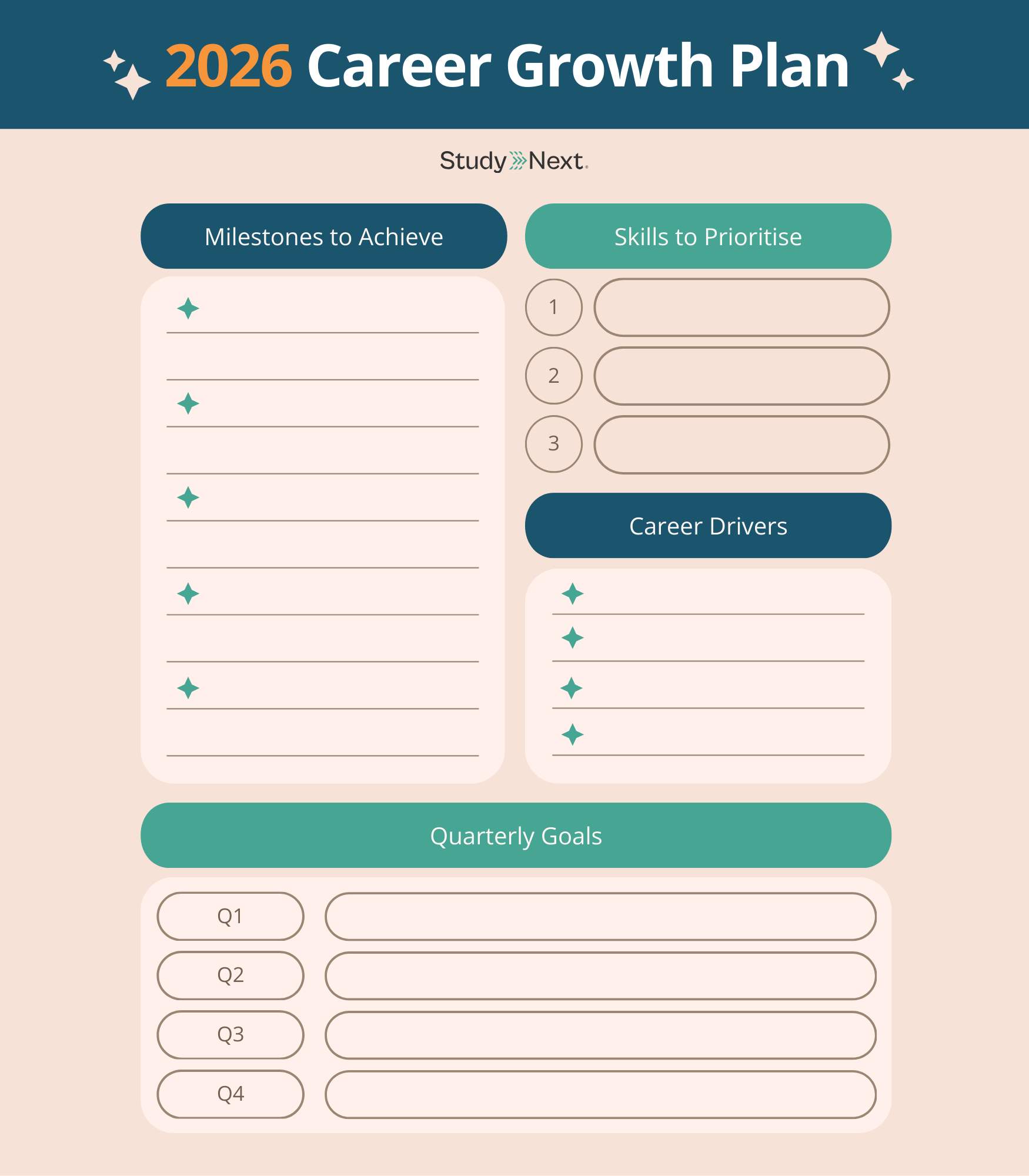
Now that you've gotten an idea of why career development goals are important, take a moment to envision and list what you want to accomplish in your career throughout 2026. This allows you to visualise your milestones and identify the skills you need to develop along the way. Dividing your 2026 goals into quarterly targets can also help you pace yourself sustainably and measure your progress effectively. It’s also important for you to include your career drivers to remind yourself of your fundamental work values that keep you engaged and motivated.
Below, we’ve designed a career growth plan template for you that incorporates all these elements together, so you can dive straight into planning your career strategy for the year ahead.
Advance your business career with postgraduate study
Setting clear career development goals for the year ahead enables you to track your progress tangibly and stay focused. If your aim is to gain new skills or refine your existing expertise, postgraduate study offers a structured pathway for you to advance your knowledge and skills. Earning this qualification may also help boost your credibility and competitiveness in today’s professional landscape, especially in high-growth fields like AI, data analytics and cybersecurity. Get started today and explore a wide range of postgraduate business courses available in Australia.