

If you’re planning to specialise in a specific area to advance your career or pivot into a new field, enrolling in a niche postgraduate business course can help equip you with the targeted skills and insights needed to make your career move.
Whether you’re interested in analysing data to measure sports performance, shaping policies that protect marginalised communities or understanding how business and neuroscience intersect, there are plenty of niche programs that can help you work towards your professional goals. Some of these offerings are even the first of their kind in Australia.
In this article, we delve into a selection of specialised courses, including graduate certificates, graduate diplomas and master’s degrees, from StudyNext Australia’s catalogue to give you a clearer idea of the niche fields of study you may consider exploring in 2026.
Graduate certificates
Graduate Certificate in Organisational Coaching and Leadership – Charles Sturt University
Developed and delivered by both Charles Sturt University and the Institute of Executive Coaching and Leadership (IECL), this course is designed to equip you with the expertise needed to guide high-performing companies.
Why study this course?
This course can help you build foundational skills in organisational coaching and leadership theory, practice and methods. Studying this program can also fast-track your journey towards earning credentials with the International Coach Federation.
Core units of study include:
- IECL Organisational Coaching Level 1 Certification
- IECL Organisational Coaching Level 2 Certification
Elective units of study include:
- Theory to Practice of Leadership
- Toxic Leadership
- Contemporary Issues in Leadership
- Difference and Leadership
- The Leadership Challenge
- Leadership in Teams
Entry requirements:
You must have the following:
- Relevant professional attainment/work experience
- An undergraduate degree from a recognised Australian tertiary institution (or equivalent) and/or enrolment in/completion of relevant IECL subjects
You may also be considered on the basis of relevant professional attainment and/or work experience alone.
2026 intake dates: March, July and November
Delivery mode: Online Duration: 6 months (full-time)
Indicative total fee (2026): $16,840 (domestic full-fee paying place)


Strengthen organisational coaching and leadership capabilities through flexible online study, with a focus on coaching practice, communication and ethical decision-making.
Graduate Certificate in LGBTQIA+ Policy Online – University of Canberra
As the first postgraduate course in Australia in LGBTQIA+ policy, this course aims to provide you with practical tools to examine policy, influence reform and advocate for LGBTQIA+ rights across a range of industries.
Why study this course?
Studying this program is ideal if you’re seeking to enter policy-focused jobs or boost your credibility in leading social change.
Units of study include:
- Foundations of Public Policy
- Equity, Leadership and Policy
- Communicating with Diverse Audiences
- LGBTQIA+ Policy and Advocacy
Entry requirements:
You must have one of the following:
- A recognised bachelor’s degree or equivalent
- A higher-level qualification in any discipline from a recognised tertiary institution
- Three years of relevant work experience
2026 intake dates: January, March, May, July, August and October
Delivery mode: Online
Duration: 8 months (part-time)
Indicative total fee (2026): $14,500 (domestic full-fee paying place)


Build specialist skills in inclusive policy, advocacy, equity leadership and strategic communication while developing evidence-informed approaches to social and policy change.
Graduate Certificate in Environmental and Business Management – University of Newcastle
This graduate certificate offers a unique blend of environmentally-focused units with business and management components.
Why study this course?
By studying this course, you’ll be prepared to pursue your passion for environmental science or deepen your understanding of workplace environmental issues.
Core units of study include:
- Business and the Natural Environment
- Environmental Management
Elective units of study include:
- Environmental Legislation and Policy
- Applied Natural Resource Management
- Organisational Behaviour and Design
- Marketing Management and Planning
- Human Resource Management
- Negotiation and Conflict Resolution
- Financial and Management Accounting
- Economics of Competitive Advantage
- Corporate Finance
- Fostering Healthy Organisations
- Understanding People in Organisations
- Systems Thinking for an Integrated Workforce
Entry requirements:
- An AQF Level 7 bachelor's degree or an AQF Level 8 bachelor’s honours degree
2026 intake dates: January and May
Delivery mode: Online
Duration: 6 months (full-time)
Indicative annual fee (2026): $15,855 (domestic full-fee paying place)


Explore the intersection of environmental management and business, gaining practical knowledge in sustainability, climate change and contemporary organisational practice.
Graduate Certificate in Data Analytics for Sport Performance – Victoria University
This course enables you to build your analytical skills in sports performance by combining the latest research insights with practical training in key programming languages.
Why study this course?
You can obtain a formal qualification in data science designed for sports, preparing you to thrive in the growing field of sports data analysis.
Units of study include:
- Introduction to Sports Analytics
- Spatiotemporal Data Analysis in Sport
- Programming for Sports Performance
- Analytics for Decision Making in Sports Performance
Entry requirements:
You must have one of the following:
- A completed Australian bachelor's degree (or equivalent) in a similar discipline
- Five years of approved work experience
2026 intake dates: N/A
Delivery mode: Online
Duration: 6 months (full-time)
Indicative total fee (2026): $17,250 (domestic full-fee paying place)


Gain a formal qualification in data science with a unique sports context.
Graduate diplomas
Graduate Diploma in Global Competition and Consumer Law – University of Melbourne
As one of the few comprehensive programs in competition and consumer law globally, this graduate diploma is taught by world-leading experts with leadership experience in private practice, intergovernmental organisations and adjudicatory bodies as well as competition and consumer authorities within the field.
Why study this course?
Designed for individuals seeking an advanced postgraduate qualification in the global competition and consumer law field, this program aims to equip you with specialised knowledge and practical skills in a legal-economic area that plays a crucial role in economic and social progress.
Intensive Teaching Period units of study include:
- Comparative EU and US Antitrust Law
- Competition in Digital Markets
- International Trade and Competition Law
Extensive Teaching Period units of study include:
- Australian Merger Law
- Cartels
- Consumer Protection
- Foundations: Competition Law and Economics
- Mergers
- Unilateral Conduct
Entry requirements:
You must have the following:
- A degree in a relevant discipline with a University of Melbourne equivalent score of at least 70
- One year of documented relevant professional experience
2026 intake dates: January and July
Delivery mode: Face-to-face
Duration: 12 months (part-time)
Indicative total fee (2026): $24,992 (domestic full-fee paying place)

Designed for students seeking a specialist postgraduate qualification in the global competition and consumer law field.
Graduate Diploma in Neuroscience and Business – University of New England
As Australia’s first postgraduate diploma to integrate neuroscience and business, this program is designed to meet the growing demand for professionals with expertise in both fields.
Why study this course?
In this course, you’ll learn to apply business theory and practice frameworks to examine how the brain influences human behaviour and decision-making. You’ll also explore how neuroscience can help address some of today's most critical business challenges.
Core unit of study include:
- A Walk Through the Brain
Elective units of study include:
- Neurobiology
- Clinical Neuroscience
- Understanding and Changing Human Behaviour
- Neurobiological Bases of Autism
- Neurobiology and Treatment of Depression
- Neurobiology of Anxiety Disorders
- Reading The Mind: The Electroencephalogram
- The Aging Brain
- Treatment Approaches in Neuroscience
- Neuroscience, Deviance, and Villainy
- Mapping the Brain with Magnetic Resonance Imaging
- Strategic Planning and Sustainability
- Advanced Organisational Behaviour
- Marketing Management
- Strategic Human Resource Management
- Management Practices in Responsible Organisations
- Organisational Leadership: Theory and Practice
Entry requirements:
You must have one of the following:
- A bachelor’s degree or above in any discipline (or equivalent)
- A UNE Graduate Certificate in Neuroscience and Business
2026 intake dates: February, June and October
Delivery mode: Online
Duration: 12 months (full-time)
Indicative annual fee (2026): $11,472 (Commonwealth supported place), $17,472 (domestic full-fee paying place)


This graduate diploma provides professionals from diverse backgrounds with opportunities to develop skills in business and gain foundational knowledge in the fundamentals of neuroscience.
Graduate Diploma in Economic Analysis – University of Sydney
Ideal for individuals with a strong foundation in economics and quantitative methods, this course caters to both recent graduates and professionals looking for high-level training to advance their careers or transition into a new field.
Why study this course?
This course delves into advanced core and elective studies in economic theory and applications. You’ll have the opportunity to learn from world-class economists whose research shapes policy at the Reserve Bank of Australia, the Treasury and international institutions like the IMF and OECD.
Core units of study include:
- Microeconomic Analysis
- Macroeconomic Analysis
- Mathematical Methods of Econ Analysis
- Econometric Applications
Selective units of study include:
- Topics in Bus. Cycles and Monetary Policy
- Topics in Labour Economics
- Topics in Industrial Organisation
- Topics in Economic Development
- Topics in History of Economic Thought
- Topics in Microeconomic Analysis
- Topics in Macroeconomic Analysis
- Topics in Empirical Macroeconomics
- Topics in Economic History
- Topics in Public Economics
- Special Topic in Economic Analysis 1
- Special Topic in Economic Analysis 2
- Special Topic in Econometrics 1
- Special Topic in Econometrics 2
Elective units of study include:
- Applied Business Forecasting
- Applied Financial Econometrics
- Analysis of Panel Data
- Communication in Economics
- Economics of Law and Public Policy
- The Economics of Financial Markets
- Behavioural Economics
- Strategic Business Relationships
- Market Structure and Strategic Behaviour
- International Money and Finance
- Economics of the Labour Market
- Public Economics
- Trade and Development
- Environmental Economics
- Financial Economics
- International Trade
- Private Equity
- Strategic Decision Making
- Health Economics and Policy Evaluation
- International Finance and Globalisation
- Global Economic History
- Special Topic in Economics 1
- Special Topic in Economics 2
Entry requirements:
You must have one of the following:
- A bachelor's degree from the University of Sydney, including a major in economics with a minimum distinction (75 per cent) average or an equivalent qualification
- Completion of the requirements of the embedded Graduate Certificate in Economic Analysis with a minimum distinction (75 per cent) or an equivalent qualification
2026 intake dates: February and August
Delivery mode: Face-to-face
Duration: 12 months (full-time)
Indicative total fee (2026): $17,399 (Commonwealth supported place), $40,700 (domestic full-fee paying place)


Undertake advanced core and elective studies to develop your knowledge in economic theory and applications.
Graduate Diploma of Australian Migration Law and Practice – Griffith University
Recognised by the Office of the Migration Agents Registration Authority, this graduate diploma can help you gain fundamental knowledge in Australian migration law by integrating theoretical frameworks with practical application.
Why study this course?
If you’re interested in becoming a registered migration agent but don’t have a legal background, this course is suitable for you. It’s also ideal for professionals in fields where migration law knowledge is valuable, including law, accounting, engineering and information technology.
Core units of study include:
- Foundations of Australian Migration Law and Practice
- Introduction to Migration Legal Skills and Ethics
- Client Skills in the Visa Application Process
- Visa Compliance, Cancellation and Review
- Advocacy Skills in Migration Casework
- Applied Migration Law and Practice
- Establishing and Operating an Ethical Migration Practice
Entry requirements:
You must have one of the following:
- A bachelor's degree in any discipline from a recognised university (or another tertiary education institution of equivalent standing) with a minimum GPA of 4.0 (on a 7-point scale)
- A Graduate Certificate in Australian Migration Law and Practice with a minimum GPA of 4.0 (on a 7-point scale)
2026 intake dates: February and April
Delivery mode: Online
Duration: 12 months (full-time)
Indicative annual fee (2026): $30,500 (domestic full-fee paying place)


Establish a strong understanding of Australian migration law, integrating theory and practice to acquire the skills and knowledge essential for success.
Master’s degrees
Master of Indigenous Business Leadership – Monash University
Designed and led by Indigenous leaders, this course connects you with respected Indigenous voices, industry experts and educators to cultivate your leadership strengths.
Why study this course?
Through collaborative exploration, you'll examine the cultural, political and economic contexts influencing how Indigenous communities engage with the business world, while learning how to create meaningful impact as an emerging leader.
Core units of study include:
- Indigenous Design Thinking and Relationality
- Leadership: People and Performance
- Leadership: Organisational Strategy and Performance
- Business Environment
- Accounting and Finance for Business Leaders
- Indigenous Rights and International Law
Elective units of study include:
- Indigenous Business Leadership Study Program
- Industry Research Project
Entry requirements:
You must have one of the following:
- An Australian bachelor’s degree in a cognate discipline or equivalent qualification and a minimum of three years of relevant employment with at least one year of professional/managerial experience
2026 intake dates: May
Delivery mode: Face-to-face
Duration: 24 months (part-time)
Indicative annual fee (2026): $17,399 (Commonwealth supported places), $38,000 (domestic full-fee paying place)


Explore how cultural, political and economic contexts shape Indigenous communities' engagement with business and discuss strategies for emerging leaders to create a positive impact.
Master of Business (Arts and Cultural Management) – Deakin University
This course is the only one of its kind in Australia taught within a business school. It combines business acumen with insights into creative industries and teaches you how to apply essential business principles to arts and cultural management.
Why study this course?
You’ll have the chance to build your leadership capabilities and engage with like-minded professionals while gaining a strong understanding of the challenges and opportunities within the modern arts and cultural landscape.
Core units of study include:
- Arts Marketing
- Arts Management
- Financial Interpretation
- Human Resource Management
- Arts Fundraising and Sponsorship
- Managing Arts in Community Settings
- Creative Industries
- Managing Events
Elective units of study include:
- Creating Your Arts Business
- Managing Innovation
- Marketing Management
- Business Strategy and Analysis
- Governance and Accountability in Turbulent Times
- Research in Practice
Entry requirements:
You must have one of the following:
- A completed bachelor's degree or higher in any discipline and at least three years of relevant work experience (or part-time equivalent)
- A completed graduate certificate or higher in a related discipline and at least three years of relevant work experience (or part-time equivalent)
2026 intake dates: March and July
Delivery mode: Online
Duration: 18 months (full-time)
Indicative annual fee (2026): $31,600 (domestic full-fee paying place)


Combine creative-sector insight with advanced business expertise to lead arts organisations, cultural institutions, festivals and creative enterprises with confidence.
Master of Business in Global Hotel Leadership – Southern Cross University
Developed in partnership with AccorHotels, InterContinental Hotel Group and TFE Hotel Group, this master’s program is tailored for entrepreneurs aiming to run their own business as well as future leaders in the hotel, tourism and leisure sector looking to advance their careers.
Why study this course?
You can gain in-depth knowledge of hotel operations, service design and delivery, asset management and disruptive technologies.
Core units of study include:
- Hotels in Context
- The Global Hotel Leader
- Sustainable Hotel Management
- Information for Decision Making
- Creating the Hotel Customer
- Talent and Culture
- Service Design and Management
- Innovation and Disruption in Global Hospitality
- Advanced Communication
- Professional Industry Development
- Industry Internship A
- Industry Internship B
Option units of study include:
- Revenue and Analytics
- Strategic Asset and Operations Management
- Managing Hotel Information Systems
- Managing Hotel Projects
- Event Operations and Management
Entry requirements:
- Contact Southern Cross University regarding the entry requirements for this course.
2026 intake dates: March, July and October
Delivery mode: Face-to-face
Duration: 24 months (full-time)
Indicative total fee (2026): $52,000 (domestic full-fee paying place)


Equips aspiring leaders with the strategic, cross-cultural and operational expertise needed to thrive in the fast-paced international hospitality industry.
Master of Not-for-Profit and Social Enterprise Management – University of Technology Sydney
This course is designed for individuals who are passionate about social justice and are looking to lead and create change within the not-for-profit and social enterprise industries.
Why study this course?
You’ll learn specialised topics in not-for-profit and social enterprise management, along with developing key general management skills to guide purpose-driven organisations. Blending theoretical study with practical application, this course helps you prepare to make a meaningful social impact.
Core units of study include:
- Diversity and Inclusion
- Creative Problem Solving
- Business and Social Impact
- Managing Staff and Volunteers
- Advocacy and Social Change
- Event Creation Workshop
- Fundraising and Revenue Streams for Sports, Events and Not-for-Profits
- Measuring Social Impact
- Legal Issues for Sports, Events and Not-for-Profits
Elective units of study include:
- Organisational Sustainability: Analysis and Practice
- Future of Work
- Principles of Event Marketing
- Managing, Leading and Stewardship
- Sport for Social Impact
- Data, Evidence and Managerial Decision Making
- Marketing for Social Good
Entry requirements:
- A completed Australian bachelor's degree or higher qualification, or overseas equivalent, with more than 75 per cent of all subjects completed at pass level (conceded pass not included)
2026 intake dates: February and July
Delivery mode: Face-to-face
Duration: 18 months (full-time)
Indicative total fee (2026): $26,316 (Commonwealth supported places), $47,510 (domestic full-fee paying place)


The course provides theories, models and practical case studies in order to understand the complex nature of not-for-profit organisations including grant writing, fundraising, volunteer management, advocacy, and the skills to measure social impact.
Why should you study a niche postgraduate course?
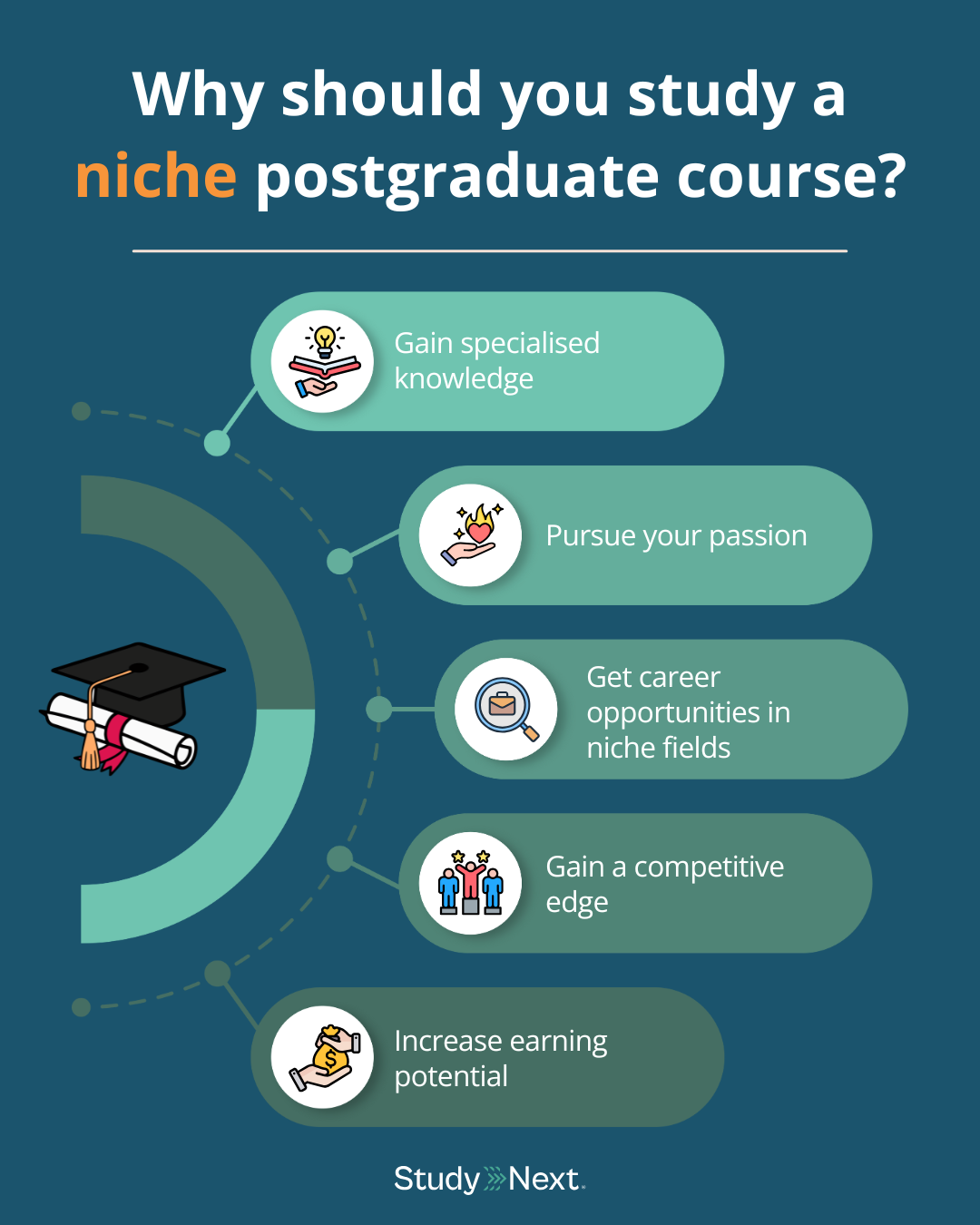
Studying a niche postgraduate course can help you build specialised knowledge and pursue a career based on your personal interests and passions. This qualification may also open doors to career paths in niche fields, give you a competitive edge and boost your earning potential. Learn more below:
Gain specialised knowledge
A niche postgraduate program enables you to delve into a highly focused area of study, allowing you to build specialised expertise that broader courses may not cover in depth. By concentrating on a specific discipline or emerging field, you can gain a deeper understanding of complex concepts, best practices, challenges and opportunities within that domain. Obtaining a postgraduate qualification with this specialised depth may help you position yourself as an expert in your field, especially if it’s an emerging or technical area where specialised knowledge is in demand, such as data analytics or sustainability.
Pursue your passion
Many business professionals intentionally choose to shape their careers based on their personal values and passions. Aligning your work with what truly matters to you can help you remain motivated and provide a sense of fulfilment. Pursuing a niche postgraduate course related to your interests can help you build a career that reflects what you care about, whether it’s advocating for human rights, preserving the environment in a sustainable way or leveraging emerging technologies ethically.
Get career opportunities in niche fields
A postgraduate qualification in a niche area can help unlock career opportunities in specialised fields like sports analytics, not-for-profit management or migration law. While a strong foundation in these fields is valuable, advancing your education through postgraduate study can equip you with deeper expertise and insights that allow you to pursue more senior or leadership roles.
Gain a competitive edge
In today’s increasingly competitive job market, standing out is more crucial than ever. A niche qualification signals to employers that you have a unique skill set and a clear professional direction. It also demonstrates your commitment and dedication to mastering a specific area. This targeted expertise could give you a significant edge over candidates with more general qualifications, especially in industries where specialised knowledge is highly sought-after.
Increase earning potential
Employers recruiting for niche roles may find it challenging to find professionals with specific capabilities. As a result, they may be willing to offer higher compensation to attract skilled talent who can contribute with their in-demand expertise and deliver value. By earning a postgraduate qualification in a niche field, you may place yourself as a prime candidate for specialised positions that offer impact and financial reward.
How do you determine your niche?
To identify your niche, you can consider your interests, strengths and long-term professional goals. Beyond self-reflection, you can examine the curriculum of niche courses, assess the job market and gain insights from professionals working in unique roles or industries. These steps can help you make an informed decision about the niche you want to pursue for your postgraduate studies. Find out more below:
- Reflect on your personal interests: Think about what genuinely inspires you, whether it’s a love for arts and humanities, a passion for helping those in marginalised communities or a desire to bridge the gap between business and sustainability. You can also consider your hobbies and specific causes you care about to help you identify a niche field that aligns with your interests and values.
- Examine your skills and strengths: Identifying your talents and capabilities can help narrow down which niche fields suit you well. For example, if you’re excellent at working with numbers, you may consider analytics-focused courses in niche or emerging areas like sports performance, artificial intelligence or financial technology.
- Consider your long-term career goals: Try picturing where you would like to be career-wise in five to 10 years. This may help you understand what kind of impact you would like to make and what kind of organisations you should join, ultimately helping you determine which niche aligns with your vision.
- Assess course content: Take the time to explore a wide variety of niche postgraduate courses along with their learning outcomes, core units and practical learning experiences. Reviewing what each course offers may help give you a clearer sense of whether a particular niche aligns with your interests and goals.
- Analyse the job market: Find out the career prospects and earning potential across various niche areas. This may help you refine your options of niche roles you want to explore that offer both financial stability and personal fulfilment.
- Get advice from professionals: It may be helpful to reach out to professionals who are already working in niche roles or industries you're curious about. By learning about their career paths, highlights and challenges, you can gain a clearer understanding of what it's like to work in that niche role or field and whether it’s something you want to pursue.
Elevate your professional journey with postgraduate study
Pursuing a niche postgraduate course can be a significant step towards advancing your career, especially if you already have a clear idea of the field you want to specialise in. Choosing to study a niche program allows you to gain targeted expertise and stand out in competitive fields. If you’re still exploring your options, assessing various unique degrees can help you identify which area sparks your interest and guide your decision for 2026. Discover a wide range of postgraduate business courses available in Australia to get started.