
Pursuing postgraduate education can be a valuable way to advance your qualifications, boost professional development and accelerate career growth. However, the cost of advancing your studies can be high, prompting many students to seek financial support. One option to consider is applying for a government subsidy, known as a Commonwealth supported place (CSP), which can substantially reduce tuition fees. However, these subsidies aren't available for every course and are often limited for postgraduate students. So, which programs can you get a CSP for?
In this article, we discuss what a CSP entails and highlight an extensive list of CSP postgraduate courses across diverse business fields, with big savings of up to 89 per cent.
You’ll also gain insight into alternative funding options that can help ease the financial burden of further study.
What is a Commonwealth supported place?
A CSP is a subsidised university place in Australia where the government covers a significant portion of your tuition fees, making higher education more affordable for eligible students. You'll be responsible for the remaining portion of your tuition, known as the student contribution amount. You can either pay this amount upfront to your provider or apply for HECS-HELP, which is a government loan that lets you defer payment until your income reaches a certain threshold.
Although many undergraduate degrees, especially at public universities, are offered with CSPs, availability at the postgraduate level is far more limited, making them highly competitive.
CSP eligibility
While CSPs are primarily available to domestic students, eligibility extends to other groups as well. According to the Australian Government, those in the following categories are eligible to apply for a CSP course:
| Citizenship/visa status | Residency requirement |
|---|---|
| Australian citizen | Study at least one unit of their course in Australia |
| New Zealand citizen | Complete their full course in Australia |
| Australian permanent visa holder | Complete their full course in Australia |
| Eligible former permanent humanitarian visa holder | Complete their full course in Australia |
| Pacific Engagement Visa (PEV) holder | Complete their full course in Australia |
How much does CSP cover?
CSP coverage can vary significantly depending on your institution, course units and discipline. Each unit of study belongs to a specific funding cluster based on its subject area. The government sets the maximum student contribution amount for each cluster that providers can charge, which means your total contribution is calculated based on the specific units you're taking. Keep in mind that these rates are also reviewed and adjusted each year.
Postgraduate business courses with CSP in 2026
You can find CSP courses in business at the postgraduate level at top Australian universities like the University of New South Wales, the University of Sydney and Monash University. These subsidised spots cover diverse areas like business, economics, artificial intelligence, management and more. Below is a selection of postgraduate courses offering CSP from StudyNext Australia’s catalogue:
Business
| University | Course | Full-fee paying place (2026) | CSP (2026) | Course fee type | Savings | |
|---|---|---|---|---|---|---|
| RMIT University | Executive Master of Business Administration | $47,040 | $4,738 to $17,399 | Indicative first-year fee | Up to 89.9% | |
| University of New England | Graduate Certificate in Agribusiness | $15,888 | $8,235 | Indicative first-year fee | 48.2% | |
| University of Wollongong | Graduate Certificate in Business | $16,753 | $8,696 | Indicative total fee | 48.1% | |
| University of the Sunshine Coast | Master of Business Administration | $30,897 | $16,417 | Indicative first-year fee | 46.9% | |
| University of the Sunshine Coast | Master of Business Administration (Extended) | $30,897 | $16,417 | Indicative first-year fee | 46.9% | |
| University of New England | Master of Business Administration | $29,136 | $16,586 | Indicative first-year fee | 43.1% |
Accounting
| University | Course | Full-fee paying place(2026) | CSP (2026 | Course fee type | Savings |
|---|---|---|---|---|---|
| RMIT University | Master of Professional Accounting | $35,520 | From $4,738 to $17,399 | Indicative first-year fee | Up to 86.7% |
| University of Sydney | Master of Professional Accounting and Business Performance | $39,700 | $17,399 | Indicative first-year fee | 56.2% |
| University of Wollongong | Graduate Certificate in Professional Accounting | $16,753 | $7,114 | Indicative total fee | 54% |
| Flinders University | Master of Accounting | $37,400 | $17,399 | Indicative first-year fee | 53.5% |
| University of New England | Graduate Diploma in Accounting | $31,776 | $16,793 | Indicative first-year fee | 47.2% |
Economics
| University | Course | Full-fee paying place (2026) | CSP (2026) | Course fee type | Savings |
|---|---|---|---|---|---|
| University of Sydney | Master of Economics | $40,700 | $16,992 | Indicative first-year fee | 58.3% |
| University of Sydney | Master of Economic Analysis | $40,700 | $17,399 | Indicative first-year fee | 57.3% |
| University of Sydney | Graduate Certificate in Economics | $20,350 | $8,700 | Indicative total fee | 57.2% |
| University of New England | Master of Economic and Regional Development | $31,632 | $14,721 | Indicative first-year fee | 53.5% |
| University of New England | Graduate Diploma in Economics | $29,712 | $17,376 | Indicative first-year fee | 41.5% |
Artificial intelligence
| University | Course | Full-fee paying place(2026) | CSP (2026) | Course fee type | Savings |
|---|---|---|---|---|---|
| Monash University | Master of Artificial Intelligence | $42,600 | $9,537 | First-year fee | 77.6% |
| Deakin University | Graduate Certificate of Artificial Intelligence | $17,200 | $4,079 | Indicative total fee | 76% |
| University of New England | Master of Artificial Intelligence | $31,504 | $8,544 | Indicative first-year fee | 72.9% |
| La Trobe University | Graduate Certificate in Artificial Intelligence | $17,400 | $4,769 | Indicative total fee | 72.6% |
| La Trobe University | Master of Artificial Intelligence | $34,800 | $9,764 | Indicative first-year fee | 72.6% |
International business and relations
| University | Course | Full-fee paying place (2026) | CSP (2026) | Course fee type | Savings |
|---|---|---|---|---|---|
| James Cook University | Master of Global Development | $32,167 | $12,910 | Indicative first-year fee | 59.9% |
| University of Sydney | Master of International Business | $39,700 | $17,399 | Indicative first-year fee | 56.2% |
| University of Sydney | Master of International Relations | $32,000 | $16,606 | Indicative first-year fee | 48.1% |
| University of the Sunshine Coast | Master of International Business | $30,897 | $16,417 | Indicative first-year fee | 46.9% |
| University of Wollongong | Graduate Certificate in International Relations | $12,669 | $7,114 | Indicative total fee | 43.8% |
Human resources
| University | Course | Full-fee paying place (2026) | CSP (2026 | Course fee type | Savings |
|---|---|---|---|---|---|
| RMIT University | Graduate Certificate in Human Resource Management | $35,520 | From $4,738 to $17,399 | Indicative total fee | Up to 86.7% |
| RMIT University | Master of Human Resource Management | $35,520 | From $4,738 to $17,399 | Indicative first-year fee | Up to 86.7% |
| University of Sydney | Master of Human Resource Management and Industrial Relations | $39,700 | $16,992 | Indicative first-year fee | 57.2% |
| University of Sydney | Graduate Certificate in Human Resource Management and Industrial Relations | $19,850 | $8,700 | Indicative total fee | 56.2% |
| University of Wollongong | Graduate Certificate in Human Resource Management | $16,753 | $8,696 | Indicative total fee | 48.1% |
Cybersecurity
| University | Course | Full-fee paying place (2026) | CSP (2026) | Course fee type | Savings |
|---|---|---|---|---|---|
| Monash University | Master of Cybersecurity | $42,600 | $9,537 | First-year fee | 77.6% |
| Swinburne University of Technology | Master of Cyber Security | $74,180 | $19,074 | Indicative total fee | 74.3% |
| Deakin University | Graduate Certificate of Cyber Security | $17,200 | $4,769 | Indicative total fee | 72.3% |
| University of New England | Master of Cybersecurity and Computing | $30,344 | $8,544 | Indicative first-year fee | 71.8% |
| University of New England | Master of Cybersecurity | $30,344 | $9,275 | Indicative first-year fee | 69.4% |
Management
| University | Course | Full-fee paying place (2026) | CSP (2026) | Course fee type | Savings |
|---|---|---|---|---|---|
| La Trobe University | Master of Biotechnology Management | $36,600 | $14,617 | Indicative first-year fee | 60.1% |
| University of Sydney | Master of Management | $37,600 | $16,992 | Indicative first-year fee | 54.8% |
| University of Sydney | Master of Management (CEMS) | $37,600 | $17,399 | Indicative first-year fee | 53.7% |
| University of the Sunshine Coast | Master of Management | $30,897 | $16,417 | Indicative first-year fee | 46.9% |
| University of the Sunshine Coast | Graduate Certificate in Management | $15,792 | $8,700 | Indicative first-year fee | 44.9% |
Other disciplines
| Discipline | University | Course | Full-fee paying place (2026) | CSP (2026) | Course fee type | Savings |
|---|---|---|---|---|---|---|
| Marketing | RMIT University | Master of Marketing | $35,520 | $4,738 to $17,399 | Indicative first-year fee | Up to 86.7% |
| Data analytics | Deakin University | Graduate Certificate of Data Analytics | $17,200 | $4,204 | Indicative total fee | 75.6% |
| Business law | University of Sydney | Master of Administrative Law and Policy | $40,700 | $17,399 | Indicative total fee | 57.3% |
| Sustainability | University of New South Wales | Graduate Certificate in Social Impact | $21,000 | $9,000 | Indicative total fee | 57.1% |
| Finance | University of Wollongong | Graduate Certificate in Applied Finance | $16,753 | $7,114 | Indicative total fee | 54% |
| Supply chain management | University of Wollongong | Graduate Certificate in Sustainable Supply Chain Management | $16,753 | $7,714 to $8,696 | Indicative total fee | Up to 54% |
| Entrepreneurship | CQUniversity | Graduate Certificate in Entrepreneurship, Innovation and Sustainability | $16,700 | $8,700 | Indicative first-year fee | 47.9% |
| Project management | James Cook University | Graduate Certificate of Project Management | $16,084 | $8,496 | Indicative total fee | 47.2% |
How to apply for a CSP in 2026
Applying for a CSP typically involves checking whether your provider offers CSP for your chosen course and confirming your eligibility set by the Australian Government before submitting an application. If you’re offered a place, you’ll then decide how to pay your student contribution amount. Refer to this simple guide below:
- Check your course: Start by checking if CSP is available for your preferred course. You can do this by reviewing the university’s course page for any mention of CSP in the pricing section. If this information isn’t available on the page, you can contact the university directly to find out.
- Confirm your eligibility: Make sure you meet the eligibility criteria for applying for a CSP by checking the requirements set by the Australian Government and any additional eligibility criteria outlined by your university of choice.
- Apply for a CSP: Once you’ve received and accepted your enrolment offer, you can then submit your CSP application to secure a subsidised place. It’s highly recommended that you apply early, as CSPs are often very limited for postgraduate students.
- Arrange your payment: If you successfully secure a CSP for your course, you can decide to either make your student contribution payment upfront or defer payment through HECS-HELP.
While these are the general steps, keep in mind that each university may have its own specific requirements and deadlines. Be sure to go through the course page on your chosen university’s website for the most accurate and up‑to‑date information. You can also contact the university directly if you have any questions.
Alternative financial assistance besides CSP
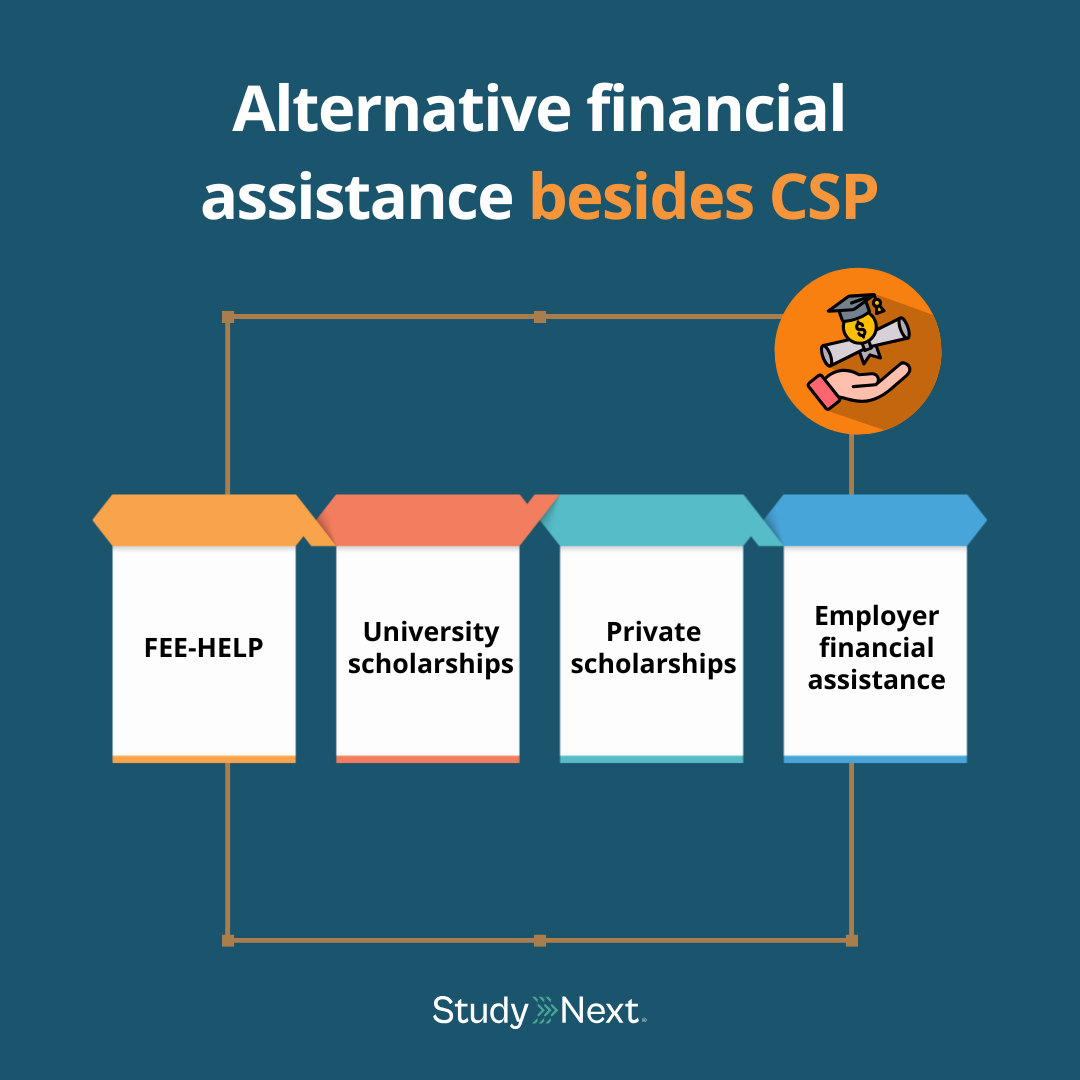
If you’re not able to secure a CSP, you can consider other options to fund your studies, such as FEE-HELP, university scholarships, private scholarships and employer financial assistance. Discover what each of these entails below:
FEE-HELP
Available to eligible full-fee paying domestic students, FEE-HELP is a government loan that covers all or a portion of your fees when you study at an approved higher education institution. Similar to HECS-HELP, you’ll only need to start repaying your loan once you start earning above the minimum threshold, which is $67,000 for the 2025-2026 income year. By taking this loan, you’ll be able to focus on your studies without worrying about making an upfront payment.
University scholarships
Many universities offer a wide range of scholarships for postgraduate students. These scholarships may be granted on the basis of merit, financial need or industry relevance. Some universities also provide scholarships for specific groups, such as women and Aboriginal and Torres Strait Islander peoples. For example, the University of Melbourne offers the Dean’s Scholarship for Women and Management, which covers partial tuition fees worth $50,000 for senior women executives pursuing the Senior Executive Master of Business Administration course. The University of Western Australia provides the UWA Indigenous MBA Scholarship, which is a full-fee waiver scholarship valued at $59,700. This scholarship aims to support high-achieving Aboriginal and Torres Strait Islander students studying the Master of Business Administration at the institution.
Once you’ve identified which course you want to pursue, be sure to explore the scholarships available at your university to determine which ones you may be eligible for.
Private scholarships
You can find many private scholarships offered by professional associations and private organisations that can support students in specific study areas. For example, the Westpac Future Leaders Scholarship is designed to assist students who want to pursue postgraduate research or coursework in fields related to technology and innovation, sustainability and social change. Successful applicants will receive flexible financial support for both their tuition and living expenses, with up to $120,000 provided across two to three years. Private scholarships may also offer other benefits beyond financial assistance, such as leadership development, global experiences and networking opportunities, that can further enrich your postgraduate journey.
Employer financial assistance
Many organisations in Australia provide structured methods to support employees furthering their education, which may include sponsoring your studies, reimbursing tuition fees or providing study leave. For example, EY Australia offers financial support to cover all or part of their employees’ tuition and study material costs for approved courses, along with study and exam leave.
If you’re a working professional considering advanced study, review your employee benefits or consult with your human resources team to find out if your company offers financial support for postgraduate education.
Invest in your future with a postgraduate course
Advancing your study with a postgraduate course can help enhance your professional standing in today’s competitive job market. With CSP and other financial assistance options available, you have many ways to ease the cost of your education, giving you peace of mind while studying. Interested in exploring more programs? Discover a wide range of postgraduate business courses with CSP offered by leading universities across Australia today.
If you have a question about any of the courses mentioned above, you can reach out to our Education and Careers Consultant, Catriona, who is available to answer them. Book a call here. Book a call here.