

In This Article
- What is a small business course?
- 11 small business courses for aspiring business owners
- Why should you take a small business course?
- What skills can you gain from a small business course?
- Are there government-funded small business courses?
- How to choose the right small business course
- Build a successful career with a small business course

Thinking about pursuing a course that can help you build the skills and confidence needed to launch your business? With a wide range of options available, ranging from graduate certificates to master’s degrees, there are plenty of courses to suit your professional goals, experience level and learning preference.
Read this article to explore why you should invest in a business course for small business success and discover a curated list of courses from StudyNext Australia’s catalogue. You’ll also gain insights on how to choose the right course to support your journey as an aspiring business owner.
What is a small business course?
A small business course is a structured learning experience designed to equip you with the essential skills, tools and knowledge to start and grow a small business. They often cover topics like business planning, operations and marketing, allowing you to learn how to set business goals, manage day-to-day business activities efficiently, promote your brand and more. These courses offer support and guidance from experienced mentors and professionals to help you navigate the business landscape as a future entrepreneur.
11 small business courses for aspiring business owners
For aspiring entrepreneurs, completing a small business course can help you obtain the expertise to establish and manage your own business. These courses are available at various levels, such as graduate certificates, graduate diplomas and master’s degrees. Discover some of these courses below:
Graduate Certificate in Entrepreneurship
This course at the University of Melbourne aims to develop your entrepreneurial abilities to examine and address business and social challenges. You’ll also have opportunities to connect with industry mentors, guest speakers, investors and incubators during your studies.
Delivery mode: Face to face
Duration: 6 months
Indicative total fee (2025): $18,496 (domestic full-fee paying place)
What you will study:
- Analyse social and business challenges to support evidence-based decision-making within enterprises
- Learn how to apply professional expertise in entrepreneurial ventures
- Discover how to think creatively and critically to develop solutions to problems within enterprises and the broader community
- Explore ways to identify entrepreneurial opportunities within simulated real-life business environments
- Learn how to examine information to support evidence-based entrepreneurial practice
Units of study include:
- Entrepreneurial Practice
- Entrepreneurial Organisation
- Managing Innovation
- Building Entrepreneurial Ventures


Build foundational knowledge and skills and refine your entrepreneurial talents to analyse and solve business and social problems.
Graduate Certificate in Entrepreneurship and Innovation
In this course at the University of Queensland (UQ), you’ll develop the skills to drive innovation, leverage the power of technology and apply strategic plans to boost business productivity, global competitiveness and lead meaningful change.
Delivery mode: Face to face
Duration: 6 months
Indicative total fee (2025): $19,240 (domestic full-fee paying place)
What you will study:
- Gain an understanding of entrepreneurship and innovation in modern business and the benefits they generate, including building better communities
Core units of study include:
- Creativity for Innovation and Design Thinking
- Idea Management
- Managing Innovation
- Building Innovation Capability


Learn to shape, test and advance new ideas through design thinking, entrepreneurial leadership and innovation management, supported by UQ’s commercialisation expertise and innovation ecosystem.
Graduate Certificate in Leadership and Entrepreneurship
This CQUniversity course introduces core concepts in business leadership, entrepreneurship and both social and business innovation. The units in this graduate certificate are drawn from the Master of Business Administration (Leadership) course, providing you with current and industry-relevant knowledge that complements your discipline.
Delivery mode: Online
Duration: 6 months
Indicative total fee (2025): $7,200 (domestic full-fee paying place)
What you will study:
- Examine business theories and practices from a leadership and entrepreneurship perspective to enhance business performance
- Communicate effectively to foster a workplace culture of confidence, integrity and innovation
- Analyse, design and communicate marketing strategies to achieve strategic results
- Drive innovation to solve problems and create new opportunities in legally, financially and socially responsible ways
Units of study include:
- Disruption, Innovation and Entrepreneurship
- People, Leadership and Culture
- Strategic Marketing
- Social Innovation


Develop leadership and entrepreneurial capabilities through flexible online study, building practical skills in innovation, strategic marketing and business leadership to strengthen your career opportunities.
Graduate Certificate in Innovation and Entrepreneurship
In this course, you can learn how to transform your ideas into business opportunities, whether you’re launching a startup, transitioning out of your full-time career into self-employment or a manager who’s interested in innovation. You’ll also have access to Australian Catholic University (ACU)’s dedicated business incubator and consultation service.
Delivery mode: Face to face
Duration: 6 months
Indicative total fee (2025): $11,480 (domestic full-fee paying place)
What you will study:
- Develop the knowledge and skills needed to turn creative ideas into commercial opportunities
- Gain insights into financing, business management and problem-solving that can help you build and manage high-growth ventures
Core units of study include:
- Entrepreneurship
- New Venture Finance
- Small Business Management
- Data Analytics and Visualisation OR Managerial Marketing


Develop the knowledge and skills to commercialise creative ideas and learn about financing, business management and problem-solving to successfully create and manage high-growth ventures.
Graduate Diploma in Entrepreneurial Growth
This course at Flinders University has three core stages to help grow your startup. First, you’ll create and test innovative ideas in the “pre-accelerator” phase. Next, you’ll develop and prepare to launch your idea in the “incubator” stage. Finally, you’ll “accelerate” your startup through industry connections and the right tools to help it grow.
Delivery mode: Face to face
Duration: 12 months
Indicative total fee (2025): $11,800 (domestic full-fee paying place)
What you will study:
- Identify and develop opportunities to generate social and economic value
- Use creative methods and tools to solve real-world innovation challenges
- Leverage business models that transform opportunities into social, cultural and economic value
- Apply innovative principles to address organisational and social issues
- Navigate disruptive markets, technologies and social structures
- Build connections within an entrepreneurial ecosystem
Core units of study include:
- New Venture Finance and Private Equity
- Legal Signposts for Decision-Makers
- Accelerating Startups: Build, Launch and Grow Ideas for Impact
Choose one from the following:
- Innovation for Social Impact
- Innovation in Medical Devices
- Innovation and Industry 4.0 GE


The course is designed to equip students with the knowledge, skills and attitudes required to support entrepreneurialism.
Graduate Diploma in Entrepreneurship
This one-year course offers an immersive learning journey where you can obtain practical experience and convert your innovative ideas into meaningful solutions. It provides a bespoke incubator program designed to boost your business acumen, entrepreneurial abilities and leadership skills. At the end of this course, you’ll have the chance to pitch your startup to the University of New South Wales (UNSW)’s angel investor community.
Delivery mode: Face to face
Duration: 12 months
Indicative total fee (2025): $13,000 (domestic full-fee paying place)
What you will study:
- Learn how to apply business knowledge effectively in both local and global settings
- Understand how to identify business problems and find effective, evidence-based solutions through critical thinking
- Develop skills to manage and share business information using various forms of communication across diverse platforms
- Collaborate with others to achieve shared business goals and reflect on their teamwork and results
- Understand and commit to ethical and sustainable business practices
- Learn about business systems globally and cultural differences to work well in diverse environments
Core units of study include:
- Identifying Opportunities
- Business Model and Lean Startup Methodologies
- Startup Placement
- Prototyping Design Solutions
- Startup 360
- Industry Projects in the Startup Ecosystem
Capstone project:
- Launching Your Startup


Turn entrepreneurial ideas into viable ventures through an immersive startup incubator that combines practical experience, mentoring and industry connections.
Graduate Diploma in Start Up Scale Up
To help you prepare for launching a new business or driving business innovation, this Western Sydney University course covers topics such as creativity and management capabilities, new markets and digital technology.
Delivery mode: Face to face
Duration: 12 months
Indicative total fee (2025): $16,992 (Commonwealth Supported Place)
What you will study:
- Develop the essential skills needed to launch or grow a business to respond to emerging regional or global demands
Core units of study include:
- Innovation, Creativity and Foresight
- Entrepreneurial Management Capabilities
- Innovation Through Digital Technology
- Innovation for New Markets
- Startup


This program provides a unique opportunity for innovative students and small-to·medium sized enterprises to be exposed to the university's business and technology incubator.
Master of Entrepreneurship
Available at the University of Melbourne, this course teaches you how to create value when you develop new businesses, products, services or processes. You'll also have the opportunity to learn from guest speakers who are local and international thought leaders, investors and innovators.
Delivery mode: Face to face
Duration: 12 months
Indicative total fee (2025): $36,992 (domestic full-fee paying place)
What you will study:
- Apply professional knowledge and skills in entrepreneurial practices
- Gain skills in identifying entrepreneurial business opportunities in a simulated real-world environment
- Analyse data to drive evidenced-based entrepreneurial strategies
- Learn about ethical problem-solving in enterprise creation through the application of appropriate concepts, principles and data
- Practice critical thinking focused on enterprise growth and pathways to market
- Learn how to communicate effectively about entrepreneurship concepts to peers and the wider community
- Conduct basic market research and gather information from a variety of sources
- Collaborate to initiate and execute entrepreneurial ventures
Compulsory units of study include:
- Business Model Innovation
- Seminars in Entrepreneurial Finance
- Managing Growth
- Entrepreneur Within
Students will also complete three constrained elective subjects and one elective subject.

Facilitates your career as an agent of change, either within a new venture or an established organisation.
Master of Entrepreneurship and Innovation
This UQ course is suitable for those who want to develop a new product, address a social challenge or lead business transformation. It offers five fields of study for you to customise your course plan according to your career goals: Biotechnology, Design and Information Technology, Social and Community Entrepreneurship, Food Entrepreneurship and Sustainable Energy.
Delivery mode: Face to face
Duration: 18 months
Indicative annual fee (2025): $38,480 (domestic full-fee paying place)
What you will study:
- Understand the role of entrepreneurship and innovation in contemporary business and the value they generate
- Develop a business model based on comprehensive customer interviews, rapid prototyping and agile development
Core units of study include:
- Idea Management
- Managing Innovation
- Building Innovation Capability
- Creativity for Innovation and Design Thinking
Students will also complete a capstone course and choose elective units from either a field of study, program electives or general electives.

Develop your understanding of entrepreneurship and innovation in emerging fields that will have a profound effect on how you practice business.
Master of Innovation and Entrepreneurship
When you study this course at Curtin University, you have the opportunity to complete specialised programs to complement your learning experience, such as the MIT Global Innovation Bootcamp and the Curtin Ignition commercialisation program. This course is targeted to aspiring entrepreneurs and corporate innovators.
Delivery mode: Face to face
Duration: 24 months
Indicative annual fee (2025): $32,338 (domestic full-fee paying place)
What you will study:
- Learn about the latest knowledge and skills in international business, entrepreneurship and startups and how to apply them as a professional
- Build and use entrepreneurial and innovation skills to find creative solutions to challenges in international business and entrepreneurship
- Communicate clearly and professionally with diverse stakeholders within ethical standards in business and entrepreneurship
- Explore the feasibility, sustainability and impact of new technologies on business and society
- Use business, entrepreneurship and innovation skills to work responsibly with industry partners
Core units of study include:
- Business Analytics and Data Visualisation
- Business Project Management
- Societal Impact of Technological Innovation
- Creativity and Innovation
- Organisational Change and Transformation
- Culture and Ethics in Global Business
- International Marketing for Managers
- Global Business Dynamics
- Business Models and Feasibility
- Design Thinking
- Intellectual Property Management and Commercialisation
- Commercialisation of Technological Innovation
- Corporate Strategy
Students will also complete two electives in this course.


Build the entrepreneurial, commercialisation and strategic capabilities to evaluate new ideas, develop viable business models and create responsible solutions across startups, established organisations and international markets.
Master of Entrepreneurship and Innovation
This Australian National University (ANU) course aims to prepare graduates and professionals from all fields to become evidence-driven decision-makers, creative problem solvers, responsible social citizens and future leaders.
Delivery mode: Face to face
Duration: 24 months
Indicative annual fee (2025): $37,520 (domestic full-fee paying place)
What you will study:
- Analyse and synthesise evidence to support decision-making
- Create opportunities and innovative solutions to organisational challenges
- Collaborate with others effectively to resolve challenges
- Consider the influence of an evolving global environment
- Demonstrate ethical behaviour and make principled decisions
- Apply specialised knowledge and skills in entrepreneurship and innovation
Compulsory units of study include:
- Marketing Management
- Technology and Project Management
- New Venture Creation
- Innovation
- Evidence-Based Management
- Organisational Behaviour
- Entrepreneurship and Innovation
- Strategic Management
- Leading People and Change
- Marketing Management
Choose to complete an internship program or two from the following:
- Applied Entrepreneurship and Innovation
- Business Growth Strategies
- Global Business Project
- Group Research and Innovation Project (GRIP)
Students will also complete either one specialisation or four elective units.


Gain specialised knowledge and skills in the area of entrepreneurship and innovation, which can be tailored to include a second specialisation.
Why should you take a small business course?
You should take a small business course as you can build the insight and competencies needed to launch, manage and scale a business. These courses not only help you develop practical skills, but also offer valuable industry exposure, giving you a clear understanding of the environment you'll be entering as an entrepreneur.
Here are several reasons to consider completing a business course for small business management:
-
Develop essential skills
The topics covered in small business courses can help you build core capabilities required to run a business successfully, such as financial management, marketing and leadership. These skills are also highly transferable across diverse industries, giving you the flexibility to start a business in your preferred field. Small business courses also help you improve your critical thinking skills, which is important when solving challenges and making smart decisions as a business owner. -
Obtain industry insights
Small business courses often include case studies, real-world examples and guest speakers from the business world, allowing you to learn directly from seasoned entrepreneurs. Guest speakers usually share their personal experiences, including challenges and successes, giving you the chance to understand today’s competitive business environment.Many courses also include units that focus on the evolving laws and industry standards in business, helping you stay informed of the latest regulations so you can run your business legally and with confidence.
-
Gain experience in a low-risk setting
Small business courses offer a safe space to explore ideas and build skills with no real-world business consequences involved. Through coursework and team projects, you can understand how businesses and teams operate and practise what you learn in a low-risk environment. Many universities also provide dedicated learning spaces, equipment and resources like business incubators to help you develop and test your business idea.Some courses offer internship opportunities, allowing you to gain hands-on experience working with industry professionals and learning the best practices. This setting allows you to learn from trial and error, experiment and graduate with practical skills to get started with your business.
-
Make valuable connections
During your studies, you’ll have plenty of opportunities to connect with like-minded peers, industry professionals and mentors who can support you on your entrepreneurial journey. Engaging with others can ignite new ideas and provide fresh perspectives, which can hone your skills to address business challenges. Building a strong network can significantly contribute to your professional development, as it can lead to potential collaborations and other opportunities. -
Diverse study options in Australia
Australian institutions offer a wide range of small business courses, from graduate certificates to master's degrees. If you’re a working professional aspiring to start your own business, you may want to find a course that offers flexibility for you to juggle your personal and work commitments effectively. With options to study full-time or part-time, on campus or online, you can tailor your learning experience to fit seamlessly around your lifestyle. -
Refresh your knowledge of the business landscape
Many budding entrepreneurs start their own business later in life, often after spending years building their careers. If it has been a while since you were in a formal learning environment, you may find that the current business landscape may have changed significantly. Pursuing a small business short course can help you refresh your skills, fill knowledge gaps and gain insights into the challenges and opportunities in running a business today.
What skills can you gain from a small business course?
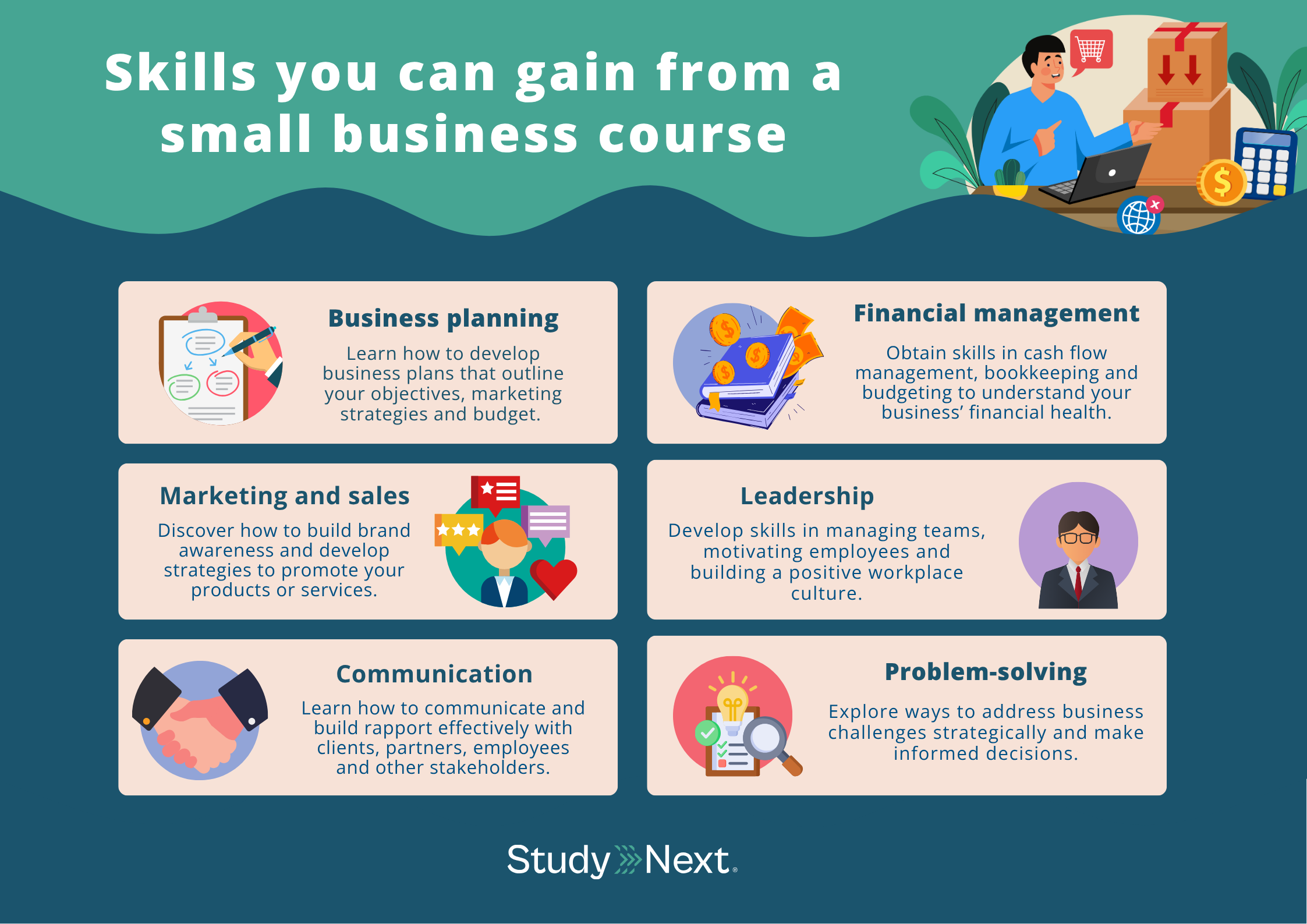
A small business course can help you obtain a wide range of skills, such as business planning, financial management, marketing and communication. These skills are essential to help you plan and launch your small business successfully. Learn more about these skills below:
Are there government-funded small business courses?
Yes, the Australian Government offers a wide variety of free small business course options, designed to help you gain knowledge and skills in essential small business functions. Managed by the Australian Taxation Office (ATO), these online courses cover topics such as starting a small business, record keeping, cash flow, goods and services tax (GST), as well as hiring and paying employees.
Another way to study a government-funded small business course is by enrolling in a Fee-Free TAFE course. As part of a joint initiative of the Australian, state and territory governments, this program offers tuition-free courses designed for eligible individuals looking to train, retrain or upskill. You can find certificates and diplomas that cover diverse sectors like business, manufacturing and retail trade, providing you with core industry knowledge to get started in your preferred field.
This initiative also includes TAFE small business courses. For example, the Certificate III in Entrepreneurship and New Business course at Charles Darwin University (CDU) is under the Fee-Free TAFE plan and is available for eligible students in the Northern Territory in 2025. The certificate covers fundamental entrepreneurship topics, including how to prepare business proposals and navigate the financial and compliance requirements for new business ventures.
Places for these fee-free courses are often limited, so it’s important to check with your TAFE provider or your state government’s website for eligibility criteria and course availability.
How to choose the right small business course
Choosing the right small business course involves understanding your learning goals, current skill level and lifestyle. The features of a course, including delivery format, cost and duration, also play a big role in finding the right one for you. Whether you want to learn how to start a business generally or upskill in a specific business area, it’s important to evaluate factors that can help determine which course supports your professional objectives. Learn more below:
Learning goals: Consider what you want to achieve with a small business course, whether it’s to learn the fundamentals of starting a business or develop your skills in a particular area like marketing, finance or operations management. Assess your current knowledge and compare course content to help you choose one that aligns with your immediate and long-term goals.
Course format: Many small business courses offer flexible options to accommodate individuals who are balancing work and family commitments. For example, studying a small business course online allows you to study remotely, saving both time and money from having to commute to campus to attend classes. Reflect on your schedule and preferred learning style to help you choose which course works best for you.
Cost: Course fees can vary widely according to the program and provider. Establishing a clear budget can help you narrow down courses that fit your financial circumstances. You can also look into government-funded small business courses to reduce your overall expenses.
Duration: A short small business course can be great if you want quick, practical knowledge, while a longer course usually offers more depth and may be better suited for you if you’re looking for a comprehensive learning experience. You should also determine how much time you can dedicate to study as it will affect how well the course fits into your schedule.
Accreditation: Pick a course that’s provided by a reputable institution, such as an Australian university, a TAFE provider or a recognised training organisation. Accredited small business courses ensure you’re getting high-quality education and recognised qualifications.
Build a successful career with a small business course
Regardless of where you are on your journey to becoming an entrepreneur, a business course for small business owners can help you develop the skills needed to achieve your professional goals. By comparing courses and examining their course content, cost and networking opportunities, you can determine the one that best fits your needs. Explore various postgraduate entrepreneurship courses offered by top Australian universities to get started.