
In This Article
- What is marketing analytics?
- Common types of marketing analytics (and what they tell you)
- How to turn data into decisions with marketing analytics
- Why do you need to master marketing analytics?
- The skills you can gain from studying marketing analytics
- Get ahead of the competition by building your marketing analytics skills
- Need further assistance? Our Education Consultant can help
The marketing landscape is made up of many channels, encompassing both traditional and digital marketing. Digital takes the lead, with Australia’s digital advertising market reaching AUD $18.4 million in 2025. With much of marketing happening digitally, every click, view, like and share becomes data that organisations can harness to improve performance and make better decisions.
Marketing analytics can help unlock this data and deliver advantages such as better return on investment (ROI) and smarter resource allocation. In this article, we’ll explore the common types of marketing analytics, how it turns data into decisions and why developing marketing analytics skills is becoming increasingly important for today’s marketers.
What is marketing analytics?
Marketing analytics is the practice of collecting, measuring, analysing and interpreting marketing data to improve performance and make better decisions. Marketing analytics has become a fundamental skill expected of marketers. Without it, you’re relying on guesswork or anecdotal evidence to make decisions.
Combining data from traditional marketing channels and digital touchpoints such as social media, email and search, marketing analytics gives you a 360-degree view of your customer and a clearer read of what’s going well and what isn’t. It answers questions like:
- Which campaigns are performing best?
- Which channels drive the most conversions?
- What’s the ROI and is the marketing spend being used effectively?
- Where are the new opportunities worth chasing?
- What can we improve to drive growth?
- What’s driving a sudden spike or drop in numbers?
Common types of marketing analytics (and what they tell you)
Marketing analytics is built on a large volume of data drawn from across your marketing activity. That data comes from a range of sources, the most common of which include:
Web analytics
Web analytics gives you insight into how users interact with your website and how you can improve their overall web experience. Common website metrics include unique visitors, bounce rate, conversion rate and traffic sources. It can be measured through tools such as Google Analytics and Adobe Analytics, along with behaviour-tracking tools like Hotjar.
Web analytics can help you determine:
- How many people visit your website, including how many are new visitors versus returning ones
- How long they spend on your website and which pages they view
- What device they’re using
- If they’re converting, whether that’s making a purchase or signing up to your company’s newsletter
Social media analytics
Social media channels such as Instagram, Facebook, LinkedIn, X and TikTok generate large amounts of data that can be useful for understanding your audience, measuring content performance and analysing brand sentiment. Examples of social media metrics include reach, impressions, follower count, post clicks, likes, comments and shares. These can be tracked on the native dashboards of each platform or through tools such as Sprout Social and Zoho Social.
Social media analytics can help you understand:
- How your social media campaigns are performing
- How many accounts are seeing your content in their feed
- The demographics of your audience
- Your brand’s share of voice compared to competitors
Email marketing analytics
Email marketing analytics tracks how recipients respond to and interact with your email marketing campaigns. Examples of email marketing metrics include open rate, engagement rate, click-through rate and unsubscribe rate. These metrics are typically measured through the email marketing platform you’re using.
Email marketing analytics can help you understand:
- Whether your subject lines and content are landing with your audience
- The conversion impact of your emails, including revenue per subscriber and customer lifetime value
- Whether your emails are driving traffic to your website
- Whether you’ve got a healthy email marketing list
Paid advertising analytics
Paid advertising analytics shows you how your ads are performing and whether your spend is delivering results. Some paid advertising metrics you might look at include reach, cost per click (CPC), cost per acquisition (CPA) and conversion rates. These metrics are typically extracted from native advertising platforms such as Google Ads and Meta Ads Manager.
Paid advertising analytics can help you understand:
- How much you’re spending to acquire each customer or lead
- Which ads and creatives are driving the best results
- Whether your ads are engaging your audience and capturing attention
- Where to allocate spend based on which channels produce the best return
How to turn data into decisions with marketing analytics
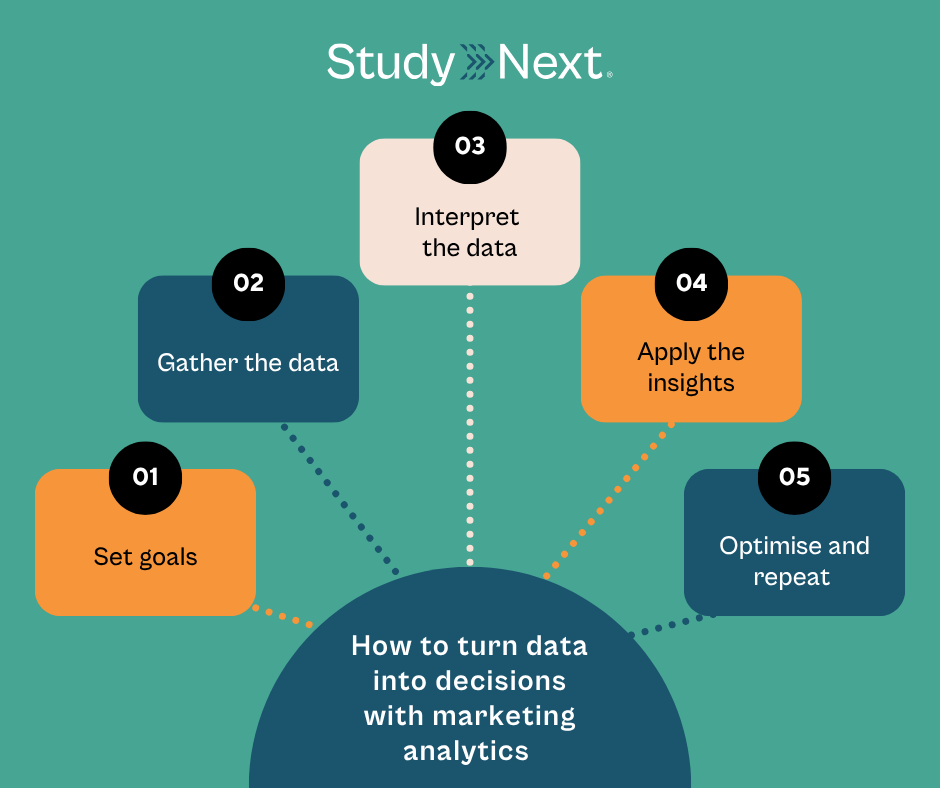
With a mountain of data coming from channels such as your website, your social channels, your email marketing platform and your ad accounts, how do you use it to make better decisions, optimise your marketing strategy and maximise return on investment (ROI)?
To illustrate how marketing analytics turns data into decisions, we’ll use the example of an activewear brand running a month-long campaign to promote a new collection.
Step one: set goals
Defining your business goals is essential, as data only means something when there’s a question for it to answer. While the goal is often increasing overall revenue, it could also be building brand awareness or increasing overall engagement.
Example: In the case of the activewear brand, their goal is to drive traffic to the landing page for their new collection and have users purchase their products.
Step two: gather the data
Once you’ve determined your goals, the next step is choosing the metrics that support them and sourcing those from the corresponding marketing systems. Then, you’ll want to consolidate your data from multiple sources into a single dataset or repository. This ensures your data isn’t fragmented, supports cleaner data hygiene and helps build a clearer picture of the customer journey.
You’ll also want to avoid fixating on vanity metrics (the numbers that look good, but don’t guide or influence business decisions). For instance, a social media advertisement might rack up a large number of likes or comments, but that counts for far less if it doesn’t translate to clicks to the website.
Example: To gauge the success of the campaign, some metrics the activewear brand would look at include click-through rate from its paid advertising and email campaigns, alongside how long users spend on their website and whether they go on to make a purchase. They would also build dashboards to keep track of specific day-to-day metrics, patterns and trends.
Step three: interpret the data
Now that you’ve gathered the data you need, the next step is looking for patterns and trends that can inform future strategic decisions. You can do this by using data visualisation tools along with marketing analytics software and tools. It also helps to ask the right questions using the descriptive, diagnostic, prescriptive and predictive analytics model.
Example: Working through the model, the activewear brand asks themselves the following questions:
- What happened? (descriptive analytics)
The data shows that while emails and paid advertising drove a considerable amount of traffic to the website, web analytics indicate a high bounce rate with minimal conversions. - Why did it happen? (diagnostic analytics)
Further analysing the data, the brand finds that most visitors are looking at the landing page on their phones. Using Hotjar to analyse how users interact with the landing page, the brand discovers that visitors were finding the site difficult to read and navigate on mobile. Session recordings and heatmaps revealed users struggling to scroll, missing CTAS and abandoning the page early. - What should we do? (prescriptive analytics)
With the campaign successfully driving traffic, the main issue to fix is optimising the website for mobile. - What’s likely to happen if we do? (predictive analytics) Based on these changes, the brand might forecast that visitors will stay longer and conversions will increase. To test the theory, it could temporarily reduce paid ad spend to see whether the improved page increases engagement and conversion. If it does, they can then increase their ad spend again.
Step four: apply the insights
This is the stage where you turn the insights you’ve gathered into action. You might use your findings to run A/B tests, improve the customer journey, guide product development or optimise your marketing channels.
Example: For the activewear brand, they decide that they need to focus their efforts on optimising the website for mobile. They do so by ensuring the website has a responsive design, touch-friendly navigation and clear, readable content.
Step five: optimise and repeat
Once you’ve made the changes and run the campaign again, you’ll generate new data that you can measure, interpret and act on. This cycle is how you continue to optimise your spend, enhance workflow efficiency and improve campaign planning.
Example: The activewear brand runs another campaign with improvements in place and sees noticeably better results. With two campaigns of data behind them, the brand can also begin to spot patterns in which products draw the most interest and which ad creatives and content resonate most with the audience, giving them useful information for planning the next collection launch.
Why do you need to master marketing analytics?
The activewear example above shows how marketing analytics can give you a comprehensive overview of your marketing activities and help you with optimising your marketing strategy. In addition, marketing analytics can also help in the following ways:
From a business perspective
Data-driven decision making
You’ll be able to pinpoint what’s working for your audience and what isn’t and adjust based on evidence rather than assumptions. You’ll also know which channels to allocate resources to, which helps you avoid draining resources unnecessarily.
Better customer insights
It’s hard to market to an audience you don’t understand. Marketing analytics gives you a clearer picture of what your customers respond to, how they behave and what they care about.
According to Adobe’s 2025 AI and Digital Trends Report, 71 per cent of consumers desire personalised offers and proactive assistance, with only 34 per cent of brands providing it. With better customer insights, you’ll be able to craft personalised marketing campaigns that speak to your audience rather than at them.
Budget optimisation
While some testing is inevitable early on, marketers are increasingly under pressure to justify every dollar spent. Marketing analytics enables smarter budget optimisation by identifying what’s working and what’s not, allowing resources to be redirected towards higher-performing channels and reducing spend on ineffective campaigns.
Predictive capabilities
Rather than just making decisions based on past performance, marketing analytics can help you anticipate future trends. By identifying patterns and trends in your data, you can forecast demand, predict customer behaviour, proactively adapt your strategy and plan for market shifts.
From a professional perspective
Gain a competitive advantage in the workplace with this marketing skill As digital tools and data sources continue to grow across the marketing landscape, one thing is certain – there will always be data that needs to be sifted through, interpreted and acted on. Analytics and insights has become one of the top digital marketing capabilities in demand in 2025 and mastering it gives you a competitive edge over other marketers who don’t.
Expands your career opportunities
Skills in marketing analytics can open doors to related roles. Examples include business analyst, analytics manager, business intelligence analyst or quantitative analyst. As organisations increasingly rely on data to guide strategy and decisions, professionals with these capabilities are also in demand across industries including consulting, strategy and business operations.
The skills you can gain from studying marketing analytics
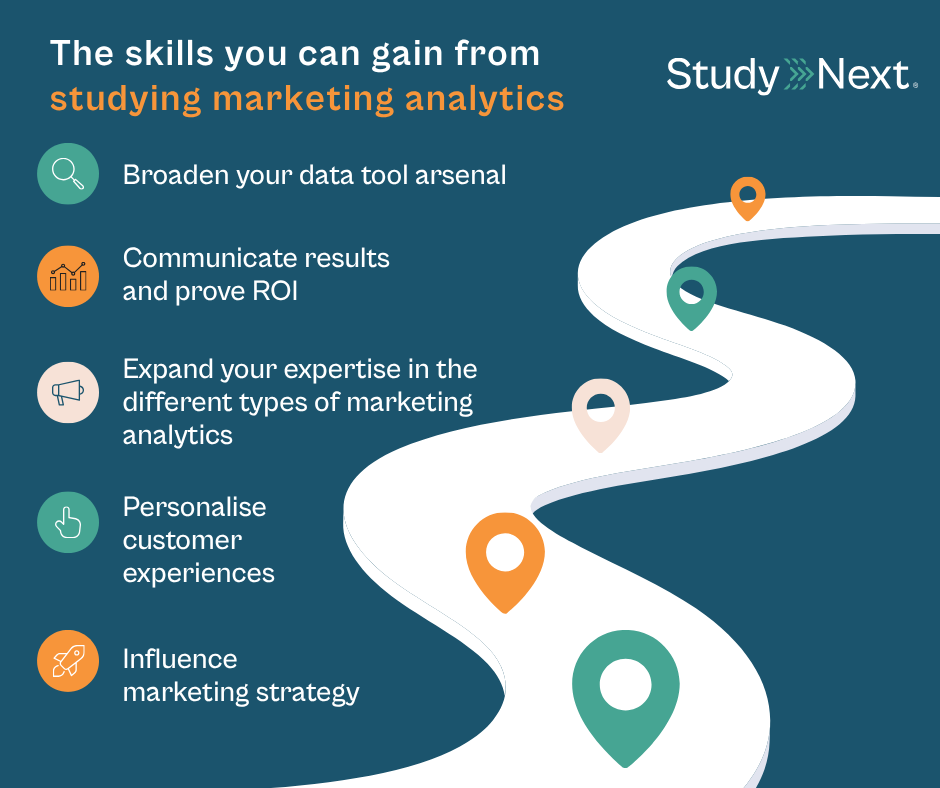
While staying up to date with industry trends and volunteering to assist with analytics projects at work can help sharpen your marketing analytics skills, studying a short course, microcredential or postgraduate qualification is also an effective way to build your skills in this field. Here’s a closer look at the skills you can gain from a marketing analytics course:
Broaden your data tool arsenal
Before studying marketing analytics: You’re familiar with basic analytics platforms such as Google Analytics and can extract simple reports when needed. However, tools like Tableau and Adobe Analytics feel unfamiliar and you’re not always sure which marketing metrics matter most or how to interpret the data.
After studying marketing analytics: You’re confident using industry-standard platforms such as Google Analytics, Google Data Studio, Tableau and Adobe Analytics. You know which metrics to track at different stages of the marketing funnel and can turn datasets into insights that inform marketing decisions.
How to get started: The Marketing Analytics and Insights short course at RMIT University can be completed online in six weeks and takes a practical, hands-on approach to analytics. You’ll gain hands-on, business-ready skills across a range of data analysis tools and learn how to produce and interpret data-driven insights.


Elevate your marketing career with hands-on experience in marketing analytics and use data to solve real-world business problems.
Communicate results and prove ROI
Before studying marketing analytics: You can prepare basic marketing reports, but presenting data in a way that’s engaging and easy to understand is a challenge. Without compelling visualisations, it can be difficult to demonstrate campaign performance or prove ROI.
After studying marketing analytics: You’re able to create clear, interactive dashboards and data visualisations that communicate your results. Using Tableau and other tools, you can transform complex datasets into persuasive visual stories that support better decision-making and showcase the impact of your marketing efforts.
How to get started: The Master of Analytics (Marketing) at the University of New South Wales can be completed part-time over two years and combines technical analytical skills with strategic marketing knowledge. As part of the course, you’ll complete units such as Data Visualisation and Communication, Predictive Analytics and Database Management.


Transform data into customer and market insights that strengthen marketing decisions, uncover opportunities and support more effective engagement across digital and customer environments.
Expand your expertise in the different types of marketing analytics
Before studying marketing analytics: You’re comfortable using web analytics to measure website performance, but your exposure to other areas of marketing analytics may be limited. This can make it harder to understand the full customer journey or identify opportunities across other channels.
After studying marketing analytics: You have a broader understanding of the different types of marketing analytics. Alongside web analytics, you develop foundational knowledge of customer analytics and social media and digital analytics. This helps you better understand customer behaviour and piece together the story behind your marketing performance.
How to get started: The Graduate Certificate in Marketing Analytics at the University of New South Wales can be completed online in eight months part-time. Alongside foundational analytics concepts, you’ll complete units such as Social Media and Digital Analytics and Managing Customer Analytics, giving you a well-rounded understanding of the field.

Strengthen your marketing expertise by developing the analytical skills to interpret customer data, evaluate campaign performance and make evidence-based marketing decisions in a digital-first environment.
Personalise customer experiences
Before studying marketing analytics: You can see whether campaign metrics have improved or declined, but you’re not always sure what the data is telling you. This can make it difficult to uncover insights and tailor marketing campaigns to suit different customer needs and preferences.
After studying marketing analytics: You’re able to analyse marketing data, identify actionable insights and use them to create more personalised customer experiences. By having a better understanding of customer behaviour and preferences, you’re able to tailor marketing campaigns and refine audience targeting.
How to get started: The Master of Digital Marketing at the University of Melbourne can be completed in 18 months full-time (or the part-time equivalent) on campus. The course includes units such as Digital Marketing Metrics and Digital Marketing Analytics, where you’ll learn how to measure marketing performance, interpret digital metrics and apply data-driven insights to create more personalised and effective marketing campaigns.


Learn how to problem-solve and become adept at analysing and solving complex digital marketing problems.
Predict future marketing performance
Before studying marketing analytics: You struggle to anticipate what might happen next or forecast customer behaviour. This can make it difficult to accurately project demand, plan marketing campaigns and allocate budgets with confidence.
After studying marketing analytics: You’re able to identify patterns and trends using marketing data to better predict customer behaviour and campaign performance. By applying predictive analytics, you can forecast future outcomes, anticipate customer needs and make more informed decisions about campaign planning, budget allocation and resource prioritisation.
How to get started: The Graduate Certificate of Marketing Technology at Deakin University can be completed part-time in one year and includes a Marketing Analytics unit. As part of this unit, you’ll develop an understanding of predictive analytics techniques and learn how to use historical marketing data to predict customer behaviour and support more informed marketing decisions.

Study online to enhance your skills in data-driven, AI-powered marketing and lead the future of digital strategy.
Influence marketing strategy
Before studying marketing analytics: You’re comfortable reporting on campaign performance, but you’re less confident in utilising data to inform marketing strategy. This can make it difficult to turn campaign data into actionable strategies that improve marketing performance and support business goals.
After studying marketing analytics: You’re able to transform marketing data into strategic recommendations that optimise campaigns, improve customer acquisition and support business growth. Using data-driven insights, you can influence marketing strategy and develop evidence-based marketing plans that drive business performance.
How to get started: Hone your digital marketing skills with the Master of Business (Digital Marketing) at the University of Southern Queensland. The course can be completed full-time in two years (or the part-time equivalent) and includes a Digital Marketing Analytics unit. You’ll develop the integrated digital skills needed to interpret marketing data, inform strategic decision-making and lead data-driven marketing initiatives.


Develop the know-how, the experience and the insights to be able to operate in this fast-paced industry.
Get ahead of the competition by building your marketing analytics skills
With an explosion in the generation of big data and data analytics, the ability to gather, interpret and apply marketing insights has become an essential skill for marketers. If you’re looking to sharpen your marketing analytics skills, take a look at the range of marketing courses available on the StudyNext catalogue. You can also broaden your expertise by exploring courses in fields such as artificial intelligence, data analytics, management and leadership.
Need further assistance?
Our Education Consultant can help With so many courses available, it can be difficult to work out which one best suits your needs and goals. Our Education Consultant, Catriona, can help you compare your options, understand your study pathways and identify the course that’s right for you. To get started, book a complimentary 15-minute course discovery call or a professional development strategy call.