
In This Article
- Should I study what I love or what makes money?
- Pursuing your passion
- Studying an in-demand field
- Is finding a middle ground possible?
- Postgraduate courses that balance personal interest with strong career prospects
- Practical factors to consider when choosing your field of studyy
- Quick checklist: which study path is right for you?
- How to keep yourself future-ready
- Blend passion with practicality in your postgraduate studies

If you’re considering postgraduate study, deciding on a field of study is a significant choice. For many, the choice may come down to either pursuing a course driven by personal passion or one that offers practical advantages that can help advance their career. But which path might be better for you?
In this article, we explore the benefits and potential drawbacks of studying what you love versus what pays and whether a balance between the two is possible. You’ll gain valuable insights into key factors to consider when selecting your academic discipline, along with strategies to stay future-ready no matter which path you choose. We’ve also included a quick checklist to help you understand which study pathway may suit you the most.
Should I study what I love or what makes money?
While choosing the right course typically depends on individual circumstances, finding one that aligns your interests with market demand can be the key to building a career that is both successful and personally rewarding.
When deciding on a field of study, many people tend to contemplate between following their passions or focusing on study areas currently in high demand to secure strong career prospects. While each path offers distinct benefits, you don’t necessarily have to choose one over the other. Instead, you can explore disciplines that both spark your interest and meet industry needs.
Pursuing your passion
Choosing to pursue your passion means prioritising a field of study based on personal interest rather than what the degree can practicality offer. This path offers several benefits, including stronger intrinsic motivation, greater career satisfaction, reduced chances of burnout and enhanced career innovation. However, it also carries potential drawbacks, such as limited financial security, the risk of passion turning into obligation, saturated job markets and uncertain career trajectories. Explore these advantages and challenges in more detail below.
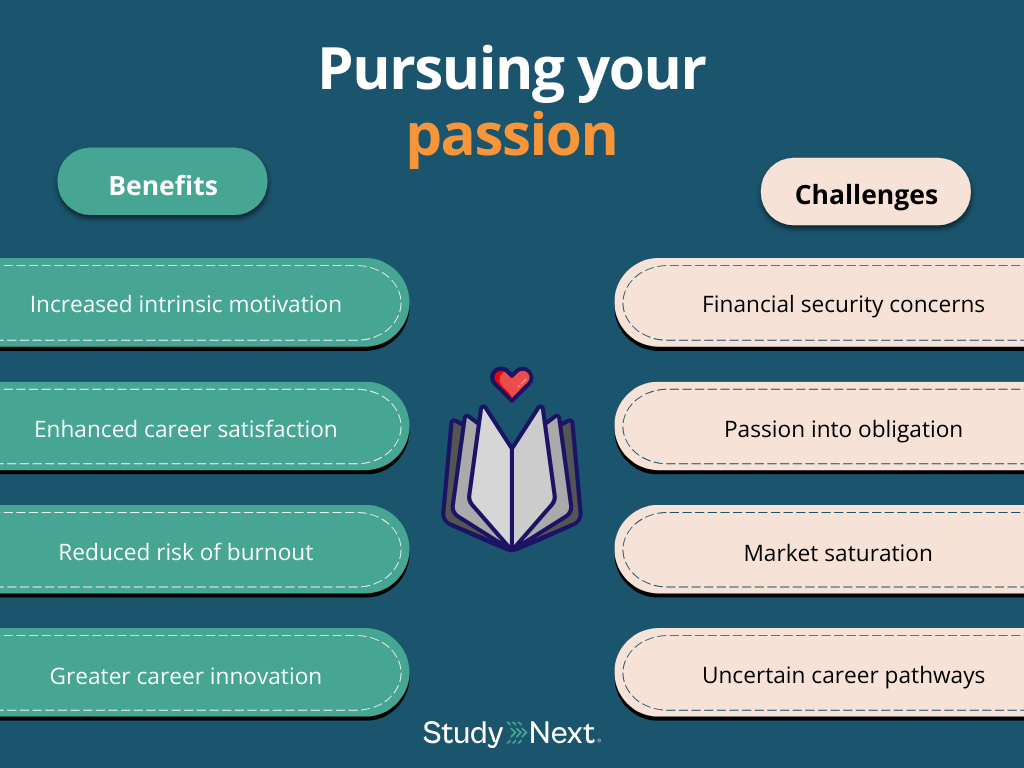
Benefits of studying what you love
Increased intrinsic motivation
Having a passion for your studies often fuels intrinsic motivation, which can lead to stronger academic performance and deeper engagement with your course material. The Graduate Outcomes Survey by the Quality Indicators for Learning and Teaching reported that the humanities, culture and social sciences, which are typically passion-driven fields, achieved the highest course satisfaction ratings among domestic postgraduate coursework graduates in 2024. This signals how genuine interest may enhance your overall learning experience.
Enhanced career satisfaction
Beyond offering a rewarding learning experience, your qualification enables you to explore careers that align with your passions. This allows you to find real meaning and satisfaction in your daily work, rather than just viewing your job as a means to earn an income. When you genuinely care about your work, you’re often better equipped to address challenges and sustain your motivation, contributing to your long-term wellbeing and professional fulfilment.
Reduced risk of burnout
When you're genuinely engaged with your course, studying can feel less like a burden. This can make it easier for you to navigate difficult material and challenging assessments with a growth mindset, reducing the risk of academic burnout. Similarly, when your career stems from a qualification in something you’re passionate about, you're more likely to enjoy what you do at work.
Greater career innovation
Choosing to pursue a course in a field you’re interested in often empowers you to carry that passion into your career, making you more inclined to think creatively and contribute meaningfully at work. For example, a project manager at a not-for-profit organisation who studied social impact may go beyond coordinating fundraising efforts to design programs that equip local residents with job-ready skills, addressing the root causes of their disadvantage rather than offering temporary relief.
Potential challenges of studying what you love
Financial security concerns
For many students, one of the most significant concerns of studying what you love is financial security. Some passion-driven fields may offer fewer job opportunities and lower starting salaries compared to disciplines that are in higher demand in the market. According to the Graduate Outcomes Survey, postgraduate coursework graduates in the humanities, culture and social sciences earned a median salary of $99,000 in 2024, which is slightly below the overall average of $100,000 across all study areas. This can make it difficult to achieve financial goals or maintain a comfortable standard of living, especially in the early stages of your career.
Passion into obligation
While following your academic passion can be rewarding, it also carries the risk of turning something you love into an obligation. When your studies evolve into a career, the spark you feel may be dulled with the pressures of deadlines, performance expectations and fulfilling stakeholder demands. This scenario is particularly common in creative fields where professionals are expected to monetise their artistic capabilities and juggle between personal expression and commercial value.
Market saturation
Market saturation can be another potential challenge for many graduates. In highly popular passion-driven fields like film and music, the number of aspiring professionals usually exceeds available opportunities. This oversaturation can make it incredibly difficult to establish yourself in the industry, possibly requiring years of junior-level work, side jobs and networking before achieving stability.
Uncertain career pathways
When you choose to study what you love, you may face the challenge of limited career pathways. While this choice may lead to a deeply fulfilling career, the journey for certain passion-based fields may be less structured and harder to predict compared to more traditional professions. That uncertainty can lead to stress, especially when you have financial obligations to fulfil or specific career goals to achieve within a set timeframe.
Studying an in-demand field
Studying an in-demand field means focusing more on what you can practically achieve after gaining the qualification. This path comes with valuable advantages, such as greater financial stability, a wide range of career opportunities, stronger job security and the freedom to pursue personal interests outside of work. On the other hand, you may find yourself facing challenges like motivation struggles, a higher risk of burnout, feeling like you’re locked into a single career path and the uncertainty of evolving market demands. Take a closer look at both sides below.
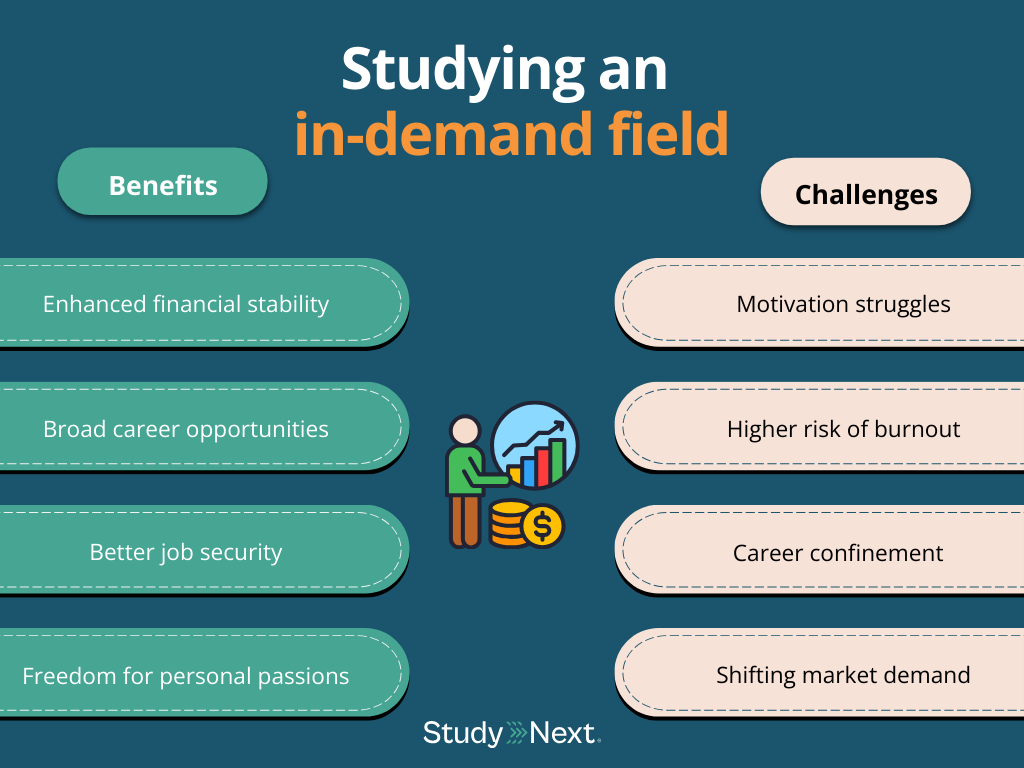
Benefits of studying a high-demand discipline
Enhanced financial stability
Many students seek out the best courses for high-paying jobs as a way to fast-track their financial independence. Since the skills gained from these courses are highly sought after in the market, graduates may benefit from higher starting salaries, faster salary growth and more stable job prospects. Having financial stability allows you to pay off student loans more quickly and save for significant life goals.
Broad career opportunities
Career opportunities tend to be more abundant in high-demand fields. When employers actively seek your skills, you usually have greater choice in where you work, more negotiating power for salary and better chances for career advancement. The Australian Government’s Jobs and Skills Report 2025 reported that service industries, such as healthcare and social assistance, as well as professional, scientific and technical services, represent 80 per cent of Australian employment, with nearly 90 per cent of job growth over the past decade. This finding translates into diverse professional opportunities available for those entering these sectors.
Better job security
Choosing to study a high-demand field may offer more security for your career, particularly in disciplines where there’s strong demand but a limited supply of qualified professionals. For example, the Digital Pulse 2024 report by Deloitte and the Australian Computer Society found that Australia will require 1.3 million technology professionals by the end of 2030 to fulfil industry needs, which equates to 52,000 additional workers each year. With such strong demand and projected growth, technology graduates may enjoy better career security and resilience in the job market.
Freedom for personal passions
Not only can studying a high-demand field help strengthen your career prospects, but it may also provide greater financial security, giving you more freedom to enjoy passions outside of work. When you have a stable income, you can pursue hobbies, creative projects or side hustles purely for personal fulfilment, without the pressure of turning them into your main source of income. Having this balance between professional stability and personal freedom can make your career choice feel more rewarding in the long run, as you get to enjoy your passions on your own terms.
Potential challenges of studying a high-demand discipline
Motivation struggles
One of the risks of choosing to pursue a high-demand field over your genuine passions is that you may not enjoy what you’re learning, which can make it harder to stay motivated and engaged throughout your studies. If you're not truly interested in the course curriculum, it can be difficult to sustain the effort required to perform well, especially in highly technical programs that require years of study.
Higher risk of burnout
When you choose to study an in-demand field primarily for its career prospects, the lack of intrinsic motivation may lead to burnout. Similarly, if your main reason to work is purely financial rather than a genuine interest, it may be harder to navigate stressful periods in the workplace. The obstacles you face may feel draining rather than serving as meaningful opportunities for professional growth, which can take a toll on your overall wellbeing.
Career confinement
Individuals who choose to study an in-demand field for its practicality may risk feeling stuck in their career trajectory later on, particularly those in more technical disciplines. After investing years in education and building specialised skills and knowledge, pivoting to a different path may feel daunting or financially impractical. This can create a feeling of being locked into an unfulfilling career path, especially when the field you studied didn’t really align with your passions.
Shifting market demand
It’s important to remember that what is considered an in-demand job today may not be the same in five or ten years. Ongoing market shifts, business trends and technological advancements can significantly reshape the employment landscape. Fields that are currently offering high salaries may face disruption in the future, requiring you to adapt or potentially make a career change. This potential challenge may reduce the sense of security you were looking for when choosing a practical field in the first place.
Is finding a middle ground possible?
When considering whether to choose money or passion, it's important to understand that you don't have to pick one path over the other. There are several ways to find a middle ground, including pursuing careers that offer both fulfilment and financial security, keeping your passion as a side venture, transitioning from a practical field to your passion later or allowing your passion to develop over time.
One effective approach is to explore courses that align your interests with market demand. By identifying the intersection between your passions and high-demand fields, you may be able to build a career that is both rewarding and secure. For example, if you care deeply about environmental issues, obtaining a qualification in sustainable business enables you to make an impact while establishing a well-paid career.
Another viable strategy is to pursue a stable, well-paying career while maintaining your passion as a side pursuit. This approach removes the pressure of monetising your passion while providing the financial freedom to explore it freely. Many creative professionals maintain "day jobs" that can support their artistic side projects and endeavours. Opting for this path can help safeguard your passion by keeping it free from commercial pressures and deadlines.
You may also consider establishing yourself in a practical, well-paying field first before transitioning towards your passion later. This passion-to-paycheck strategy allows you to build financial stability and create a safety net before pursuing a less conventional path of your personal interest. For example, a brand manager who loves fine arts may build their first career to fund their lifestyle, expand their network and develop business acumen to open an art gallery in the future.
It’s important to remember that developing passion over time is also possible. Not everyone enters university with a burning passion for a particular discipline. Instead, they may discover a genuine interest in a field they initially chose for practical reasons once they dive deeper into their studies. They can carry their newfound passion into their careers, allowing them to find enjoyment and fulfilment in high-paying, in-demand roles.
Postgraduate courses that balance personal interest with strong career prospects
If you’re looking to advance your studies with a course that balances passion and practicality, you can find a variety of options from leading universities in Australia. These courses often integrate business disciplines with areas of personal interest, such as arts and culture, sports and sustainability. By combining practical skills with fields you care deeply about, these programs can help you build a career that’s both meaningful and impactful.
The Master of Creative Industries and Master of Management at Macquarie University is ideal for those who want to pursue their passion in the creative sector while building the business acumen required to advance into management roles. Through this double degree, you’ll gain insights into diverse approaches to modern production, distribution and audience engagement within creative industries. The university provides access to professional studios for screen production, performance, music recording and radio, as well as industry-standard digital workstations. You’ll also complete management units that explore today’s business environments and provide opportunities to apply your knowledge to real-world corporate issues.


Combine creative production with contemporary management capabilities to develop original projects, guide teams and turn ideas into professionally delivered outcomes across the creative industries.
Deakin University’s Graduate Certificate of Business (Arts and Cultural Management) is another great example of a course that combines passion with practicality. Taught by academics with successful careers in the arts and creative industries, this program aims to equip you with the essential business skills required to excel in this sector. Studying this course can help you prepare to explore leadership opportunities across diverse creative contexts, including performing and visual arts, community arts and cultural development, museums and galleries, publishing houses and touring companies.


Learn to manage arts and cultural organisations with practical business capabilities spanning marketing, finance, people management and creative-sector operations.
If you want to work in the sports industry but are seeking strong career prospects, you may consider studying sports analytics, combining your passion with in-demand data analytical skills. Victoria University offers a Graduate Certificate in Data Analytics for Sport Performance, which is designed to equip you with the competencies to examine, visualise and interpret sports performance data using the latest research and core programming languages. Completing this course provides you with a formal qualification in data science with a unique focus on sports.


Gain a formal qualification in data science with a unique sports context.
Adelaide University‘s Master of Business Administration Specialising in Sustainable Futures is designed for individuals who are passionate about sustainability and committed to responsible business practices. This program explores critical topics such as climate science and carbon footprint, equipping you with the skills to evaluate a company’s environmental and social impact while finding opportunities for change. You can also benefit from direct engagement with industry leaders and renowned sustainability researchers. As part of the MBA experience, you can complete the exclusive directorship course offered by the Australian Institute of Company Directors.


Gain essential business knowledge and sustainability expertise.
Practical factors to consider when choosing your field of study
When deciding on a field of study, you need to take into account several factors, such as financial considerations, personal strengths, job market trends, long-term career goals and individual priorities. Factoring in these elements can help you make a choice that reflects not only your personal life but also external realities. Learn more below:
- Financial considerations: Evaluate your circumstances by considering different aspects of your financial situation, such as how much student debt you'll accumulate, whether you have financial support and what your expected starting salary might be in different fields. If you're facing significant financial constraints, pursuing a passion field that typically leads to lower-paying roles may cause financial stress for many years, which could affect your ability to enjoy your work. In this scenario, researching the most profitable degrees can help you identify options that align with your financial goals.
- Personal strengths: Success often relies on your skills and strengths, rather than interest alone. By analysing your natural aptitudes and existing expertise, you can determine which field suits you best. This self-reflection also enables you to find an academic path where both interest and skills align, increasing your chances of building a thriving and fulfilling career. For example, if you have strong digital skills and have a love for crafting compelling narratives, you can consider studying digital marketing to merge your technical expertise with creativity.
- Job market conditions: Regardless of whether you’re focusing on a passion-driven or high-demand field, it’s important to research the job market to understand what your career prospects may look like. This usually involves examining salary data, typical career progression and whether your desired career would be impacted by technological disruption in tomorrow’s workforce. You can also explore careers in emerging fields that didn’t exist a decade ago that can offer strong job prospects and personal satisfaction.
- Long-term career plans: Creating a long-term plan for your professional journey can help you make more informed decisions about what to study in order to reach your career goals. Different fields often lead to different pathways, so your chosen degree should align with your broader vision rather than just your immediate interests or financial needs.
- Personal priorities: Understanding your personal values can play a crucial role, whether your priority lies in having creative freedom, achieving financial security, making a meaningful impact or developing future-focused technical expertise. Having clarity about what you want in both your personal and professional life enables you to make important decisions, such as what course to study, that you won’t regret.
Quick checklist: which study path is right for you?
Deciding on the right study path often depends on your personal and professional circumstances. If you're still unsure of how to choose a course to study, use the checklist below as a guide to understand your current priorities.
Section A - Following your passion
- I have a clear and specific passion that I want to learn more about
- I’m willing to accept a lower starting salary in exchange for doing work
- I love I’m comfortable with exploring a non-linear career path
- I’m motivated by purpose and meaning at work more than financial reward
- I’m pursuing this field primarily because it reflects who I am and what I value
Section B - Studying what pays
- Financial security and stability are some of my top priorities
- I prefer a clear and structured career pathway
- I want to pursue my personal interests outside of work
- I’m comfortable studying a course I’m not deeply passionate about
- I’m motivated by career growth, earning potential and professional achievement
Section C - Blending both approaches
- I want to pursue a career that is both financially rewarding and personally meaningful
- I’m open to exploring how my passion intersects with in-demand industries
- I want the stability of a practical career while still feeling engaged with what I do
- I’m comfortable experimenting with different career paths before settling into one
- I’m open to considering roles that blend technical expertise with creative skills
Your results can be used as a starting point for your own reflection. The section where you checked the most boxes suggests what matters most to you right now. If your ticks are evenly spread across all three sections, it indicates that your priorities are still evolving, which can be a common stage in the decision-making process.
Even when it comes to choosing a career based on money or passion, there's no single universally correct answer. However, understanding both paths enables you to make a more informed choice about which field of study will best support your journey towards your professional objectives.
How to keep yourself future-ready
To stay competitive in tomorrow’s workforce, it’s important to cultivate transferable skills, commit to lifelong learning, expand your professional network and stay informed about the latest industry trends. These strategies can help ensure you remain future-ready, whether you choose to study a field driven by passion or one focused on financial reward. Find out more below:
Develop transferable skills
In today’s professional landscape, it’s highly recommended for you to build capabilities that transcend jobs and industries. Transferable skills like critical thinking, digital literacy and collaboration are valuable across almost all fields. These competencies can help you stay adaptable and competitive as you navigate market shifts or consider changing careers. For example, a business analyst who develops strong communication and strategic thinking skills alongside their technical expertise may consider pivoting into a consulting role, which requires similar strengths.
Practise continuous learning
Throughout your career, it’s important to keep updating your professional skills and knowledge in an increasingly competitive job market. This can involve completing courses on online learning platforms, obtaining professional certifications and taking short courses from recognised providers. To keep yourself future-ready, you can even explore short courses in emerging areas to help you refine your knowledge or upskill quickly.
For example, if you work in finance and want to understand how artificial intelligence (AI) technologies can shape your work processes, the Chartered Accountants Australia and New Zealand offers a Planning for GenAI Implementation in Finance Micro Course. In this online short course, you’ll delve into the value of generative AI (GenAI) by identifying its opportunities and how it can be integrated into workflows. Designed for finance and business professionals, you’ll learn practical strategies for implementing GenAI effectively within teams and understand the preparation processes required before deploying GenAI solutions for enterprises.


Discover how to pinpoint the areas where Generative AI can provide the greatest value.
If you’re an existing or aspiring leader within your organisation who’s looking to enhance your data skills, you can consider completing the University of New South Wales’ Data-Driven Leadership short course. Conducted in person over two days, this program aims to equip you with the tools and skills to drive organisational transformation and leverage data analytics to make more informed business decisions. You’ll also learn how to examine your company’s analytical maturity to identify capability gaps and explore the Data Ethics Framework to better understand and address ethical challenges.


Leverage data to improve decision-making and drive results.
The University of Sydney’s The Net Zero Sprint short course is a suitable option if you’re seeking to strengthen your sustainability expertise by understanding carbon accounting, reporting and reduction strategies. This two-week sprint introduces the fundamentals of carbon emissions, global and national regulatory frameworks and the principles of effective emissions management. You’ll learn how to evaluate your organisation’s greenhouse gas emissions and design practical decarbonisation strategies.


Discover how to monitor and address your business's carbon emissions while transitioning to net zero.
Expand your professional network
Your network can be a valuable asset for long-term career resilience. Throughout your studies and career, you should build meaningful relationships with peers, mentors, faculty members and industry professionals. These connections can provide you with access to career opportunities, insider knowledge, support and diverse perspectives. This can help you adapt to new trends, technologies and evolving market demands, enabling you to stay resilient in a changing workforce.
Keep up with the latest industry trends
It can be helpful to stay informed about how ongoing developments, such as technology advancements and global events, are reshaping your industry. You can subscribe to relevant publications, follow thought leaders on LinkedIn and engage with professional communities. This can help you anticipate changes and prepare accordingly to remain relevant in the job market. With the rapid adoption of AI across industries, it’s also important to examine which aspects of your field are most likely to be augmented or replaced, so you can focus on improving uniquely human skills that will remain essential.
Blend passion with practicality in your postgraduate studies
The passion vs practicality question doesn’t have one clear-cut answer, as each person's circumstances and aspirations are unique. To maximise your chances of building a career that’s successful and personally meaningful, you can explore courses that balance both your interests and strong career prospects. Browse the diverse postgraduate programs offered in StudyNext Australia’s course catalogue to begin finding options that best fit your goals.