
In This Article
- What are online university short courses and online learning platforms?
- Advantages of online university short courses and online learning platforms
- Disadvantages of online university short courses and online learning platforms
- Online university short courses vs online learning platforms: direct comparison
- Which option is right for you?
- Can you study both formats?
- Enrol in an online short course today

Online short courses can be a great option for individuals looking to balance short-term study with personal and professional commitments. These curated programs allow you to explore new fields and refresh your skills, which is essential in preparing for the future of work. You can typically find these courses offered by both universities and learning platforms. Each has its own advantages, so how do you decide which format is right for you?
In this article, we compare online university short courses and online learning platforms, highlighting what makes them distinct to help you identify the format that best suits your goals. We’ve also included a short quiz to guide your decision.
What are online university short courses and online learning platforms?
Online university short courses deliver brief, niche-specific lessons designed to build specific skills, while online learning platforms are websites that provide a wide range of courses across diverse fields. Both formats allow learners to refine or learn new skills without committing to a full degree, empowering them to specialise or pivot into new careers. Discover what they generally entail below:
Online university short courses
The defining feature of online university short courses is that they are delivered by accredited universities. These courses can range from a few hours to several months, depending on the topic and institution. Many universities usually offer short courses that focus on in-demand areas like artificial intelligence (AI), data analytics, sustainability and leadership, allowing you to upskill in competencies that can help future-proof your career.
The level of depth and practical experience offered in online short courses can vary significantly. For example, if you’re looking for a program designed to boost your leadership capabilities, Queensland University of Technology offers a Business Fundamentals: Managing People short course that’s fully self-paced and only takes 10 hours to complete. If you’re looking for a more intensive option, you can consider enrolling in the University of Melbourne’s New Leader Development Program. Spanning five weeks, this program combines self‑paced modules with live workshops led by experts and interactive activities. Keep in mind that the depth of course content can also affect pricing. When exploring short courses, you can narrow down your options by reflecting on your career goals, budget and preferred learning style.

Expand your knowledge and understanding of what managing people is all about.

Build the confidence and practical skills to influence others, lead teams and navigate your first leadership role.
Besides online modules, online university short courses may include virtual lectures, live seminars and group discussions. Choosing a short course with these real-time components can help you stay engaged and connected throughout the journey. Upon completion, you typically receive a digital badge or certificate from the university, which can be displayed on your resume, LinkedIn profile or personal website to highlight your achievement.
Online learning platforms
Many courses on online learning platforms focus on casual self-paced formats that allow learners to progress at their own speed. You can find diverse topics for both professional development and personal fulfilment across thousands of courses, from understanding the basics of Python to learning how to write and produce music. The learning experience on these platforms often includes pre-recorded videos, self-paced modules, practical exercises and community forums.
Online learning platforms often feature short courses delivered by industry practitioners and professional organisations. Many of these courses are taught by subject matter experts who are actively working in their respective industries, providing current, real-world perspectives into your learning experience. For example, you may find successful entrepreneurs sharing business strategies, professional photographers teaching how to use photo editing software applications or digital marketing agencies sharing search engine optimisation tips. Having this diversity of expertise enables you to develop practical, job-ready competencies while gaining insights into the latest industry practices.
The time taken to complete a course on these platforms varies as well. For example, Coursera offers Guided Projects, which are project-based programs that take up less than two hours. Some online learning platforms offer full undergraduate and postgraduate degrees from global universities, such as the University of London, Lancaster University and the University of Colorado, which can take you years to complete.
Pursuing a short course on an online learning platform can be a cost-effective option for many individuals seeking to delve into a wide range of disciplines. These platforms typically offer subscription-based access or pay-per-course options, giving you flexibility in how you can access learning content. For instance, Coursera’s main subscription model, Coursera Plus, gives you access to most courses for US$35 a month or US$119.50 per year. If you’re only interested in learning a single course and earning a credential, it would cost you US$29 per month. While some courses are available for free, they typically don’t include a certificate.
edX, another major online learning platform, allows you to access the learning content of many of its courses without cost for a limited time. Payment is only required if you want graded assessments, exams and a verified certificate. For organisations such as businesses and universities, subscription plans are available starting at US$25 per user per month.
Many Australian universities partner with these platforms to offer their content to wider audiences. For example, the University of New South Wales short courses, along with programs from the University of Melbourne, the University of Sydney, Macquarie University and the University of Western Australia (UWA) are made available through Coursera. These short courses cover a broad range of subject areas, such as agriculture, cybersecurity, gender quality and creative thinking skills, and are not listed on university websites, making the content exclusive to online learning platforms. You may typically be able to preview them by exploring their first module for free before deciding if you want to commit financially.
Advantages of online university short courses and online learning platforms
Online university short courses often deliver strong brand recognition, stackable academic credits, a structured learning environment, faculty support and expertise in high‑growth fields. In contrast, online learning platforms are typically more affordable and flexible, offering courses across a broad range of areas from diverse providers, including globally recognised universities. Many platforms also provide course preview options. Learn more below:
Online university short courses
Brand recognition
Completing an online short course from a recognised university allows you to highlight the institution’s name on your LinkedIn profile and resume, which can hold greater weight than credentials from non‑university platforms. While the course may not always be formally accredited, completing it still connects you academically to the university, which can be helpful if you’re not a student pursuing a full degree. This visibility can help boost your personal brand and signal to employers that you’ve invested in quality education from a trusted source.
Stackable credits towards a full degree
Some universities allow you to stack their short courses for credit towards a full qualification. For example, Deakin University offers stackable short courses that can be converted into credit for a complete postgraduate degree, while UWA Plus micro-credentials can be accumulated and turned into credit towards an undergraduate or postgraduate program. This provides you with the flexibility to build new skills over time, while giving you the opportunity to pursue formal study in the future.
Structured learning environment
Universities often design short courses with a structured curriculum, including clear weekly modules, set timelines and specific learning outcomes. If accountability helps you remain motivated, this format can be a strong fit. These short courses can also enable you to maintain your learning momentum and ensure you cover all essential topics systematically, making it easier to stay on track.
Faculty support
Many university short courses provide direct access to experienced academics and industry leaders. They may offer personalised guidance and provide detailed feedback on your work through virtual consultations and live Q&A sessions. One example from the University of Sydney short courses is The Net Zero Sprint, which aims to provide you with the expertise needed to manage carbon accounting, reporting and reduction strategies across your organisation. This short course includes self-paced modules and online live sessions, giving you time and space to ask important questions to your instructor and network with peers. Having this faculty support enables you to better understand complex concepts, allowing you to apply them effectively in your professional context.

Discover how to monitor and address your business's carbon emissions while transitioning to net zero.
Recognised expertise in high-demand fields
Online short courses offered by universities typically focus on skills for in-demand careers and emerging fields as a response to rapid developments in today’s job market. Often designed with direct industry input, completing a short program enables you to upskill with future-ready competencies while obtaining a recognised credential upon completion. For example, you can learn how AI can transform your business with RMIT University’s Developing AI Strategy short course. Developed in collaboration with Amazon Web Services, this program delves into fundamental AI concepts, practical applications and ethical considerations with insights from leading industry partners. After completing the course, you’ll obtain an RMIT credential to demonstrate your expertise.
Many of the University of Melbourne’s short courses also focus on fast‑growing fields in the future of work, including data analytics. If you’re interested in building skills in this area, you can consider taking the Data Analytics for Business Professionals short course at the University of Melbourne. This program aims to equip you with practical skills in Microsoft Excel, mathematics, statistics and data storytelling, empowering you to produce persuasive, well-informed business narratives for stakeholders. Through this course, you can learn how to find new market opportunities and growth areas for your organisation, while earning a credential from one of Australia’s top business schools.


Discover the implications of artificial intelligence (AI) on your business and learn how to build an AI strategy to keep ahead of the curve.

Learn how to use data to drive innovation, improve performance and make a real impact in your organisation.
Online learning platforms
Great affordability
Online learning platforms offer many courses at significantly lower price points compared to traditional education, which helps to remove financial barriers to professional development. Many platforms, such as Coursera and edX, provide financial aid options for eligible certificates. edX’s auditing feature also allows you to expand your knowledge for free if certification isn’t a priority. This affordability enables you to invest in multiple courses across different skill areas without the financial commitment required by many university short courses.
Broad range of study areas
Online learning platforms provide access to a variety of subjects, from business and technology to arts and humanities. You can tailor your learning journey to your career goals or explore new areas of interest without being limited to a single discipline. Having such a wide selection ensures that you can find courses that match your needs and aspirations, whether you’re seeking professional advancement, academic enrichment or simply exploring new hobbies.
Access to leading institutions worldwide
Since many learning platforms host online short courses from universities, you can access programs from globally recognised institutions as well. For example, Coursera partners with top universities such as Yale University, Princeton University and the University of Oxford. Completing these courses allows you to earn credentials from prestigious universities worldwide. This may significantly enhance your employability, as recognised qualifications from highly reputable providers can help you stand out to employers.
High flexibility
Online learning platforms design many of their courses with flexibility in mind, making it easier to fit study into busy schedules. Instead of having to follow rigid class times, you can go through the learning material at your own pace, which may mean pausing study when you’re occupied with professional or personal responsibilities or accelerating when you have more free time. This format is especially valuable for working professionals, parents and anyone balancing multiple commitments, as it allows education to integrate seamlessly into your life.
Course previews
Platforms like edX and Coursera offer preview options that let you explore courses without upfront payment. Free online short courses are available through edX's auditing feature, which allows you to access individual courses for a limited time. This suits learners who value knowledge and skills over graded assignments and official certification upon completion. Coursera also offers free access to the first module of eligible courses, while some programs include a seven-day trial period that unlocks the full learning content. Previewing what you’ll learn offers an opportunity to examine the course before choosing to make your purchase or subscribe to a paid plan.
Disadvantages of online university short courses and online learning platforms
While online university short courses often offer stronger credibility and structured support, they may be more expensive and less flexible than courses on online learning platforms. On the other hand, while these platforms may provide more self-study options and a wide variety of subject areas, their courses may lack credibility and offer limited accountability. To give you a more balanced perspective of both formats, explore some of the potential drawbacks below:
Online university short courses
Cost barrier
University short courses typically come with higher price tags compared to online learning platforms, often ranging from hundreds to thousands of dollars for courses that may cover similar content. This upfront payment can be restrictive for many learners, especially those who are just trying out new fields or looking to update multiple skills through different courses.
Limited flexibility
While short courses that have fixed semester schedules and assignment deadlines may be preferred by those who need structure in their studies, they may not be ideal if you need more flexibility to study in your own free time. You may even need to wait weeks or months for the next intake. This structured approach can also be challenging for professionals in different time zones.
Limited study areas
If you’re specifically looking for online short courses from universities, your options may be limited to the study areas provided by those institutions. As a result, you may not always find specialised niche topic areas or training in their offerings.
Enrolment barrier
Unlike online learning platforms that often give you instant access to the course you’re enrolling in, universities may have their own formal application procedures before you can begin. Some courses may also have prerequisites that require prior knowledge or qualifications. These additional steps can delay the time it takes for you to start studying.
Online learning platforms
Limited credibility
Certificates earned through online learning platforms that are not affiliated with well‑known or established institutions may hold less value than university short courses. Employers and hiring managers may be sceptical about the credibility of these platform certifications and may view them as less rigorous or credible than university qualifications.
Inconsistent quality standards
Since courses on these learning platforms are offered by a wide range of providers, their quality may vary, unlike universities that often have their own established academic standards. Due to this, you may not always have the assurance that the course content you’re learning reflects the latest industry practices or that you’re being taught by credible instructors.
Minimal accountability
Plenty of courses on online learning platforms highlight the benefits of self‑paced study, which offers convenience. However, they may also come with limited external accountability that helps keep learners motivated and on track. Free access features, such as course previews or auditing options, can further reduce accountability since there are no financial consequences if you don’t complete the course.
No academic credit
Short courses offered by non‑university providers on learning platforms typically don’t translate into academic credit towards a university degree. This means if you decide to advance your qualifications with formal learning later, you may end up repeating similar content in your course, as you can’t convert your prior platform learning into credit.
Online university short courses vs online learning platforms: direct comparison
| Factors | Online university short courses | Online learning platforms |
|---|---|---|
| Cost | One course can cost hundreds to thousands, depending on the subject and institution. | Typically offers annual subscriptions that cost hundreds with access to many courses. May offer pay‑per‑course options. |
| Employer recognition | Typically carries more weight, especially credentials from well-established universities. | May vary depending on which industry you’re in and if employers value credentials from recognised organisations. |
| Breadth of study areas | Usually focuses on emerging areas and skills relevant to the future of work. | Offers a wide variety of courses across diverse disciplines for professional and personal growth. |
| Networking opportunities | May include cohort-based learning experiences. | Usually provide discussion forums to engage with fellow learners. |
| Flexibility | Many courses have fixed schedules with set deadlines. | Many courses are self-paced and can be studied at your convenience. |
| Academic pathways | May offer stackable credit that counts towards a formal degree. | Courses from non-university providers generally don’t offer formal credit. |
| Instructor support | May provide direct access to instructors and faculty support. | Depends on the structure of the course. Support may be limited in self-paced formats. |
Which option is right for you?
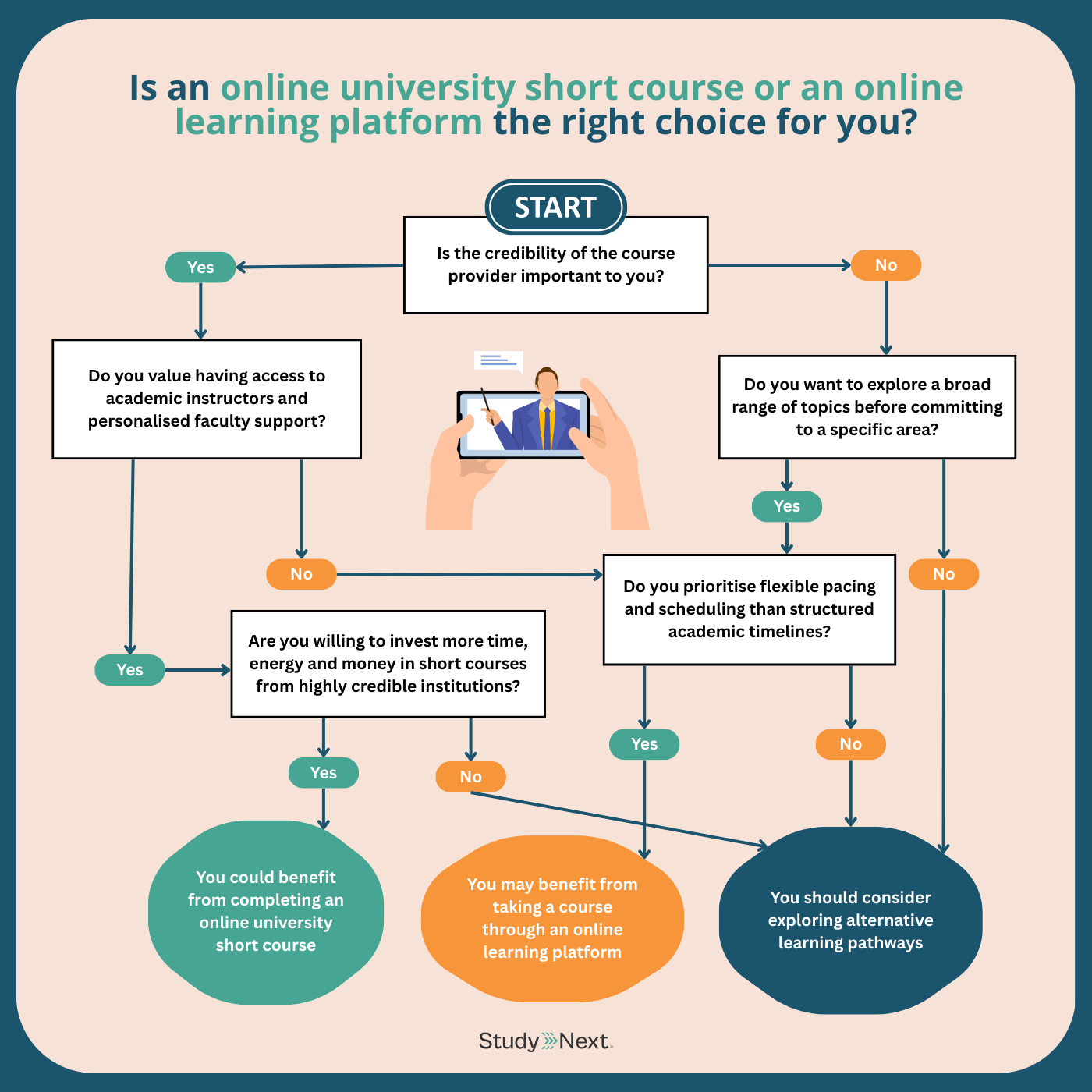
Deciding whether you want to study an online university short course or complete a short course on an online learning platform typically depends on your personal and professional circumstances. If you’re budget-conscious and want to explore different skills and study areas, a subscription plan on a learning platform may be a more suitable choice. On the other hand, if your priority is to gain a credential from a recognised institution, a university short course may better align with your goals.
Take the quiz below to see which format suits you best, based on your interests and learning preferences.
Can you study both formats?
Completing university short courses online and using learning platforms is definitely an option. You can consider leveraging both formats to maximise your professional development. Creating a hybrid strategy allows you to capitalise on the strengths of each format at different stages of your learning journey.
The most practical application of this approach is by using online learning platforms to explore various fields and courses before committing to a more expensive university credential. For example, if you're considering a career pivot into data analytics, you may want to begin your journey by taking several affordable courses on Coursera or edX to explore different aspects of the field, such as Python programming, statistical analysis and data visualisation. This can help you identify which area genuinely interests you and aligns with your career goals. Once you've confirmed your direction, you can then pursue a more rigorous online short course in your chosen specialisation from a recognised university. This approach allows you to minimise financial risk, as you’re likely to be more confident that the university credential you’ve invested in can give you maximum career impact.
This strategy can also work well if you need both specialised expertise in your core area and complementary skills across related domains. For instance, if your primary field is digital marketing, you may want to consider refining your expertise through a university short course, such as Digital Marketing Strategy and Leadership from the University of Melbourne. This course is designed to enhance your digital marketing skills, ensuring you stay ahead in a rapidly evolving business landscape. At the same time, you may complete learning platform courses to develop supporting competencies in graphic design, copywriting or basic web development. This combination can help you become a more versatile professional in your field.
A hybrid approach can be valuable for ongoing professional development as well. After completing a university short course, you can take courses on learning platforms to stay current with emerging tools, technologies and industry trends. For example, if you completed a short-term program in project management two years ago from a university provider, you can keep your skills updated by completing courses on learning platforms about new AI-powered project management tools or agile methodologies. This can help you maintain momentum in lifelong learning as you advance in your career.

Build customer-led digital strategies that connect channels, campaigns and performance with broader business goals.
Enrol in an online short course today
Online short courses are designed to give you the convenience to upgrade your professional competencies, no matter where or how you choose to study. Many Australian universities offer these programs, enabling you to upskill while earning a credential from a trusted institution. Interested to know what kind of programs are available? Browse through diverse online short courses offered by top universities across Australia from StudyNext Australia’s catalogue today.