
In This Article
- Why should creative professionals consider transitioning to business?
- How can creative professionals excel in business?
- What can hold creative professionals back from pursuing a business career?
- What kind of business careers should creative professionals consider?
- Examples of creatives who moved into business successfully
- Do you need an MBA to transition into a business career?
- Are you prepared to shift your career from creative to business?
- Get creative with your future in business

In today’s evolving professional landscape, transitioning from a creative background into business can be a feasible career path for many. With growing concerns around job stability and the rising cost of living in Australia, creative professionals may want to explore alternative career options that can offer greater security and financial rewards.
In this article, we explore the present landscape for creatives in Australia and highlight how your skills can position you as strong candidates for business roles. You’ll discover examples of career paths that bridge creativity and business, along with practical steps to support your transition. To help you assess your readiness, we also provide a checklist designed to guide you through your next career move.
Why should creative professionals consider transitioning to business?
For many creative professionals, pivoting into business can often help secure better career and financial security. Business fields can offer a wide range of opportunities where creative skills are valued, while potentially providing stability that you may not be able to find within creative industries.
The current landscape for many creative professionals in Australia points to why making this shift can benefit them. According to the Artists as Workers: An Economic Study of Professional Artists in Australia report by Creative Australia in 2024, full-time creative practice experienced a sharp decline, with only nine per cent of artists working full-time in 2023 compared to 55 per cent in 2009. The study also found that the proportion of artists supporting their income with non-arts work rose from 26 per cent in 2016 to 56 per cent in 2023, highlighting the growing issue of job insecurity within creative fields.
The average income levels of artists also present another challenge. Creative Australia revealed that between 2021 and 2022, artists earned an average of $54,500, which is below the national average of $73,300. Meanwhile, professionals in management positions earned $107,400 during the same period, highlighting the significant earnings gap experienced by those in the creative sector.
With 52 per cent of artists reported to apply their creative skills outside of the arts, this study suggests potential opportunities for creatives to explore more stable fields such as business. These industries may offer higher earning potential while still providing avenues for artists to continue expressing their creativity in impactful ways.
How can creative professionals excel in business?
Creatives can thrive in business by leveraging skills typically honed throughout creative careers, such as creative thinking, storytelling, client management and commercial awareness. These competencies are highly transferable and can be applied across a wide range of creative business careers, enabling you to transition smoothly without feeling like you need to start from scratch. Find out how these skills can give you a competitive edge below:
Creative thinking is one of the most valuable transferable skills for creative professionals. This competency is widely regarded across industries for its ability to generate fresh and innovative solutions. The World Economic Forum’s Future of Jobs report in 2025 also highlighted the increasing relevance of creativity in business, identifying creative thinking as the fourth most essential core skill sought by employers worldwide. It also ranked fourth among the skills projected to grow in importance between 2025 and 2030, highlighting its vital role in tomorrow’s workplace.
Given the nature of their work, many creatives naturally cultivate this ability, as you’re often required to present new and engaging ideas. In a business setting, this skill can enhance problem-solving by examining issues in unconventional ways and producing creative business solutions. As a result, your creative input can be valuable when businesses face market disruptions, develop new products or tackle organisational challenges.
Storytelling can be another powerful advantage that many creatives can bring to professional settings. Those with strong storytelling skills can build compelling narratives and translate complex concepts into clear and persuasive messaging that resonates with intended audiences. In business, this ability is especially useful in fields such as marketing, advertising and sales, where you’re expected to strengthen brand identity, build customer engagement and generate leads.
Many creatives also tend to excel at client management. You may be accustomed to working with briefs provided by clients, meeting deadlines and managing expectations as part of your daily work routines. These experiences can help cultivate strong communication, negotiation and organisational abilities, which can often be translated seamlessly into business-oriented fields like project management, account management and stakeholder engagement.
Some creatives already have a strong sense of commercial awareness, often developed through freelancing or working within agencies. This may involve understanding how to price your work, pitch creative projects to clients and manage budgets. Developing this practical knowledge can form the foundation of solid business acumen, which can be a critical asset if you want to explore business-focused careers.
What can hold creative professionals back from pursuing a business career?
Creative professionals may hesitate to make a career change into business fields for several reasons, including feelings of imposter syndrome, missing relevant business credentials, fear of losing creative identity and resistance to change. These challenges may slow down your progression, or in some cases, discourage you from pursuing the move altogether. Explore each barrier in more detail below:
- Imposter syndrome: Creative professionals may feel out of place in the business world because their background is rooted in the creative field. This belief can fuel self-doubt, especially compared to more experienced business practitioners. You may feel you lack the skills to succeed in a business role, even though many aspects of creative projects closely mirror the complexities of business.
- Lack of relevant credentials: Some business roles in fields like finance, accounting and economics typically require formal qualifications or technical knowledge that you may not have yet. Without a business degree or relevant certifications, it can be difficult for you to demonstrate readiness and capabilities to hiring managers who prioritise candidates with these credentials.
- Fear of losing creativity: Many creatives worry that taking on responsibilities in a corporate setting means sacrificing the creative expression that significantly defines their professional identity. You may perceive business as a rigid field that could take away your artistic freedom and diminish your sense of self.
- Resistance to change: Transitioning from a creative environment into the world of business can feel daunting. You may be reluctant to move away from familiar, established work routines, which can make it more challenging to adapt to new responsibilities and expectations that come with business roles.
What kind of business careers should creative professionals consider?
Depending on your creative background, you can explore various business careers, including content strategist, communications advisor, brand manager, product manager or creative director. Your prior creative experience may make you a strong candidate for these roles, helping you transition smoothly into the business world. Discover examples of viable career paths that bridge creativity and business below, along with average salaries for these professions according to SEEK:
Writer to content strategist
Writers typically have effective storytelling skills and a deep understanding of the readers they’re writing for. These skills can often translate seamlessly into content strategy, where you can shape brand narratives and lead impactful campaigns designed to resonate with target audiences.
Average salary: $85,000 to $100,000 per year
Journalist to communications advisor
Journalists are trained to research thoroughly, write clearly and deliver information in compelling narratives, which are skills that a communications advisor can benefit from to excel in their role. You can leverage this expertise to manage media relations and act as the bridge between an organisation and the public, helping to shape and protect the company’s reputation.
Average salary: $105,000 to $115,000 per year
Stylist to brand manager
Stylists tend to have a refined understanding of visual identity and how aesthetics can be used to communicate values. As a brand manager, you can utilise similar competencies to help companies define their overall image, translating business objectives into ideas that engage potential and existing customers as well as the general public.
Average salary: $105,000 to $125,000 per year
UI/UX designer to product manager
User interface and user experience (UI/UX) designers generally have a strong grasp of user needs and product development cycles. These skills can make you suitable for product management, where you can define product vision, optimise features and ensure user-centred outcomes.
Average salary: $125,000 to $145,000 per year
Graphic designer to creative director
Designers who combine creativity with commercial awareness may be well-suited for creative director roles. This role typically oversees how a company’s creative identity is expressed across products, services and campaigns. As a creative director, you also take on leadership responsibilities, guiding teams to keep the brand's artistic identity fresh and innovative.
Average salary: $140,000 to $160,000 per year
7 strategic steps to transition from a creative to a business career
Before applying for business roles, there are several steps you can take as a creative professional to strengthen your transition, including identifying transferable competencies and business skills gaps, updating your personal brand, gaining business experience and leveraging your professional network. Pursuing postgraduate study can also add credibility and accelerate your career shift. Find out how each step can support your move into a new career path below:
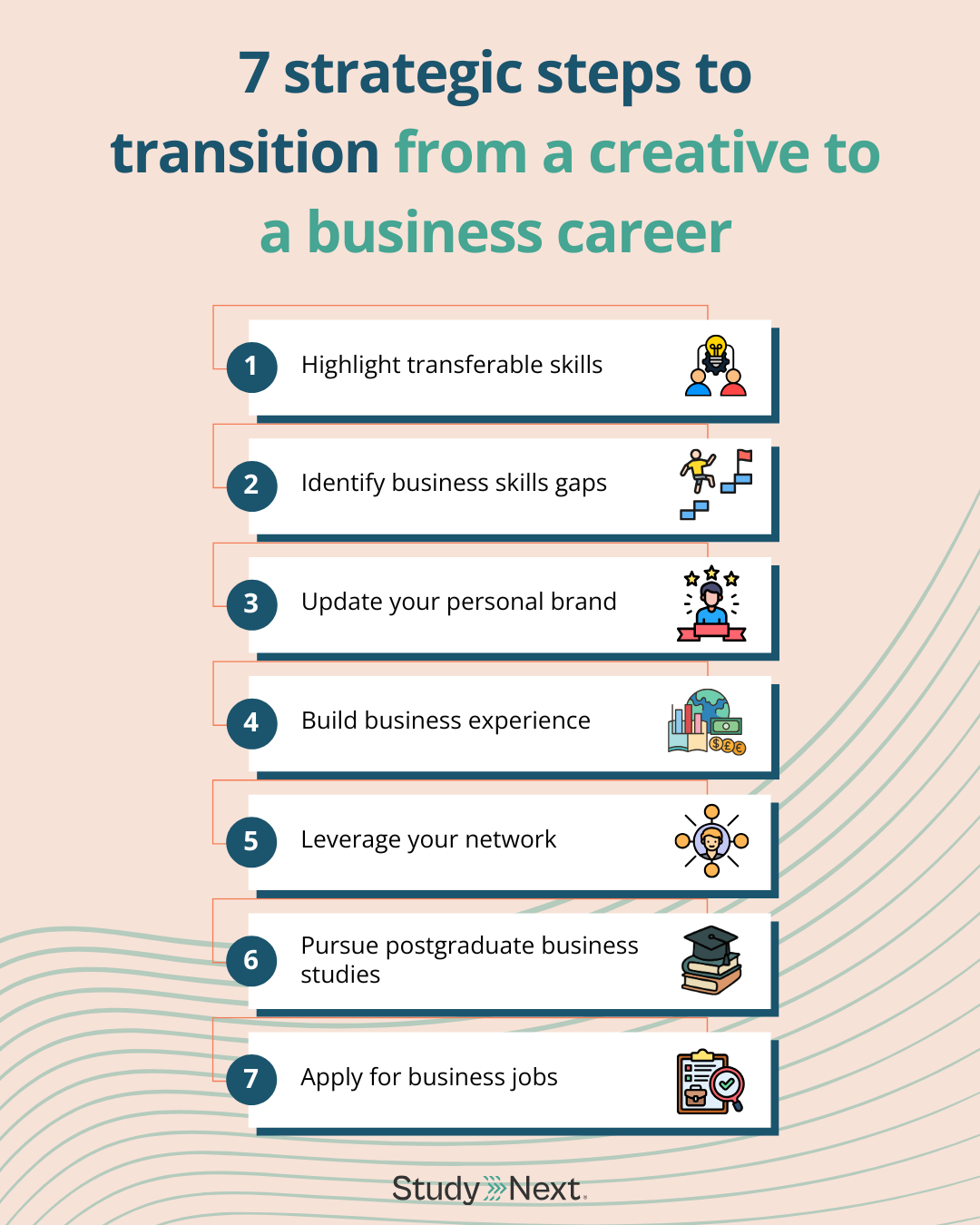
Highlight transferable skills
The first step is to recognise the business value of the work you already do. Examine your career experience and identify transferable capabilities that can be applied across business and creative industries. For example, if you have experience managing multiple client projects simultaneously, this can demonstrate your skills in project and stakeholder management. If your work focuses on visual design, you can connect it directly to brand strategy. Pitching creative concepts can highlight your presentation and persuasion skills.
Repackaging your creative expertise in a business context can help you better position yourself as a strong candidate for roles that value both creativity and commercial acumen.
Identify business skills gaps
After identifying your existing strengths, the next step is to find areas for growth. This often means recognising which business competencies you need to develop to ensure a smoother career move. For example, you may want to strengthen your understanding of business operations, improve financial literacy or build proficiency in using business analytics tools. Online learning platforms such as Coursera and LinkedIn Learning offer beginner-friendly courses that can help you close these skill gaps quickly, often at little or no cost.
If you prefer a more structured approach, you can explore short courses from reputable institutions, which provide targeted learning experiences across core business disciplines. These programs allow you to focus on specific areas most relevant to your career goals, giving you practical knowledge that can enhance your professional profile.
For instance, with CPA Australia’s Data Visualisation and Storytelling short course, you can transform your creative storytelling abilities into powerful data skills. Covering the principles of effective visualisation, this self-paced program guides you on how to select the right charts, design impactful dashboards and apply storytelling methods to communicate insights that support organisational objectives. By mastering the art of data storytelling, you’ll learn how to present information in ways that can drive meaningful outcomes.
Some creative professionals may work independently, so developing strong communication skills can significantly help enhance career growth. The University of New South Wales offers The Authentic Communicator: Activating Presence short course, which is designed to equip you with a comprehensive toolkit of communication techniques to drive strategic results. Delivered in person over two days, you’ll explore core topics like body language and vocal patterns, developing leadership presence, active listening and audience engagement. You can also develop the ability to tailor your messaging to suit your intended audience.
Short courses can also help you gain expertise for a more technical career pivot. For instance, UX/UI designers aiming to move into product management may consider taking on RMIT University’s Product Management Fundamentals as a starting point. Through this program, you can focus on building skills to deliver and optimise digital products. You’ll delve into different product types and the responsibilities of a product manager, examine each stage of the product lifecycle and learn about product delivery methodologies and their applications. You’ll also analyse metrics for measuring product success.


Learn to interpret and present data meaningfully and effectively to support organisational goals using best practice techniques.

Develop your communication techniques, allowing you to lead with presence and increase your impact in any scenario.


Deliver desirable, feasible, and commercially viable digital products. Learn how to consistently adopt a product-led focus to enable scalable solutions at every stage of the product life cycle.
Update your personal brand
Since your personal brand reflects how you present yourself professionally, it should be refreshed to clearly signal your shift towards building a career in business. Update your resume and LinkedIn profile by rewriting your professional summary, adding any new business qualifications or courses you’ve completed and reframing your achievements to show business impact rather than just creative output. You can also strengthen your LinkedIn presence by asking former clients or colleagues for recommendations that highlight the value you bring in business settings.
A well-crafted personal brand allows potential employers to see how you can combine innovation with commercial acumen to take on business challenges in new and creative ways.
Build business experience
Hiring managers in business often look for candidates with proven work experience. If most of your experience has been from working in creative industries, you may need to actively build this credibility. One approach is to freelance or volunteer for not-for-profits, startups or small businesses, offering your skills in exchange for broader business exposure and valuable professional connections.
You can also strengthen your business profile by pursuing side projects. Depending on your creative background, you may want to launch a small business, develop a product or manage a project that can give you hands-on experience in business areas like operations, budgeting and marketing. By intentionally seeking out these opportunities, you can bridge the gap between creative expertise and commercial experience, preparing you to pursue business roles with confidence.
Leverage your network
When changing careers, the people you’ve worked with can be a valuable resource. Your existing creative network, such as former clients, collaborators and colleagues who have transitioned into business roles, may be able to offer advice, provide references and share insider knowledge about the industries you’re targeting. Start by assessing your contacts and identifying those in business fields, then reach out for conversations about their career paths, the skills they value most and any career opportunities they may know of.
Besides leveraging your current network, you can build new connections in business circles by attending industry events, joining professional business associations and engaging with other professionals on LinkedIn. You may also want to consider finding a mentor who can provide you with guidance and help accelerate your career transition.
Pursue postgraduate business studies
Pursuing postgraduate business studies can be a powerful way to accelerate your progression from a creative background into business. These programs provide structured learning experiences, recognised credentials and access to alumni networks. Many courses also offer flexible options, such as online or part-time study, allowing you to maintain your current creative career while building new competencies.
If you would like to remain in the creative industry while gaining the skills to explore management roles and focus on the business side, Macquarie University’s Master of Creative Industries and Master of Management can be a strong option for you to consider. This double degree can help you deepen your expertise in creative media project design, contemporary production, distribution and audience engagement within the creative sector. At the same time, as an aspiring manager, you’ll explore modern business environments and learn how to apply your learning directly to existing corporate challenges.
A Master of Business Administration (MBA) is a popular option for those looking to advance their career in business. You can find many MBAs offering specialisations that align closely with career goals, such as Torrens University Australia’s online Master of Business Administration, Innovation and Leadership. In this MBA, you’ll work on real projects with tangible commercial impact while getting exposure to influential organisations in Australia. Collaborating with the university’s industry partners can provide valuable insights into contemporary business challenges and equip you with the practical skills to address them effectively.
Many creative professionals may choose to transition into marketing and advertising, as these fields provide opportunities to express their creativity. To gain a competitive edge in these sectors, you may consider advanced study through programs such as Griffith University’s Master of Marketing. This course covers the latest techniques and technologies in market research, integrated marketing communications and consumer behaviour. You can develop knowledge in advanced marketing principles and innovative ways to build customer relationships. This program also includes future-ready units, such as Digital Marketing and AI, equipping you with the skills that can help prepare you for a rapidly evolving industry.
Some creatives choose to pivot into business by launching their own entrepreneurial ventures. Having the right skills is essential for success, so consider exploring courses like the Master of Entrepreneurship at the University of Melbourne, which aims to equip you with the knowledge to develop new businesses, processes, products or services that generate value and improve revenue. Throughout this program, you’ll have numerous opportunities to engage with experienced entrepreneurs and apply your learning in practical settings. You’ll gain insights into the latest frameworks, tools and techniques, enabling you to determine and implement new business opportunities effectively.

Combine creative production with contemporary management capabilities to develop original projects, guide teams and turn ideas into professionally delivered outcomes across the creative industries.

Develop advanced leadership and innovation capability through this online MBA, combining applied business learning with industry projects to prepare you to lead organisations, identify new opportunities and respond to complex business challenges.


Develop a strong foundation of knowledge and skills in the latest techniques and technologies related to consumer behavior, market research and integrated marketing communications.

Facilitates your career as an agent of change, either within a new venture or an established organisation.
Apply for business jobs
Now that you’ve highlighted your strengths, addressed your skills gaps and tapped into your professional network, the last step is to begin applying for business roles. Make sure to tailor your application by aligning your relevant strengths and experiences according to each company’s requirements, showing how your unique combination of creative and business skills makes you an ideal candidate.
4 examples of creatives who moved into business successfully
Australia has many examples of creatives who have successfully transitioned into business leadership, including Thalia Economo, Taryn Williams, Josh Simons and Ben Bradshaw. Their inspiring career journeys demonstrate how it’s possible for creative professionals to advance their careers in the business world. Discover more about their stories below:
- Thalia Economo – Graphic designer to creative director
After earning a Bachelor of Arts in Design and Illustration at Curtin University, Thalia began her career in graphic design and worked with the Institute of Architecture, WA Chapter and Adcorp Australia. Around the age of 40, she was recruited by Myer to work as a graphic designer cum art director, which led to a decade of art direction across home, lifestyle, beauty and fashion campaigns for famous local brands like Country Road, Myer and Cotton On. She has also provided creative direction for major retailers such as Kmart, Sheet Society and Target. Her career path evolved organically from hands-on design work into a business leadership role, while still remaining within the creative industry. - Taryn Williams – Model to company founder
As a former model with nearly a decade of experience in the modelling, advertising and media industries, Taryn launched her own agency, WINK Models, in 2007 at just 21. Building on that success, she later founded Notable Co., which focuses on connecting APAC’s major thought leaders with innovative global businesses. Offering services like curated events, keynote and panel curation, B2B influencer campaigns and advisory board recruitment, the company reflects her ongoing vision of bridging creativity and business strategy, marking her successful career transition from a model to a business founder. - Josh Simons – Musician to CEO
Josh Simons was the lead singer of Australian indie rock band Buchanan. He was also the founder and managing director of a record label and collaborated with global artists like Troye Sivan, Coldplay and Keith Urban. He later founded Vampr, a leading social platform to help creatives connect and build their careers. In 2023, he became the CEO of Vinyl Group, overseeing multiple ventures like Vinyl Media, Vinyl.com, Serenade and Vampr. Having raised over $35 million for his startups, Josh exemplifies the evolution from artist to visionary entrepreneur, bridging music, media and technology. - Ben Bradshaw – Magician to CEO
Driven by his passion for magic and illusion, Ben initially faced challenges in building a full-time career as a magician until he discovered the power of Google Ads and search engine optimisation to market himself. This breakthrough propelled him to national recognition with TV appearances, tours and two Guinness World Records. Inspired by how digital marketing transformed his own success, he founded Disrupt Digital to help small businesses promote themselves. After scaling over two decades, the company is now one of Australia’s leading digital marketing firms with more than 200 employees. Ben’s journey illustrates a unique evolution from corporate magician to digital marketing CEO.
Do you need an MBA to transition into a business career?
Whether you need an MBA to transition into a business career ultimately depends on your professional trajectory. While an MBA can be a powerful credential that can accelerate your business career and expand your network, it may not be a prerequisite for every business role.
For example, if you’re a creative who’s exploring entry-level or mid-level creative business jobs, you may be able to make the transition by building relevant expertise through a shorter qualification such as a graduate certificate, graduate diploma or short course, which require less commitment than a full MBA. However, if your ambitions are geared towards senior leadership, pursuing an MBA may be significantly more beneficial for your career path.
To determine whether an MBA is necessary for you, research specific roles and industries you’re interested in pursuing a career in. A practical way to do this is by reviewing LinkedIn profiles of professionals in positions you’re interested in and checking their educational backgrounds. This can give you a better idea of whether a postgraduate qualification, such as an MBA, is typically expected for you to achieve your career goals.
Are you prepared to shift your career from creative to business?
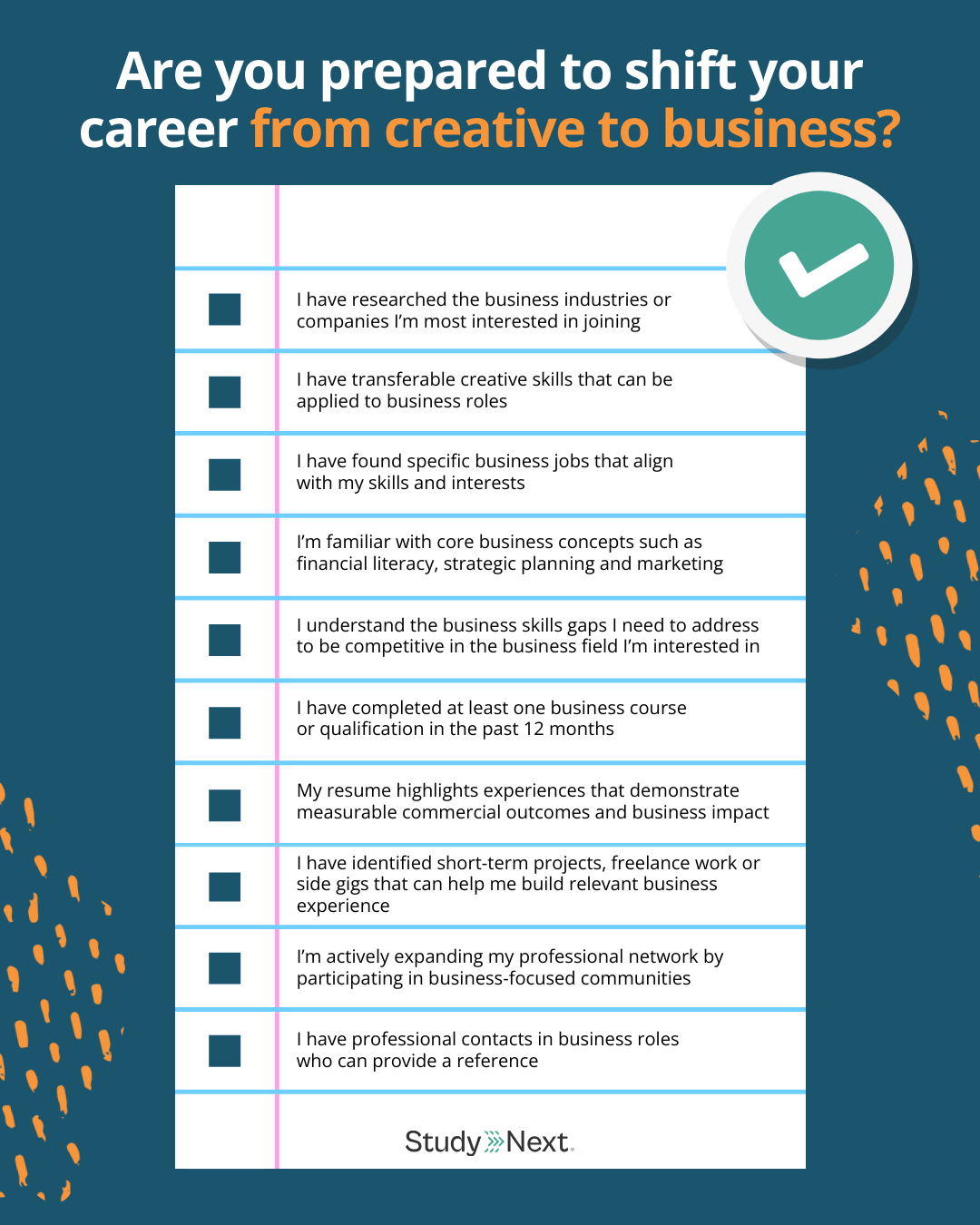
Not sure if you're ready to take the leap? Go through the checklist below to assess your current readiness. The more boxes you tick, the better positioned you may be to begin your career transition:
Results
Eight or more checks: You’re fully prepared for a career pivot. At this stage, you’ve built a strong foundation of skills, experiences and readiness to begin the next chapter of your professional journey.
Five to seven checks: You’ve already made significant progress and are well-positioned for change. To maximise your readiness, focus on the areas you haven’t yet addressed, whether that’s gaining additional experience, expanding your network or building specific competencies.
Four or fewer checks: Consider improving your skills further so you can make your career move with confidence. Take this result as an opportunity to invest in learning and training. By working on these areas for improvement now, you can set yourself up for a smoother career transition when the time is right.
Get creative with your future in business
As a creative professional, transitioning into business can open doors to exciting opportunities to expand your career prospects, as the field offers a wide range of roles and specialisations. Your creativity and innovative mindset can also help set you apart from others in the competitive job market.
To strengthen your business capabilities, you can consider enrolling in business courses to address your skills gaps. Explore diverse postgraduate business programs and short courses offered by leading universities in Australia today to get started.