In This Article
Whether you’re a few years into your career or over a decade in, the question of what counts as a “good salary” in Australia and whether you’re being paid a fair and competitive wage has likely crossed your mind more than once.
In this article, we unpack the latest salary data from the Australian Bureau of Statistics (ABS) to determine what’s considered a good salary in Australia. We also take a look at insights from the Hays Salary Guide so you can see how your pay stacks up against the national average in your industry.
Snapshot of salary figures in Australia
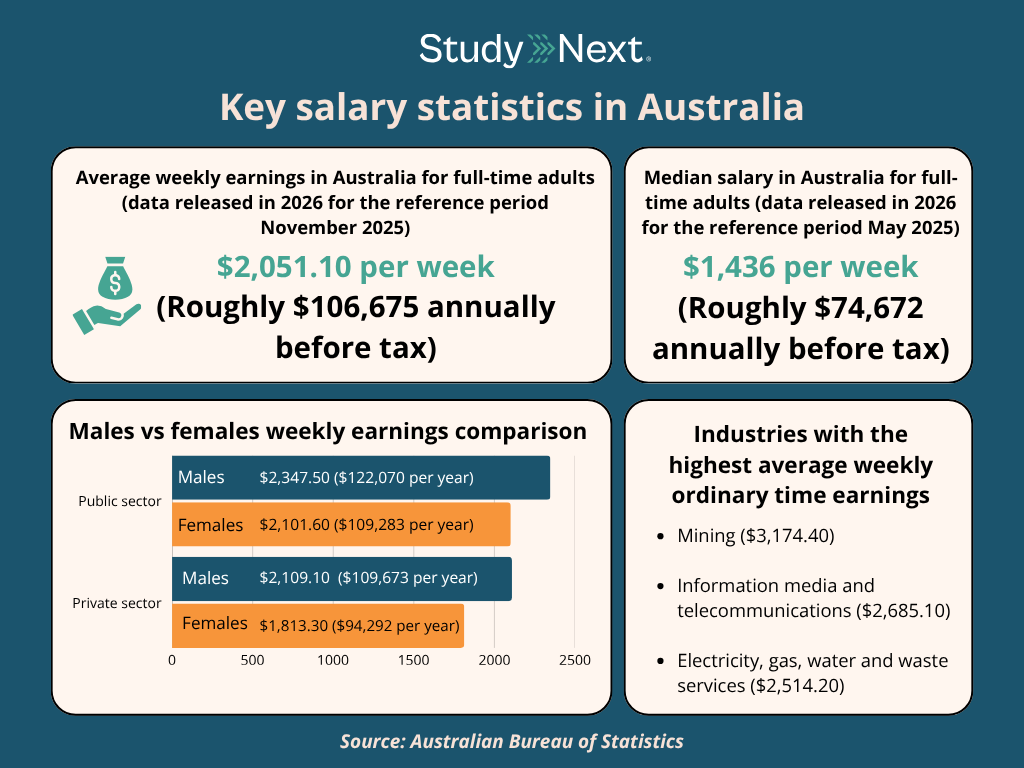
According to the recent average weekly earnings statistics released by the ABS, the average weekly ordinary time earnings for full-time adults is $2,051.10 (seasonally adjusted). This works out to $106,675 annually before tax. While average weekly earnings have increased by 3.8 per cent annually, it’s less than the 4.5 per cent growth recorded in the August 2025 report.
Statistics also indicated that females had lower average weekly earnings than males. While males were earning an average of $2,347.50 weekly ($122,070 annually) in the public sector and $2,109.10 weekly ($109,673 annually) in the private sector, females were earning $2,101.60 weekly ($109,283 annually) in the public sector and $1,813.30 weekly ($94,292 annually) in the private sector.
What’s the difference between average, median and gross salary?
Average salary
The average salary is calculated by dividing total earnings by the total number of people. While it’s a helpful figure to know, it’s not the most accurate for comparing your own salary against, as the figure can be skewed by high earners. For instance, if three people are each earning $70,000 per year and two people are each earning $400,000 per year, it skews the average to $202,000, even though the majority are earning $70,000.
Median salary
The median salary is often a more useful benchmark as it provides the middle earnings figure where half earn less than the median earnings value and half earn more. According to the ABS data released in January 2026, the median weekly earnings was $1,436 for all employees or $74,672 per year. Males had a higher median pay of $1,674 weekly ($87,048 annually) compared to $1,250 weekly ($65,000 annually) for females.
Gross salary
Gross salary refers to the total amount your employer pays you before income tax, super and any other deductions. The average salary figures provided by the ABS have been calculated with gross salary.
What is considered a good salary in Australia?
It is highly dependent on several factors such as what your day-to-day expenses look like and the current cost of living. Typically, however, a good salary in Australia is one that sits above the national median ($1,436 per week or $74,672 annually), covers your cost of living and gives you room to invest, save and enjoy life without financial stress.
This number is, however, subjective and can vary between individuals depending on their personal circumstances and financial goals. A survey conducted by Finder in 2025, for example, revealed that respondents believed a good salary starts at $152,775 per year, more than double the median salary. The number also differed across generations, with Gen Zs believing a good salary starts at $177,212, the highest amongst all of the generations.
Factors such as where you currently live and the number of dependents you have can also affect what a good salary looks like in Australia. For instance, a salary of $90,000 might be good for someone who’s single and renting in Brisbane. However, it could be insufficient for a couple with two children and a mortgage who are living in Sydney.
Overall, however, a good salary is less about hitting a specific number and more about ensuring your income aligns with the life you want to live, covers your expenses comfortably and gives you financial breathing room.
General salary guide
While a good salary is subjective, here’s a breakdown of what different salary ranges typically look like in Australia in 2026:
Under $60,000
A salary of under $60,000 sits below the national median for full-time workers. While it’s a liveable wage for a single individual living in a regional area, it may not be enough to cover expenses in major cities such as Melbourne and Sydney.
$60,000 to $90,000
This salary range sits around the median salary in Australia. It’s a comfortable wage for a single person in most cities, but it may feel tight in pricier cities like Sydney or Melbourne, or if you’ve got dependents that you’re supporting.
$90,000 to $120,000
Sits above the median salary and is generally considered a comfortable income in Australia. Typically enough to cover daily expenses while still saving some rainy day money, investing and maintaining a good quality of life in most parts of Australia.
$120,000 to $160,000
Considered a good to high income in Australia. According to ABS data, 90 per cent of employees earned less than $3,000 per week ($156,000 annually), putting this salary range around the 90th percentile.
$160,000 and above
High-earning territory that is typically associated with senior, specialist or executive-level roles. This would put you well within what Finder survey respondents consider a “comfortable living” salary, which averaged $164,577 per year.
What are the factors affecting salary in Australia?
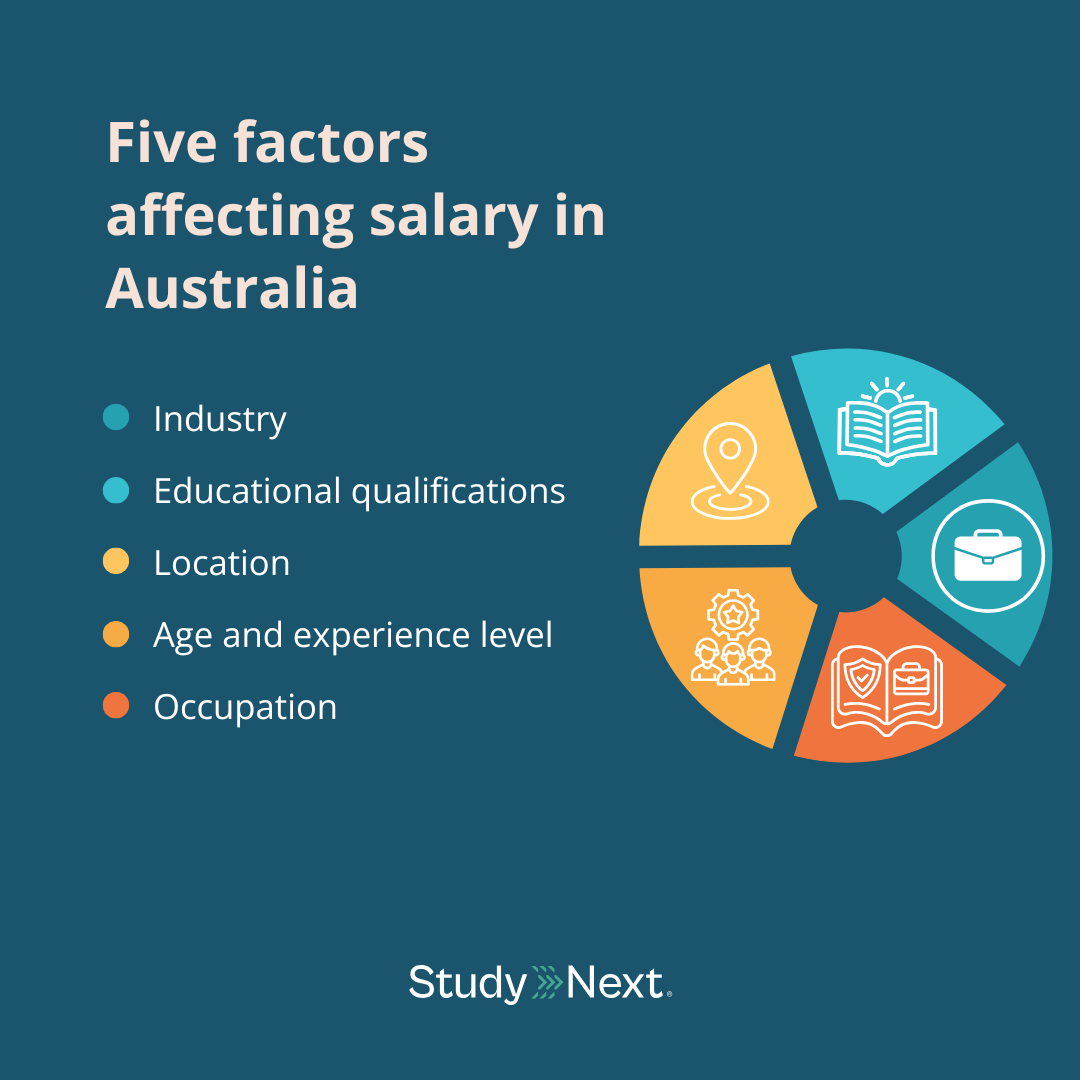
There are a multitude of factors that affect salary in Australia. These include:
Industry
Your salary can vary significantly depending on the industry you’re working in. Mining, for example, is a lucrative industry due to high demand for workers, higher risk levels, remote working locations and longer hours (typically 12-hour work days).
According to ABS data, the industries with the highest average weekly earnings are:
- Mining ($3,174.40 per week, $165,069 per year)
- Information, media and telecommunications ($2,685.10 per week, $139,625 per year)
- Electricity, gas, water and waste services ($2,514.20 per week, $130,738 per year)
The industries with the lowest weekly average earnings are:
- Accommodation and food services ($1,501.60 per week, $78,083 per year)
- Retail trade ($1,565.20 per week, $81,390 per year)
- Arts and recreation services ($1,826.90 per week, $95,999 per year)
Educational qualifications
According to ABS data, higher qualifications tend to correlate with higher median weekly earnings.
- Employees with a postgraduate degree earned the most at $2,000 per week ($104,000 per year)
- Employees with a graduate diploma earned $1,900 per week ($98,800 per year)
- Employees with a bachelor’s degree earned $1,700 per week ($88,400 per year)
- Employees without non-school qualifications earned the least at $1,000 per week ($52,000 per year)
Location
Location also has an effect on salary. The state and territory with the highest average weekly earnings are:
- Australian Capital Territory (ACT) at $2,248 per week ($116,917 per year)
- Western Australia at $2,193 per week ($114,046 per year)
The state and territory with the lowest average weekly earnings are:
- South Australia at $1,935 per week ($100,625 per year)
- Tasmania at $1,821 per week ($94,702 per year)
The ACT typically has a higher average salary due to a large proportion of the workforce being employed by the Australian Public Service (APS) and the ACT Public Service, which tend to offer higher salaries. Western Australia’s higher average is largely driven by its mining sector, which is one of the highest-paying industries in the country.
Age and experience level
According to the Hays Salary Guide, salary tends to grow with age. Data shows that those between 30 and 39 were earning an average of $140,000 a year, before rising steadily, with those between the ages of 50 and 59 earning an average of $159,000 a year.
Experience also plays a part, with seasoned workers typically earning more due to the depth of knowledge, skills and industry expertise they bring to the table.
Occupation
According to ABS data, the occupation groups with the highest median weekly earnings are:
- Managers at $2,072 per week ($107,744 per year)
- Professionals at $1,900 per week ($98,800 per year)
Occupation groups with the lowest median weekly earnings are:
- Sales workers at $742 per week ($38,584 per year)
- Labourers at $940 per week ($48,880 per year)
Examples of professions that fall under the managers category include finance managers, business administration managers and procurement managers. Occupations that fall under the professionals category include accountants and auditors, business promotion and communication professionals and mining engineers.
How does your pay stack up (by industry)?
Now that we’ve covered what’s considered a good salary in Australia and the factors that affect it, how does your pay stack up in your industry?
This isn’t meant to be a be-all, end-all, but it’s a useful way to see whether you’re earning roughly in line with what’s common for your role. Using data from the Hays Salary Guide FY25/26, here’s a salary snapshot of selected roles across key industries. Instead of providing state-by-state data, we’ve taken an average of the typical salary across Australia’s states and territories to give a national picture. All figures represent base salary packages (exclusive of superannuation).
Accountancy and finance
| Role | National average |
|---|---|
| Credit controller | $78,000 |
| Assistant accountant (Over four years of experience) | $85,000 |
| Management accountant (turnover of up to $100 million) | $105,000 |
| Financial analyst (turnover of up to $100 million) | $106,000 |
| Tax accountant | $107,000 |
Banking
| Role | National average |
|---|---|
| Personal banker (retail banking) | $68,000 |
| Financial planner | $106,000 |
| Portfolio analyst | $112,000 |
| Private banker | $125,000 |
| Financial planning manager | $142,000 |
Engineering
| Role | National average |
|---|---|
| Graduate/entry-level design engineer (building services – design) | $70,000 |
| Civil/structural drafter (civil and structural) | $87,000 |
| Structural engineer (civil and structural) | $108,000 |
| Project manager (building services – delivery) | $121,000 |
| Senior project manager (building services – delivery) | $157,000 |
Executive
| Role | National average |
|---|---|
| CFO (not-for-profit, turnover of up to $50m) | $220,000 |
| COO/EGM (not-for-profit, turnover of up to $50m) | $225,000 |
| COO/EGM (commercial, turnover of up to $50m) | $250,000 |
| CFO (commercial, turnover of up to $50m) | $270,000 |
| CEO/MD (not-for-profit, turnover of up to $50m) | $300,000 |
Human resources
| Role | National average |
|---|---|
| HR coordinator | $82,000 |
| Learning and development advisor | $106,000 |
| Training manager | $125,000 |
| HR manager (250 to 1,000 employees) | $158,000 |
| Change manager | $175,000 |
Marketing and digital
| Role | National average |
|---|---|
| Marketing coordinator | $72,000 |
| Marketing executive | $88,000 |
| Content writer | $96,000 |
| Senior marketing manager | $143,000 |
| Marketing director | $189,000 |
Office support
| Role | National average |
|---|---|
| Administration assistant (Over 12 months of experience) | $68,000 |
| Project coordinator | $84,000 |
| Personal assistant (assisting multiple executives) | $88,000 |
| Office manager | $90,000 |
| Executive assistant (working for one person) | $99,000 |
Policy and strategy
| Role | National average |
|---|---|
| Policy officer/advisor | $88,000 |
| Senior policy officer/advisor | $107,000 |
| Business analyst | $109,000 |
| Project manager | $125,000 |
| Strategic manager | $134,000 |
Resources and mining
| Role | National average |
|---|---|
| Graduate mining engineer | $101,000 |
| Mining engineer | $156,000 |
| Maintenance superintendent | $199,000 |
| Underground/quarry manager | $220,000 |
| Registered mine manager | $248,000 |
Sales
| Role | National average |
|---|---|
| Field sales representative (FMCG and consumer goods) | $81,000 |
| Key account manager | $103,000 |
| National sales manager | $141,000 |
| Director of sales | $194,000 |
| Sales director (IT and telecommunications) | $222,000 |
Technology
| Role | National average |
|---|---|
| Service desk (level one) | $61,000 |
| Data analyst | $105,000 |
| Cybersecurity analyst (SecOps) | $131,000 |
| Senior software engineer | $135,000 |
| Artificial intelligence engineer | $171,000 |
Don’t see your role on the list?
These are just some of the roles covered in the Hays Salary Guide FY25/26. You can view the full list and download your copy of the guide via Hays’ website. If you’re curious about how your pay compares with others in your company, check out the Australian Financial Review’s salary comparison tool.
How to increase your salary in Australia
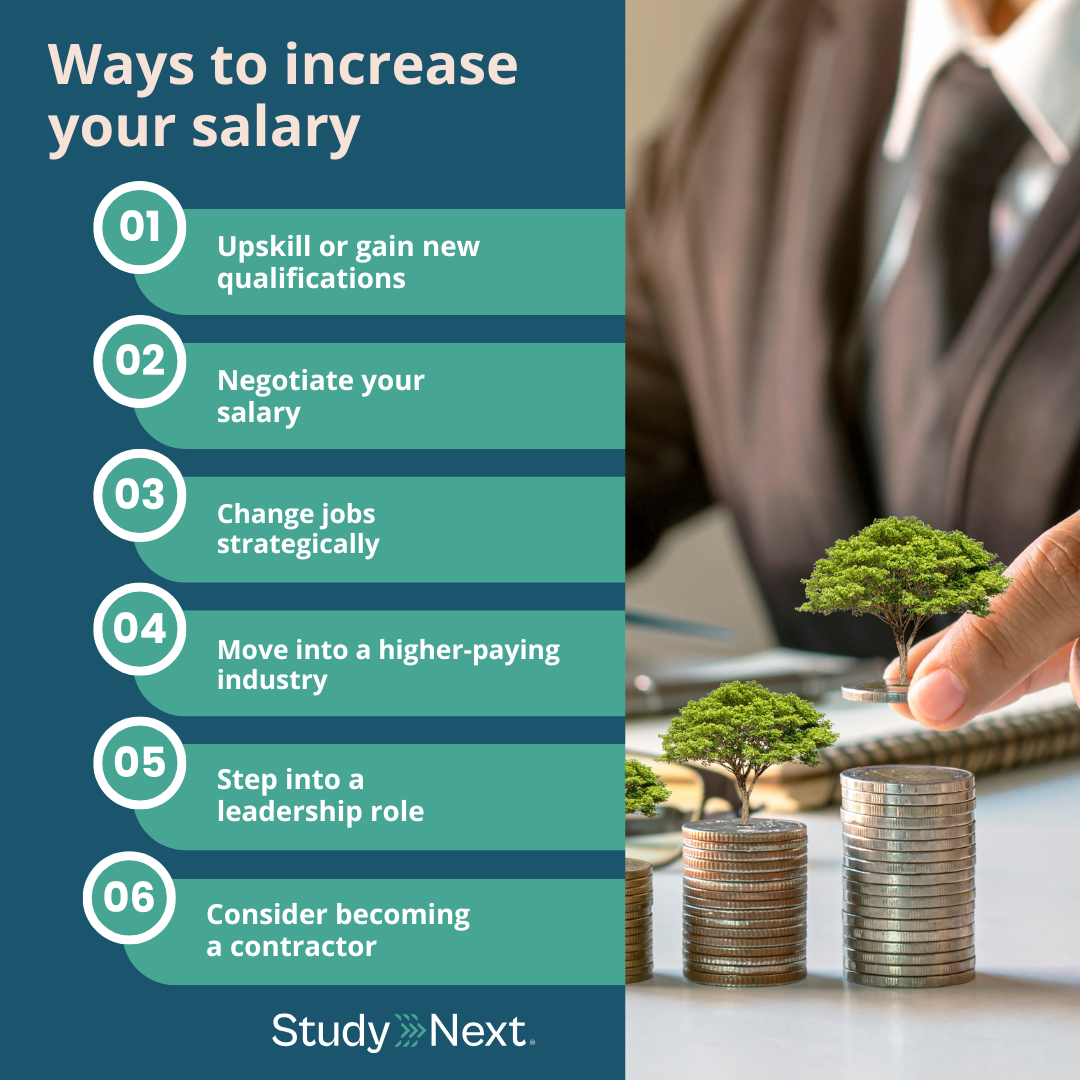
If you’re looking to increase your salary and elevate your career, here are some practical ways to get started:
Upskill or gain new qualifications
As highlighted earlier, individuals with higher educational qualifications typically have higher weekly median earnings. By keeping your skills current and acquiring new knowledge, you can increase your value to your current employer while also making yourself a more attractive candidate for future opportunities.
What skills should you be looking at gaining or upskilling? While it depends on the industry you’re in, the Hays 2025 Skills Report found that hiring managers across industries are seeing gaps in four key areas:
- 57 per cent cited hard or technical skills specific to job roles
- 50 per cent cited critical thinking and problem-solving
- 46 per cent cited leadership and management
- 41 per cent cited communication
When it comes to hard or technical skills, in most industries, skills related to artificial intelligence and data analytics continue to come up as some of the most in-demand capabilities. If you’d like to develop your competencies in these areas, some courses worth considering include:
Graduate Certificate in Artificial Intelligence at Victoria University
This six-month course provides a solid foundation in AI technologies and their real-world applications. You’ll learn about the latest developments in the field and undertake units such as Applied Natural Language Processing and Advanced Object-Oriented Programming.


Build foundational skills in artificial intelligence, including programming, data mining, natural language processing, neural networks and deep learning.
Graduate Certificate in Data Science at RMIT University
If you’re looking to build a solid foundation in data analysis, visualisation and programming, this eight-month, part-time course is a good starting point. Suitable for individuals with a non-technical background, you'll gain essential data skills through units such as Applied Analytics and Practical Data Science with Python.


Gain essential data skills for future leaders.
If you’re short on time, short courses and microcredentials are a great way to build targeted skills in a condensed format. Some courses to consider include:
AI for Business at Melbourne Business School
In this two-day face-to-face course, you’ll learn AI fundamentals, how to use generative AI effectively and explore strategies for building AI capability within your organisation. Taught by leading professionals in the space, by the end of the course, you’ll be equipped with the tools and technologies to implement AI within your company.

Build the knowledge and strategy to lead responsible Generative AI adoption.
AI Dexterity Sprint at the University of Sydney
This two-week online course equips you with practical skills for working effectively with generative AI. You’ll learn how these systems work, explore how to choose and customise the right tools for your needs and complete an AI workbench project where you’ll analyse AI applications within your own workflow and organisation.


Learn how to prompt, customise and manage Generative AI tools and how to lead their responsible adoption across your team.
Data Analytics for Business Professionals at Melbourne Business School
For those looking to master the art of data-driven decision making, this six-week online course is designed to help you acquire practical business analytical skills. You’ll learn how to improve operational performance and discover how predictive analytics can help identify new market opportunities and areas of demand.

Learn how to use data to drive innovation, improve performance and make a real impact in your organisation.
If you’re looking to improve your skills in areas such as communication, leadership and critical thinking, a Master of Business Administration (MBA) is one of the most effective ways to do so. While an MBA will broaden your business acumen, it’ll also build interpersonal skills through collaborative coursework, group projects and case-based learning that mirrors workplace scenarios. In addition, studying an MBA could also lead to a salary increase. MBA graduates have the potential to step into leadership roles such as operations manager (average salary of $125,000), finance manager (average salary of $140,000) and chief executive officer (average salary of $220,000). Some MBAs to consider include:
MBA at the University of Technology Sydney
This part-time online MBA offers a range of specialisations and electives that you can tailor according to your goals. Beyond building your management capabilities, you’ll work alongside a diverse cohort of professionals, honing your ability to communicate, collaborate and think critically across diverse business contexts.


Learn contemporary approaches to innovative and sustainable business practices, driven by social values as well as global responsibility.
MBA at the University of Canberra
Develop high-level business competencies while sharpening your interpersonal skills in this 18-month course. As part of this MBA, you’ll complete units such as Leadership in Contemporary Organisations and Managing Human Capital. The course also places an emphasis on applied learning, giving you the opportunity to develop skills in areas such as stakeholder engagement, negotiation and leadership.


Strengthen your capabilities across finance, marketing, leadership and strategy while developing the analytical and decision-making skills to navigate contemporary business environments.
Negotiate your salary
Asking for a pay rise is never an easy conversation to have, but if you’ve done your research on what others in your industry are earning and believe your contributions warrant one, it’s worth having that conversation with your leader. There’s no single best way to approach it, but if you’re nervous or unsure about timing, your annual performance review is typically the best place to start. Prior to the conversation, you’ll want to come prepared with evidence of your contributions and market data on what comparable roles are paying.
Change jobs strategically
If you’ve had conversations with your manager and can’t see further progression happening within your current organisation, it might be time to explore other options. According to the Hays Salary Guide FY25/26, of those who changed jobs in the past 12 months, 66 per cent moved to a different organisation, with salary cited as the primary driver. The data suggests this can pay off, with those changing roles receiving a 12.4 per cent average increase in salary.
Move into a higher-paying industry
Switching to a different industry can be a way to increase your salary. According to the Hays Salary Guide FY25/26, of those who changed jobs, 21 per cent changed professions completely, with a low salary cited as the main reason for the change. While changing professions is no easy feat, data suggests that it can lead to the largest salary increase, with one in four individuals receiving a salary increase of over 20 per cent.
Step into a leadership role
Moving into a leadership position is one of the most reliable ways to increase your salary. The Hays Salary Guide FY25/26 highlights that directors (75 per cent) and C-suite professionals (72 per cent) report the highest levels of salary satisfaction. Some practical ways to work towards a leadership role include taking on additional responsibilities or projects in your current role, having a conversation with your leader about your progression pathway or developing leadership capabilities through formal training. While an MBA is a popular route for building leadership skills, other courses focused on leadership development can also help. Some suggestions include:
Graduate Certificate of Leadership at Deakin University
This eight-month online course is ideal if you’re looking to gain a thorough understanding of leadership concepts and apply them directly within your workplace. The course can be completed in eight months part-time, and consists of units such as Crisis Leadership, Leadership Practice with Impact and Innovation and Leadership.

Strengthen your ability to lead change, communicate direction and deliver strategic outcomes while applying contemporary leadership thinking to challenges from your own workplace.
Learning the Practice of Leadership at the University of Queensland
This three-day face-to-face course is a great option if you’re looking to gain foundational leadership tools and want to build leadership skills in a practical setting. As part of the course, you'll work through a series of realistic leadership challenges and learn how to delegate tasks, coach colleagues and manage performance effectively.


Gain foundational leadership tools to confidently guide others and achieve positive outcomes.
Consider becoming an independent contractor
If you’re not tied to having a full-time role and have significant years of experience under your belt, you may want to consider becoming an independent contractor. The data from the Hays Salary Guide FY25/26 report shows that of those leaving their organisation, those looking to move into contracting cited more money (49 per cent) as the main driver.
Contracting roles in fields such as technology, IT and engineering often pay significantly higher than permanent base salaries, even after accounting for the lack of benefits such as paid leave. It’s definitely not for everyone, but if you’ve got specialised skills, it can be a fast way to increase your earnings.
Frequently asked questions (all things salary)
From the average salary increase in Australia to what’s considered a high salary in Australia, here are some of the most commonly asked questions about salaries in Australia.
What is considered a high salary in Australia?
If you’re earning more than $3,000 per week ($156,000 per year), that would be considered a high salary in Australia. According to ABS data released in December 2025, 90 per cent of employees earned less than $3,000 per week, so earning more than that would place you in the top 10 per cent of earners in Australia.
Which industry has the highest average earnings in Australia?
As per ABS data released in February 2026, the mining industry currently has the highest average earnings in Australia, with full-time adults making an average weekly ordinary time earnings of $3,174.40 a week, or $165,069 per year.
Does gross salary include superannuation?
No, gross salary does not include superannuation. Gross salary is the total amount that your employer pays you before income tax, super and any other deductions.
What is the average salary increase in Australia?
Based on ABS data released in February 2026, the average salary in Australia increased by 3.8 per cent.
What does pro rata salary mean?
Pro rata salary means your pay is adjusted based on the hours you’ve worked. For instance, say you work part-time at a firm where the full-time salary is $80,000 based on a 38-hour work week. If you only work 18 hours, your pro rata salary would be $37,895.
Does base salary include super?
No, in Australia the base salary does not include super. For instance, if your base salary is $120,000, your employer must pay an additional 12 per cent on top of that, which works out to $14,400 in superannuation contributions per year.
Is 100k a good salary in Australia?
$100,000 is considered a good salary in Australia. It sits just below the average for full-time workers and well above the median. For a single person in most Australian cities, it’s typically enough to lead a comfortable lifestyle. For families with a mortgage in a more expensive city like Sydney or Melbourne, however, it may feel tighter. While it’s a solid income overall, whether it’s “good” also depends on your personal circumstances and spending habits.
What is the gender pay gap in Australia?
According to the Hays Salary Guide, the average salary for men was $151,000 compared to $137,000 for women. The gap widens at higher salary bands, with 40 per cent of men earning $150,000 or more, compared to 25 per cent of women.
Upskill your way to a higher salary
The question of what makes a good salary in Australia doesn’t have a one-size-fits-all answer. It depends on factors such as where you live, the lifestyle you want to lead and your spending habits.
If you’re looking to increase your earning potential, upskilling with a postgraduate qualification or short course is one of the most effective ways to build high-income skills and take your salary to the next level. To get started, take a look at the extensive range of courses available on the StudyNext catalogue. Courses are available across a range of disciplines including business, human resources, marketing, data analytics and more.