

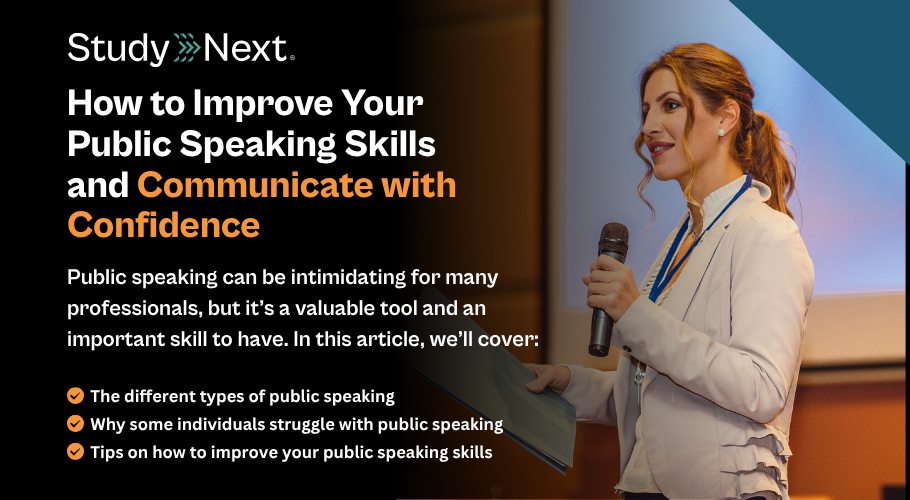
If the thought of standing up to speak at a conference in front of a group of professionals makes you feel queasy, this phenomenon is more common than you think. According to Macquarie University, studies show that one in three people have a significant fear of public speaking.
Even if public speaking fills you with dread, chances are you’ll need to do it at some point in your career. While it can be daunting, public speaking is a valuable tool and being able to command a room with confidence, persuasively convey your ideas and leave a lasting impact is an important skill to have.
Ready to move past the nerves and become a more confident, capable speaker at work? In this article, we’ll share why public speaking can be a struggle for many and share comprehensive, actionable tips to help you get better at it.
What is public speaking and what are the different types?
When you think of public speaking, your first thought probably involves getting up in front of a large audience (most likely a conference) and delivering a speech or presentation. While that’s part of it, public speaking encompasses far more than addressing a large crowd at a conference.
Public speaking is the practice of delivering information to an audience in a clear, structured and impactful way. This can be to an audience you already know, or a room full of strangers, and it can be to a small audience or a larger group. So while presenting to 200 attendees is an example of public speaking, so is presenting to a group of four, walking your team through how to use a new piece of software or pitching an idea to a group of executives.
What are the different types of public speaking?
Public speaking tends to fall into four categories. These include:
Informative speaking
Informative speaking involves educating your audience and sharing factual information. An example could be a work training session, where an employee teaches their colleagues how to use a new system or process. Another example might be a project manager presenting a status update to stakeholders.
Persuasive speaking
This type of public speaking involves convincing your audience of a particular point of view or taking a specific action. Examples include a sales executive delivering a pitch to a group of executives to win them over on a product or service or a manager presenting a proposal to leadership in the hopes of getting their project funded.
Entertaining speaking
The goal of entertaining speaking is to captivate and amuse your audience, so it tends to occur in settings such as award nights or celebrations. Examples include emceeing at a corporate gala or delivering a toast or tribute at a work event.
Inspirational speaking
As the name suggests, inspirational speaking aims to motivate, empower and inspire. Examples include delivering a keynote at a leadership conference or a town hall speech.
While these four types of public speaking each have their own purpose, they’re all built on the same foundational structure and principles, which we’ll elaborate on further down in the article.
Why do some individuals struggle with public speaking?
If public speaking makes you anxious, you’re not alone. Public speaking anxiety can range from feeling a little nervous to a strong fear of public speaking, also known as glossophobia.
A fear of public speaking typically stems from a range of factors, which include:
Physical stress response
If your heart starts pounding, your breathing turns shallow and your muscles tense up before a public speaking engagement, that’s your body’s fight or flight response. When you’re fearful or anxious about something, it activates the autonomic nervous system, which reads the situation as a potentially threatening stimulus. It then starts preparing your body for battle, flooding it with stress hormones such as adrenaline and cortisol.
For some people, this also presents as shaky hands during public speaking, a dry mouth or losing their train of thought mid-sentence. That feeling alone can be enough to put someone off pursuing public speaking opportunities altogether.
Negative thoughts
For some people, a fear of public speaking stems from a deeper fear of embarrassment and negative judgement. You might worry that you’ll be evaluated, criticised or that you’ll make a mistake and embarrass yourself in front of others.
Some of the negative thoughts you might harbour include, “I’m not a good speaker”, “Nobody’s going to listen to me” or “What if I mess up and embarrass myself?” Left unchecked, these thoughts can debilitate you and hold you back from public speaking altogether.
High-pressure situations
There might be specific situations or settings that increase your public speaking anxiety. For instance, you might be perfectly fine speaking to a small audience, but a larger audience makes you feel nervous.
Other examples might include speaking in front of an audience that’s actively evaluating you as part of an assessment or speaking to people who hold more seniority than you at work, such as executive leadership or a board of directors.
Lack of practice
If you haven’t had many opportunities to practise public speaking, you’ll naturally find it unfamiliar and intimidating. Just like other skills such as driving or playing an instrument, the more you shy away from it, the fewer chances you give yourself to improve. The more you practise, the better and more comfortable you’ll get.
Tips on how to conquer your nerves and improve your public speaking skills
There are many benefits associated with public speaking including helping to build your confidence, improve your oral communication skills and boost your credibility.
Leadership and public speaking are also inextricably linked, with many prominent leaders such as Steve Jobs and Barack Obama being known for their exceptional oratory skills. If you’re a leader in your organisation or looking to pursue a leadership role, sharpening your public speaking skills can assist in areas such as communicating your vision and influencing key decisions.
Improving your public speaking skills, however, may be challenging, especially if you have public speaking anxiety. In saying this, there are small manageable steps you can take to make it feel far less daunting. Here are some tips we’ve put together to help you improve your public speaking skills:
Laying the foundations
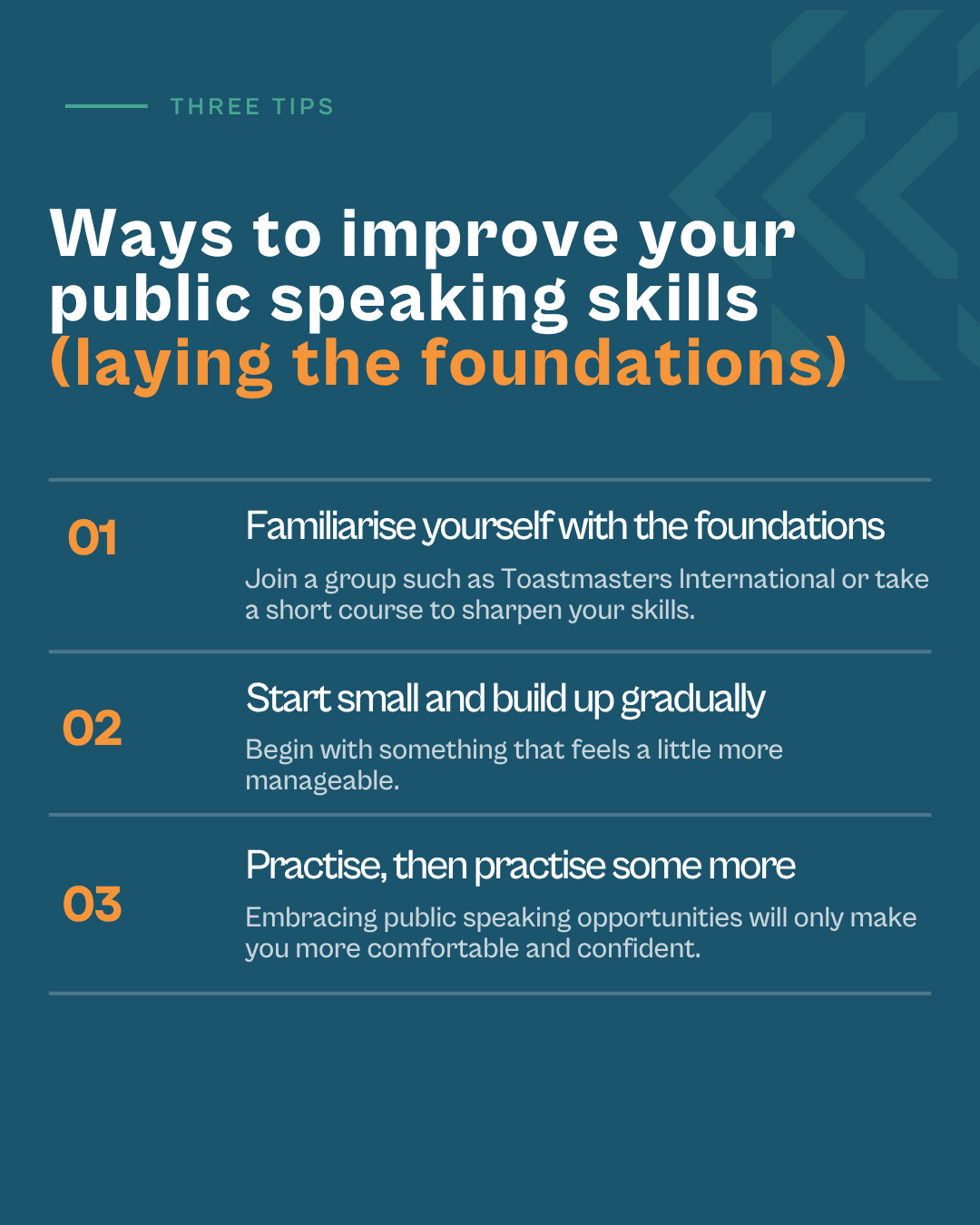
When it comes to improving your public speaking skills, a lot of work happens behind the scenes before you step in front of an audience.
Familiarise yourself with the foundations
If you’re relatively new to public speaking, or you’re unsure of what being a competent public speaker entails, some great ways to get started include:
- Joining a group such as Toastmasters International, which lets you practise public speaking and receive constructive guidance in a safe space
- Taking a short course such as The Authentic Communicator: Activating Presence at the University of New South Wales. The course is designed to help you become a more confident and compelling communicator and covers areas such as vocal delivery, managing nerves and communicating with clarity and confidence


Develop your communication techniques, allowing you to lead with presence and increase your impact in any scenario.
- Tuning into business podcasts, which are a great way to pick up tips and tricks for improving your communication skills. The Think Fast, Talk Smart: Communication Techniques podcast hosted by Stanford lecturer Matt Abrahams, for example, covers a wide range of public speaking techniques including non-verbal habits, framing, timing and more
Start small and build up gradually
One of the most effective ways to work through public speaking anxiety is to ease into it rather than throwing yourself straight into the deep end. Begin with something that feels a little more manageable, such as presenting to colleagues that you feel comfortable with before tackling a larger public speaking engagement.
Stepping out of your comfort zone is never easy, but doing it slowly and steadily makes it far more manageable. Each small win also helps build your confidence for the next step and over time your brain learns that public speaking isn’t so bad after all.
Practise, then practise some more
They say practice makes perfect and since public speaking is a skill, practising will only make you more comfortable and confident. Practising can involve:
- Speaking out loud in front of a mirror
- Watching a recording of yourself speaking to see whether there’s anything you can improve, such as your posture and delivery
- Rehearsing in front of colleagues you feel comfortable with
Another way to practise is in a low-stakes environment such as a postgraduate course, where you’re surrounded by peers who are also learning. The Master of Business Administration at Melbourne Business School, for instance, gives you plenty of these opportunities. Alongside building your business competencies in areas such as leadership, marketing and finance, you will also build your public speaking skills by delivering presentations, sharing your ideas in front of your cohort or pitching an idea to your team.


Complete a comprehensive MBA online, one subject at a time, designed for experienced professionals.
During your delivery
Now that you’ve done the groundwork, it’s time to put what you’ve learned into practice. Here are some tips to help you with your delivery.
Know your content
Being familiar with your content helps reduce public speaking anxiety, since the more prepared you are, the more in control you feel. A confident, knowledgeable speaker is also more engaging to listen to, as it shows you’re across the topic you’re sharing.
Knowing your content well also means you’ll be more focused on your audience rather than constantly looking down at your notes or reading word for word from a script or your slides.
Keep your language simple and clear
Avoid using jargon or overly complex phrasing in your presentation, as it tends to lose people. Instead, tailor your language to your audience. For example, saying, “we need to cut costs” lands more clearly than “we need to implement cost-optimisation efficiencies.” You’ll also want to use shorter sentences as they’re easier to follow, especially when you’re communicating more complex ideas.
Slow down and use pauses
When nerves kick in, the natural instinct is to speed up and rush to the finish line. The trouble with rushing is that it makes you harder to follow and there’s also a tendency to start rambling. Instead, slow down as you speak and incorporate deliberate pauses to give your audience time to absorb what you’re saying. Pausing also helps you gather your thoughts and gives you a moment to regroup.
Use visual aids to your advantage
Visual aids can help take some of the pressure off you being the sole focus in the room. If you plan on using them, use them sparingly and make sure they support your message rather than compete with it. For example, if you’re sharing a specific statistic, a single clear chart can reinforce it nicely. Avoid slides crammed with information or text as these can overwhelm your audience.
Work on your voice, body language and presence
While how you deliver your message makes a difference, so do non-verbal cues such as body language and posture. You’ll want to:
- Project your voice and speak loudly enough to be heard
- Stand with an open posture and your shoulders back, avoid slouching
- Use purposeful hand gestures and avoid nervous or distracting ones such as fidgeting or moving them erratically. The “ball gesture” which involves holding an imaginary ball between your hands, is a technique commonly used in public speaking to project confidence and emphasise key points
- Make eye contact with your audience
Engage with the audience
This takes some practice and might not feel comfortable in the beginning, but engaging with your audience is a great way to create those small moments of connection. Some ways to do this include:
- Starting with a hook, such as a personal story or statistic
- Using interactive participation, such as asking the audience to reflect on a question or using non-verbal polling, where you gather feedback or input from your audience without them having to say anything
- Move around the space, as it helps hold attention and allows you to connect with different parts of the room
- Incorporating a touch of humour into your message
Adjust for virtual speakings
Public speaking isn’t always done in person and in this digital age, chances are you’ll find yourself presenting through digital platforms at some point, whether it’s a video call or a webinar. If you’re speaking virtually, here are some tips:
- Look directly into your camera rather than at the faces on your screen, as that’s what creates the feeling of eye contact for your audience
- Position your camera at eye level so you’re not looking down or up and frame yourself from the chest up so your gestures are still visible
- Check your lighting and background beforehand, facing a window or light source so you’re well lit, with a tidy, non-distracting backdrop behind you
- Test your audio and internet connection in advance, since muffled sound or a dropping connection can quickly lose your audience
Use your breath to steady yourself
Shallow breathing is a common stress response during public speaking and it creates a vicious cycle where the less air you take in, the worse you feel and the less effectively you speak. Taking slow, deep, controlled breaths before your delivery helps calm your body's stress response.
Box breathing is a great technique for re-centering yourself and improving concentration. It involves breathing in for four counts, holding for four, exhaling for four and holding again for four, before repeating the cycle.
Quiet the noise inside your head
Thoughts such as “What if I mess up” or “What if the audience thinks I’m bad” will only fuel your anxiety. When they surface, try to reframe them. For example, instead of telling yourself, “Everyone will see how nervous I am”, reframe it to, “I’ve practised and done the work, now it’s time for me to deliver”. Shifting the inner dialogue will help calm your nerves and help you focus on what’s ahead.
Reflection and refinement
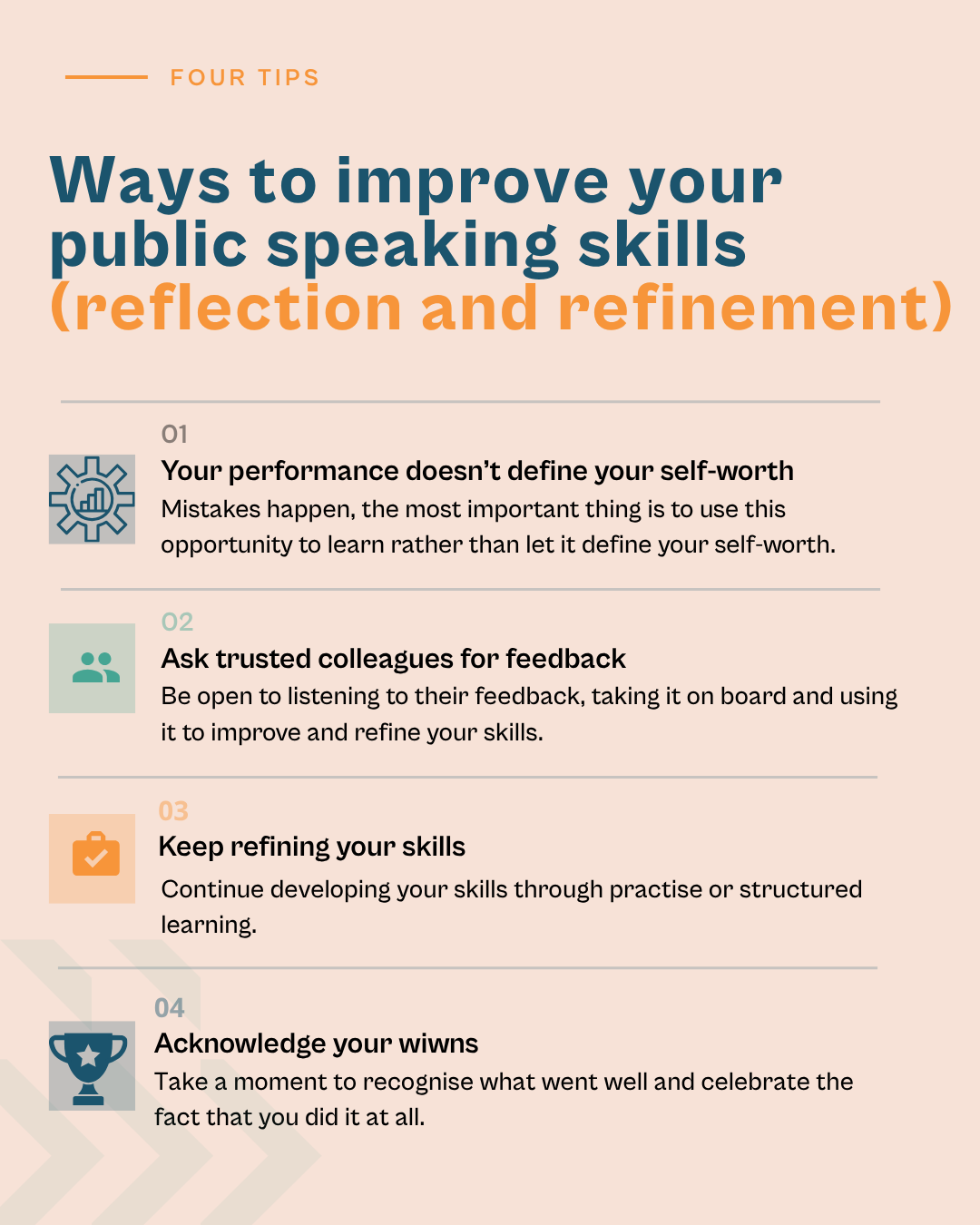
You did it. Your public speaking engagement is over and that in itself is something to acknowledge. It’s also an opportunity to reflect on what you’ve learned and find ways to keep building on that success.
Acknowledge your wins
It’s easy to walk away from your public speaking experiences replaying every small mistake or stumble you’ve made. Instead of doing so, however, take a moment to recognise what went well and celebrate the fact that you did it at all, because that’s no easy feat. Acknowledging your wins, even if the experience felt difficult, builds a positive association with public speaking and makes the next time feel less daunting.
Remember that your performance doesn’t define your self-worth
Even if you stumbled, forgot a line or missed something you’d planned to say, that’s perfectly okay. It’s normal to make mistakes, and embracing imperfection and learning from them is more important than letting it define your self-worth.
Most people aren’t going to remember the small mistakes you’re replaying in your head as we’re often our own harshest critics. Use this as an opportunity to learn, don’t let one misstep discourage you or prevent you from trying again.
Ask trusted colleagues for feedback (and be open to it)
One of the best ways to improve is to ask for feedback from people you trust. After your presentation, ask your colleagues if there were one or two points in particular you could have improved on. Be open to listening to that feedback, taking it on board and using it to improve.
Keep refining your skills
Every speaking experience teaches you something. The goal is not to be perfect, but to carry each lesson into the next opportunity. You may also find it helpful to continue developing your communication skills through structured learning, especially in an environment designed to support professional growth.
Some courses to consider include:
The New Leader Development Program at Melbourne Business School
A course designed for professionals who are new to a leadership role or preparing to move into one. The course focuses on building leadership confidence, self-awareness, communication, influence and presence, all of which can help strengthen your public speaking capabilities.

Build the confidence and practical skills to influence others, lead teams and navigate your first leadership role.
The Graduate Diploma of Business at Southern Cross University
This course helps develop the business competencies needed to succeed in a professional environment. The course covers areas such as business statistics, organisational behaviour and accounting and includes a Management Communication unit where you can build skills, techniques and practices used in areas such as professional communication and oral presentations.


Empowers professionals to deepen their business acumen and drive organisational success through flexible, real-world learning tailored to their career goals.
Sharpen your public speaking skills
Public speaking, though intimidating, offers value to professionals across every field. To become a confident speaker, you’ll need to step out of your comfort zone, practise and continuously refine your skills. Any small step you take can help you on your journey to becoming a better public speaker.
If you’re ready to build your public speaking skills in a supportive learning environment, take the next step in your career by completing a short course, microcredential or postgraduate course. Choose from a selection of topics ranging from business analytics to data analytics, finance and marketing.
Need help choosing a course? Our Education Consultant, Catriona, can help point you in the right direction. She can compare study options with you, help you understand entry requirements and choose the right course. Get started by booking a 15-minute course discovery call, or a free professional development strategy call to map out your career plan.