
In Australia, freelancers now make up more than a third of the workforce and it’s not hard to see why. The lure of flexibility, autonomy and the freedom to choose your own clients draws many people to freelancing.
If you’re thinking of becoming a freelancer in Australia, or considering it and want to know more, this article gives you a detailed step-by-step guide on how to get started, along with helpful tips and some courses you can consider pursuing to help set you apart from the competition.
What is a freelancer in Australia?
A freelancer is a self-employed independent worker who provides their services to clients on a per-job, per-task or project-by-project basis. Rather than earning a salary from an employer, you run your own one-person business. As a freelancer, you’ll typically be:
- Setting your own rates and negotiating them with each client
- Marketing yourself, sourcing your own clients and handling your own invoicing
- Taking care of your own taxes and managing your own super contributions
- Working for a variety of clients simultaneously, often across different industries
- Deciding your own work schedule, including when, where and how much you work
The easiest way to think of it is that you’re self-employed and responsible for every aspect of your work, from how much you charge, to which clients you take on and how much you work.
You can freelance full time as your main source of income, or alongside a permanent job as a side hustle to bring in some extra money. Plenty of people start out doing the latter and make the leap to full-time freelancing once they’ve built up a steady client base.
The most lucrative freelancing industries
While industries such as marketing, graphic design and virtual administrative support are commonly associated with freelancing, the most lucrative industries are those that combine specialised skills with strong client demand.
According to Upwork, the highest-paying freelance industries in 2026 include:
- Technology and AI, covering roles such as machine learning engineer, cybersecurity developer, AI or prompt engineer and blockchain developer
- Finance and business, including financial consultants and business consultants
- Marketing, spanning user experience designers, media buyers and planners, copywriters, public relations managers, SEO specialists, digital marketing consultants, web designers and social media managers
Considerations of freelancing
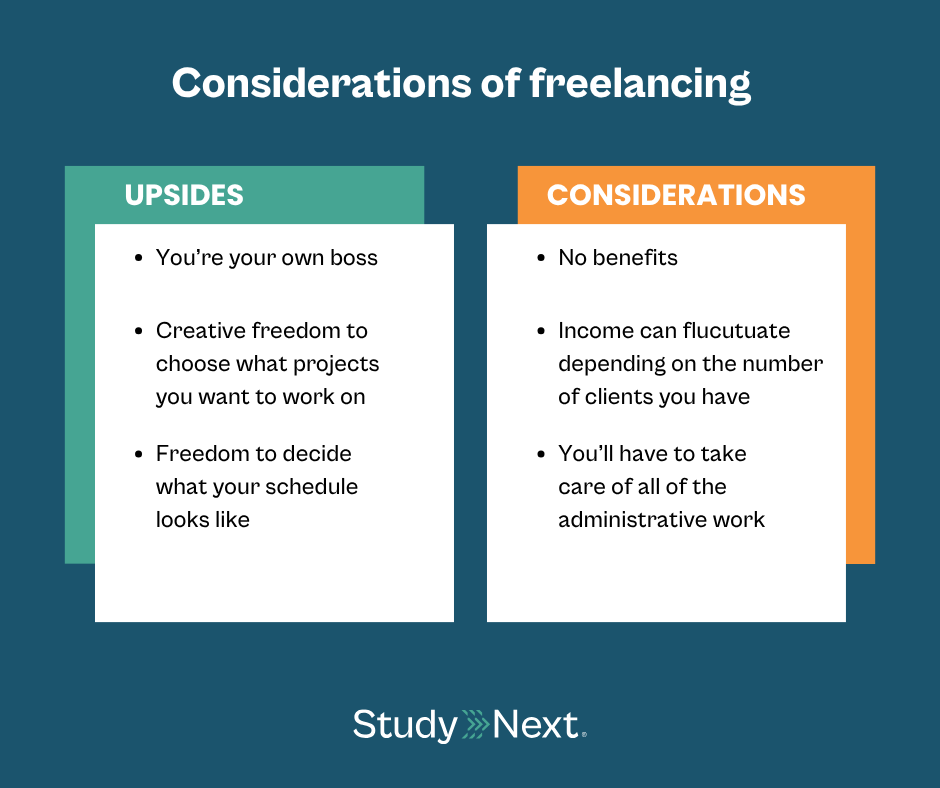
If you’re thinking of becoming a freelancer, it pays to understand what the lifestyle entails rather than seeing it through rose-tinted glasses. Here are some considerations:
The upsides
- You’re your own boss, so you get to decide how much you charge, have control over your workload and can choose where you want to work from
- You’ve got access to a diverse array of projects, with clients across just about every industry, and the creative freedom to decide which clients you’d like to work for. As a content writer, for example, you could choose to write for industries ranging from healthcare to travel, sports, business and more
- Being a freelancer means you get to decide what your schedule looks like. Want to work four days a week? No problem. Need to take the morning off to look after the kids? That’s no issue either
- There’s a common misconception that freelancers earn less than those employed by companies. While it depends on the industry you’re in and the rates you’ve set, Upwork reports that many high earners say their freelance income is often double what they made in full-time roles
The considerations
- Likely the biggest consideration of becoming a freelancer is that you don’t get any benefits such as paid leave and you’re responsible for your own taxes and superannuation. A way around this, however, is to freelance as a side hustle if your full-time job permits
- Since you're self-employed, you’ll have to take care of all of the administrative work, including finding clients, invoicing and chasing up clients for late payments
- Working for yourself (and mostly alone) means there might be moments where you feel isolated or disconnected
- As a freelancer, your income is very much dependent on the clients that you have. As the number of clients fluctuates, so does your income, which means a degree of forecasting and budgeting is required on your part
How to become a freelancer in Australia (step-by-step)
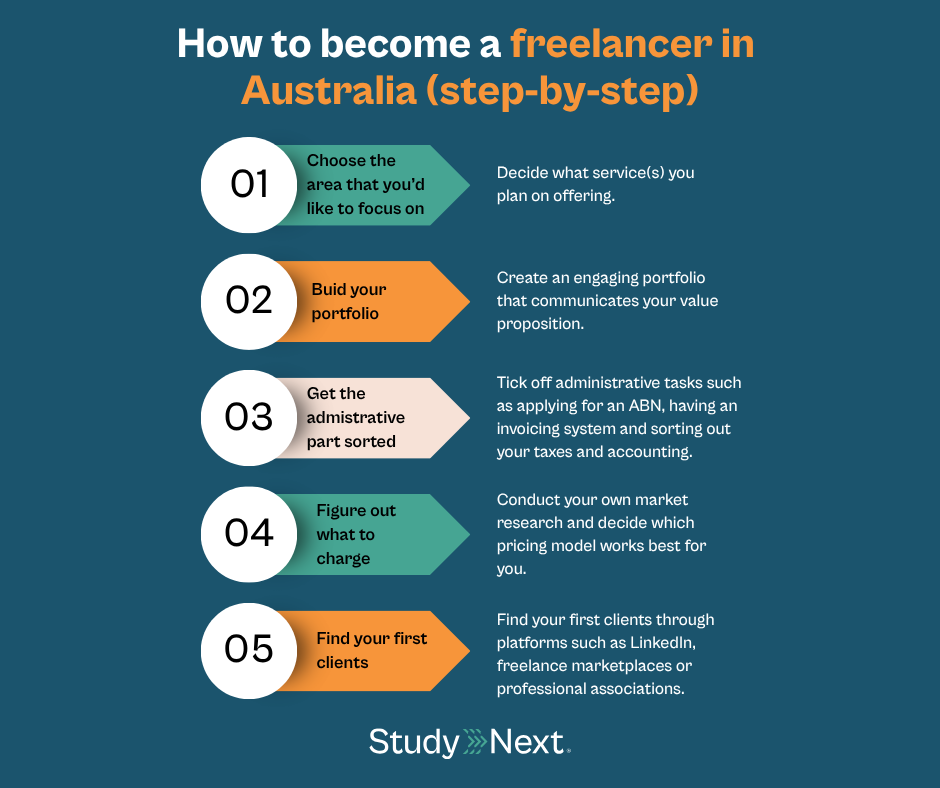
If you’ve decided that you’d like to become a freelancer, here are some steps to help you get started:
Step one: choose the area you’d like to focus on
The first step to becoming a freelancer is deciding what services you’d like to offer. While it might be tempting to offer a range of services, it’s best to stick with one particular area that you’re good at, as clients tend to favour specialised skills over generic services.
Here are some questions to ask yourself when you’re figuring out what to offer:
- Do you have formal training or experience in a particular field?
For instance, if you’ve got a qualification in marketing and have worked in the field for a while, it makes sense to offer services in that area. If you don’t have any formal training or experience, roles such as virtual assistant or transcriber are typically a great entry point into freelancing.
- Does the service you plan on offering have demand?
The sweet spot is offering a service where your skills and market demand intersect. As mentioned earlier, industries that tend to be in high demand include technology, finance, business and marketing, so if the service you’re offering leans in any of those directions, you’re starting from a good position.
- Can you narrow down the service you’re offering even further?
Narrowing your focus helps you establish authority in the field, and it often lets you charge more. For instance, you might decide you want to offer content writing services that focus on a specific area such as healthcare or education.
- Will you enjoy the work?
Freelancing means doing a lot of this work solo, so it pays to choose something you enjoy and won’t tire of quickly.
Step two: build your portfolio
Your portfolio is essentially a cover letter and resume wrapped up in one. It’s one of the first things clients look at when deciding whether to hire you and it’s a great way to showcase what you have to offer. Some websites you can easily build your portfolio on, since they don’t require much technical know-how, include WordPress, Squarespace and Wix.
Here are some tips to help you build an engaging portfolio:
- Know your target market
It’s important to know who your portfolio is speaking to, because that shapes everything from the copy on your website to the work you display. If you’re a social media marketer who helps small businesses, for example, the copy on your portfolio should feel personable, approachable and results-oriented and you should be showcasing high-performing social media posts you’ve curated for other small businesses.
- Communicate your value proposition
Your portfolio should showcase your unique value proposition. Rather than simply saying, “I’m a content writer”, you could say something like, “I write engaging, credible and well-researched health and medical content that supports and educates consumers.” A strong value proposition tells clients not just what you do, but why they should choose you.
- Design matters
A clean, well-organised site signals professionalism. Make sure your portfolio is easy to navigate and isn’t overly cluttered. If you offer work across different areas, say photography and writing, separate them into clear categories so visitors can quickly find what’s relevant to them.
- Showcase your best work
As tempting as it might be, you don’t have to show everything you’ve done. Instead, be selective and lead with the work you’re proudest of and most relevant to prospective clients.
- Add testimonials
Where possible, include testimonials from past clients as they’re an effective way to establish credibility and trust with prospective clients.
- Have a clear call to action
Make sure the contact form on your website is easy to find so clients can easily reach out and enquire about your services.
- Add a personal touch
Your portfolio is also a chance to let your personality shine. Write a short profile about yourself, share a few of your interests and ensure that your portfolio reflects who you are. Clients look at numerous portfolios, so infusing your personal brand into yours can help you stand out from the competition.
Step three: get the administrative part sorted
To become a freelancer in Australia, there are a few administrative tasks you’ll need to tick off:
- Apply for an Australian Business Number (ABN)
You’ll need to start by applying for an ABN via the Australian Business Register website. It’s free, and to start, most individuals apply as a sole trader. Your ABN is how the government and your clients identify your business, and you’ll need it for invoicing, claiming deductions and registering for GST.
- Keep an eye on the GST threshold
If your business reaches a GST turnover of $75,000, you’re required to register for GST and you must do so within 21 days. Once you’ve registered, you’ll need to include GST in the prices you charge for your services.
- Have an invoicing system in place
There are plenty of free online invoice generators that can help you create invoices quickly and professionally. Make sure your ABN is listed on every invoice, and if you’re above the GST threshold, remember to include GST in your pricing.
- Get your taxes and insurance sorted
As a freelancer, you’re in charge of your own taxes. You can consider setting aside money for tax in a separate bank account, so when tax time rolls around it’s all ready to go. Depending on the service you provide, you may also want to look into professional indemnity insurance, which can cover you against claims of negligence or mistakes in the work you deliver.
- Decide how you’ll handle your accounting
It’s important to have a clear accounting system in place, whether that’s using software to help you or working from a template. An accountant can also manage your accounting for you and help you work out which expenses are tax deductible when tax season comes around.
- Manage your own superannuation
Since you don’t have an employer paying super on your behalf, it’s up to you to make voluntary contributions if you want to keep building your retirement savings. Setting aside a little regularly can make a big difference down the track.
Disclaimer: The information above is general advice only. For the most comprehensive and up-to-date information, we recommend doing your own research.
Step four: figure out what to charge
Pricing is a question that most freelancers agonise over and it can be tricky to determine what your rates should be, especially when you’re first starting out. A great way to gauge your starting price is to look at what other freelancers charge on marketplaces such as Upwork or Fiverr, refer to the rates listed by professional associations such as the Australian Society of Authors or use a freelance rate calculator to get started.
While it differs depending on the service you offer, the experience you have and the niche you work in, you typically have a few pricing models to choose from:
- Hourly (you charge a set rate for each hour you work)
- Project (you agree on a total price for the whole project upfront and get paid on completion)
- Fixed pricing (you have a set price for a specific deliverable)
- Retainer (you work with a client for a set period, say three months, to deliver an agreed body of work, usually for a recurring fee)
- Per word (most common in copywriting or content writing, where you charge a set rate for each word)
Here are some tips for working out what to charge:
- Start by figuring out how much you’d like to earn per year. From there, you can work backwards to roughly how much you need per month
- You might set a lower rate when you’re starting out to secure work, but make sure you review it regularly and increase it as your experience grows
- Factor things like superannuation and tax into your rate, since those are costs you’ll need to cover yourself
- Avoid setting your rate too low, even when you’re tempted to in the early days to win clients. You’ll end up underselling yourself and it may not be enough to sustain you month to month
Step five: find your first clients
Now that you’ve got the administrative side sorted and your portfolio published and ready to go, it’s time to find your first clients. Here are some tips to help you get started:
- Build your contact list through social media
LinkedIn is typically a great place to start, as it’s the world’s largest professional networking platform. Engage with prospective clients, talent acquisition teams and thought leaders, write insightful posts and make sure you’ve got a link to your portfolio on your profile. Depending on the service you offer, it’s also worth exploring other platforms such as TikTok and Instagram.
- Join professional associations and communities
Joining a professional association and freelance community is a great way to network, find useful resources and seek advice from others in your field. Some to consider include the Media, Entertainment and Arts Alliance (MEAA), Freelance Jungle and the Australian Society of Authors.
- Network in person
Attending meet-ups and events in your field is another great way to make connections. If you offer marketing services, for example, you could attend marketing summits and conferences or join industry groups. You could also consider joining a co-working space, where you might meet like-minded people who could become clients or refer you on to others.
- Join freelance marketplaces
Freelance platforms like Upwork, Fiverr and Freelancer can be a useful way to land work, especially in the early stages. Just know, however, that they can be competitive. Upwork, for instance, has a bidding process, so you’ll be up against numerous other freelancers. To gain a competitive advantage, make sure your offering is differentiated and your portfolio is personalised, engaging and targeted.
- Ask for referrals
Once you’ve done some work and built up a few happy clients, don’t be shy about asking if they can recommend your services. Referrals tend to convert far better than cold outreach, since individuals are more likely to trust a personal recommendation.
A few additional helpful tips for freelancers
Other than the above, here are some additional tips to help you as you begin your foray into the freelancing world:
Protect yourself with a contract
If you’re not using a platform like Upwork or Fiverr, which typically comes with a contract in place for both you and the client, you’ll want to consider drawing one up before you start work. A contract gives both parties clarity, defines your scope of work and sets out payment terms, helping to ensure you’re paid on time.
Personalise every application
When you’re applying for work, especially on freelance marketplaces, resist the urge to send out generic, copy-and-paste pitches. Clients sift through numerous applications, so a tailored pitch that speaks to that specific client and project will always stand out over a generic, AI-generated application.
Be okay with rejection
As a freelancer, you’re constantly pitching for new clients, especially in the beginning, and rejection comes with the territory. As difficult as it may be, know that it’s part of the process and for every no, there are clients who’ll say yes and pay for your services.
Keep learning
You’re selling expertise, so that expertise has to stay current. Whatever your niche, make a habit of keeping up to date with the latest information, whether that’s new tools, trends or best practices. You can do this by reading industry newsletters, research journals or taking a short course, microcredential or postgraduate qualification.
Know your worth and negotiate
Part of being a freelancer is being able to advocate for yourself. As your client base and reputation grow, so should your rates. Be comfortable negotiating with clients and make it a habit to review your rates each year to ensure your work is valued according to market expectations.
Build your own safety net
Since you don’t have sick leave or annual leave to fall back on, it’s important to build a financial buffer into your income for the days you need to take a break. Some months may also be quieter than others, so having a cushion to fall back on means a slow stretch won’t catch you out.
Create your own structure
As a freelancer, you work independently, so it’s up to you to ensure you’re not overworking or feeling isolated. Ways to mitigate this include setting your own working hours, taking regular breaks, finding ways to stay connected and having downtime. Remember that it’s okay to turn down work when you’re at capacity, as your wellbeing matters and saying no helps you avoid burnout.
Courses that will give you an edge in freelancing
As a freelancer, clients are paying for the expertise you deliver, so it’s essential to continuously sharpen your skills and knowledge in the area you’re providing services in. Courses are a great way to give your skills the boost they need to help you excel.
If you’re new to freelancing and want to break into a particular space, whether that’s marketing or business, courses can give you the skills you need to get started. Having a credential not only boosts your credibility, it gives you the skills required to hit the ground running.
Short courses, microcredentials and postgraduate courses can build your skills across a range of areas and give you an edge in freelancing. Here are some courses to help you get started:
Sharpen your negotiation skills
Negotiating rates and advocating for yourself is an integral part of achieving positive outcomes in freelancing. If you’re keen to sharpen your negotiation skills, the Strategic Negotiation and Influence course at the University of New South Wales is ideal for learning how to negotiate with confidence. During this face to face three-day course, you’ll learn negotiation strategies, discover how to influence complex negotiations in dynamic environments and develop your own unique set of negotiation tools and techniques.


Equip yourself with advanced negotiation and influence skills that are essential for achieving success in leadership.
Get ahead with AI skills
AI is here to stay, so equipping yourself with the practical skills required for working effectively with generative AI is a wise move. The AI Dexterity Sprint at the University of Sydney is a two-week short course that teaches you aspects such as how to build effective prompts and map AI to your working day.
You could also consider the Graduate Certificate in Artificial Intelligence at Victoria University. The course can be completed in six months, face-to-face full time and gives you a solid foundation in programming, data mining, data analytics, deep learning, natural language processing and more.


Learn how to prompt, customise and manage Generative AI tools and how to lead their responsible adoption across your team.


Build foundational skills in artificial intelligence, including programming, data mining, natural language processing, neural networks and deep learning.
Build marketing competencies
Level up your marketing skills with this six-week Content and Social Media Marketing course at RMIT University. The course covers everything you need to know, from content ideation to SEO, social media engagement tactics and more. As part of the course, you’ll also complete and present a final marketing plan.
If you’re looking to gain knowledge in crafting a digital marketing strategy, the Digital Marketing Strategy course at RMIT University is a six-week course that covers all things digital marketing, from digital channels to understanding conversion rate optimisation and how to measure the success of your strategy.


Amplify your brand awareness and engage your audience through effective content, social media strategies and campaigns.

Understand the key drivers and metrics of the ACCR (awareness, consideration, conversion and retention) and the key strategies to improve awareness, engagement and the performance of your marketing efforts.
Strengthen your business competencies
If you’re looking to build your business capabilities, business analytics is currently one of the most sought-after skills in the business world. The Business Analytics and Visualisation course at RMIT University can be completed in six weeks and will teach you how to master essential business analytics tools and drive data-informed decisions.
If you’re after a more comprehensive overview in business acumen, the Graduate Certificate in Business at the University of Canberra is an eight-month online course that covers everything from marketing to financial management, managerial economics and data-driven decision making.

Learn the foundations of business analytics by familiarising yourself with Excel and tell compelling stories through data visualisation with Tableau.


Build core business capabilities in decision-making, finance, marketing, workforce management and strategy while developing the analytical skills to respond to complex organisational challenges.
Set yourself apart in a competitive freelance market
A tricky part of being a freelancer is standing out among a sea of other freelancers and winning the work. Some ways to do this include having a portfolio that communicates your value proposition and honing in on a focused niche. Earning a credential through a course is another effective way to stand out, as it signals to clients your willingness to continuously learn and grow. To get started, the StudyNext catalogue offers over 1,600 courses across areas such as data analytics, digital marketing, marketing, artificial intelligence and more.
Not sure which course is right for you? Our Education Consultant, Catriona, can help you weigh up your options and find the right fit for your goals. Get started by booking a complimentary professional development strategy call with her.