
In This Article
- What are microcredentials?
- Are microcredentials worth it?
- Reasons why obtaining a microcredential is worth your time
- Short courses vs microcredentials: what’s the difference?
- How to choose the right microcredential
- Are microcredentials recognised by employers?
- Get started with these microcredentials
- Build industry-relevant skills with a microcredential

With so much changing and evolving in today’s professional landscape, upskilling to stay abreast of what’s happening within the industry is no longer a nice-to-have, but increasingly becoming an expectation. With work and personal commitments, however, many professionals don’t have the luxury of stepping away to study full time or even part time.
According to a recent survey released by the Australian Bureau of Statistics, 44 per cent of respondents stated having too much work or not enough time as the main barrier to work-related training. Microcredentials could be the solution, offering a practical and flexible way to upskill without the time commitment of a postgraduate qualification.
In this article, we’ll delve into everything you need to know about them, including what they are, how they compare to short courses, whether they’re worth it and how to find the right one for you.
What are microcredentials?
Microcredentials are mini certification courses that allow you to acquire specific skills, capabilities or knowledge in a short period of time. Some typical features of a microcredential include:
- Having a completion time of a few hours to a few weeks
- Having an assessment component where you’ll need to achieve a minimum overall score
- Receiving a digital badge or certificate upon completion of your microcredential that you can share via platforms such as LinkedIn
- The ability to stack your microcredentials together to use as combined credit to apply for a course. While this varies by institution, at the University of Melbourne, for example, four microcredentials can be stacked together to achieve a total of 12.5 credit points
Microcredentials are becoming increasingly sought-after due to their practicality, lower financial cost and shorter completion timeframe. In recent years, an increasing number of institutions have also rolled out microcredentials thanks to the microcredentials pilot in higher education. This pilot ran from 2023 – 2024 and 2025 – 2026 and supported the delivery of courses for up to 4,000 students.
Are microcredentials worth it?
Yes, microcredentials are worth it, but it also depends on your goals and where you’re at in your career. To put things into perspective, consider these two scenarios:
Scenario A - When it is worth it
You’re currently a leader in your organisation and have noticed that artificial intelligence has started to make waves across the industry you’re working in. You’re not too familiar with the concept and would like to upskill quickly to get up to speed with this technology and learn how it can be applied to your organisation.
In this instance, completing a microcredential like the AI Fluency Sprint at the University of Sydney makes sense. You’ll be able to complete it part time and online in under 2.5 weeks and the course will equip you with a comprehensive understanding of AI, including its capabilities and challenges. You’ll also get to put your new knowledge to the test by completing a final fluency project related to your own organisation.


Accelerate AI understanding for informed business decisions and strategies.
In this case, you've identified a specific skills gap and you know exactly how filling it will benefit your career. This is just one example, but some other scenarios where a microcredential could be worth it include:
- If you’ve already got solid foundational experience in a particular skill, but want to get better at it
- If you’re looking to add job-relevant skills to boost your resume so you’ll be a more viable candidate for a particular role or promotion
- If you’re looking to refresh your knowledge after some time away from the industry
- If you’re short on time and want to upskill quickly
- If you’re looking to gain specific, industry-relevant skills to help you pivot careers
So when are microcredentials not the best fit? Consider this example:
Scenario B - When other options may be more suitable
You’ve worked in your current role for a few years and your goal is to move up the ranks and into a leadership position. Rather than having a particular skill you’re looking to improve, you’re looking to enhance your overall skill set to become a more well-rounded and marketable business professional.
In this case, a Master of Business Administration, at a university such as the University of Technology Sydney might be a better fit. The course is designed to strengthen your business acumen, refine your leadership skills and meet your professional goals. You’ll complete subjects in areas such as economics, marketing, finance and leadership and personalise your MBA with majors and electives from a variety of disciplines.


Learn contemporary approaches to innovative and sustainable business practices, driven by social values as well as global responsibility.
As you’re looking for broader fluency in business rather than improving a specific skill, a course like an MBA would provide the knowledge and skills you’re looking for over a microcredential. Other instances where a microcredential might not be suitable include:
- If you’re seeking the academic depth that comes with a postgraduate degree
- If you’re applying for a role that requires an accredited degree
- If you’ve got a lack of hands-on work experience
- If you’re looking to have it substitute a formal qualification
Reasons why obtaining a microcredential is worth your time
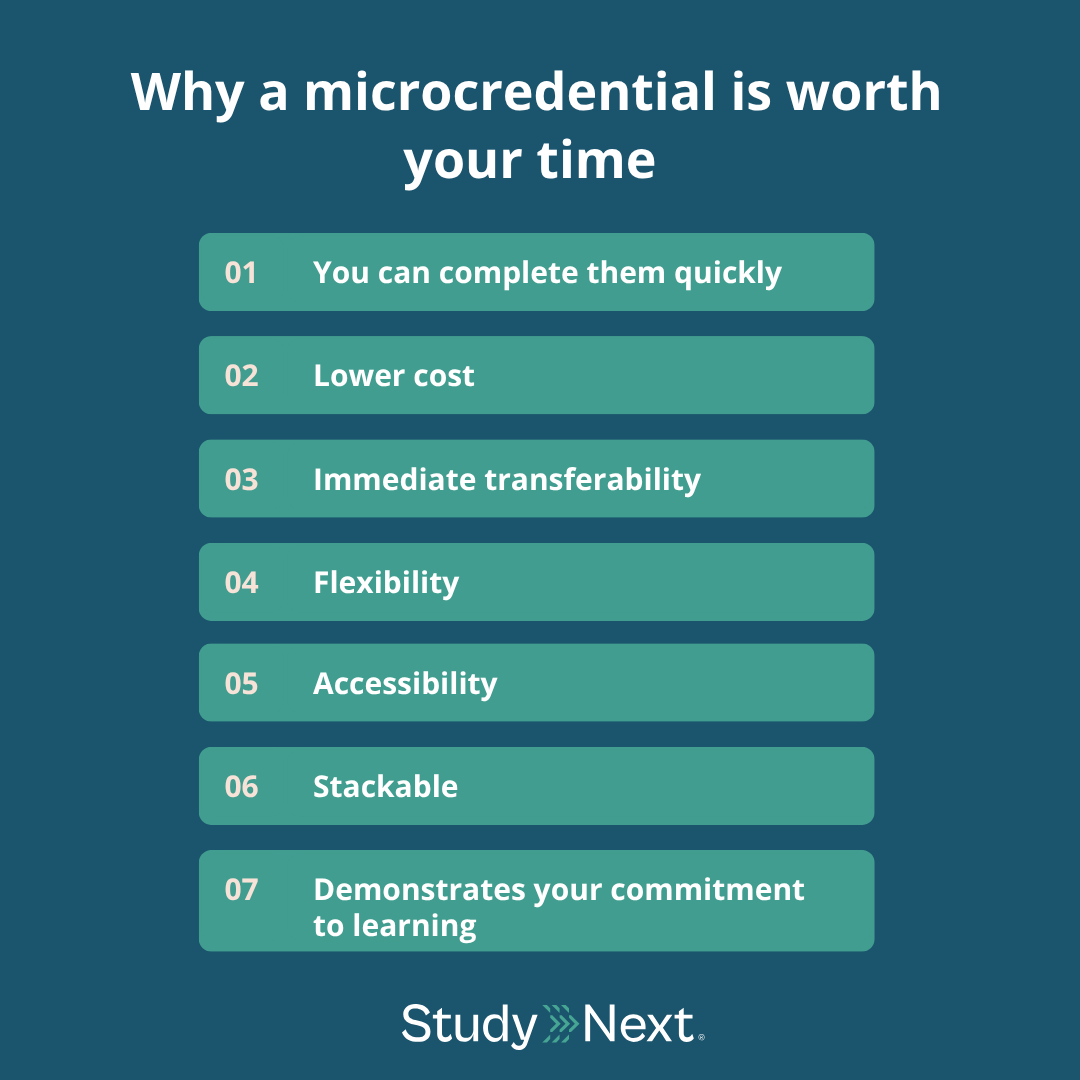
Looking to upskill, but are still on the fence as to whether or not a microcredential is worth your time? Here are some reasons why they’re becoming an increasingly popular choice:
You can complete it quickly
Microcredentials can be completed in days or weeks rather than months or years. As an example, the Business Fundamentals: Managing People course at Queensland University of Technology can be completed in just 10 hours part-time. If you’re short on time, microcredentials are a great way to upskill and equip yourself with the skills you’re looking for without a lengthy time commitment.


Expand your knowledge and understanding of what managing people is all about.
Lower cost
Compared to a postgraduate degree, microcredentials are significantly more affordable. RMIT University’s six-week Artificial Intelligence in Marketing course, for instance, costs $1,900, while a Graduate Certificate in Marketing at RMIT University that can be completed in six months costs $17,760.
While both courses serve different purposes, the lower cost of microcredentials makes them a more accessible pathway. There’s also a higher possibility that your employer would be willing to sponsor the course in full, compared to a pricier postgraduate course where you’d likely have to fork out some, if not all, of the cost yourself.


Elevate your marketing skills with real-world AI martech and ethical strategies to keep pace with the rapidly evolving landscape.

Explore the motivations behind consumer choices, craft compelling communications, navigate the intricacies of marketing management and harness the power of research to inspire meaningful connections and drive success for your business.
Immediate transferability into your current role
One of the main draws of microcredentials is that you’re able to apply what you’ve learned pretty much straight away. Courses are industry-informed and led by experts in the field and the assessment component means you’ll also have the opportunity to put what you’ve learned into practice.
The Quantum Opportunities Sprint at the University of Sydney, for instance, delves into the fundamentals, applications and strategic implications of quantum technologies. You’ll also complete an applied project where you’ll create a quantum readiness roadmap for your organisation. By the time you’re finished with the 1.5-week course, you’ll have the knowledge required to prepare your organisation for quantum disruption.

Gain a solid understanding of the basics, applications and strategic implications of quantum technologies.
Flexibility
For the most part, microcredentials are created with working professionals in mind, so they typically offer flexible delivery modes to cater to a busy schedule. The three-week AI Unlocked course at the University of New South Wales, for instance, is conducted completely online and consists of 14 hours of self-paced learning and live workshops.


Build confidence and capability to use AI effectively in your everyday work.
Accessibility
The barriers to entry for microcredentials are considerably lower than those of postgraduate courses. Unlike postgraduate courses, where you’ll typically need a bachelor’s degree or a certain amount of work experience to enrol, microcredentials typically don’t have any formal prerequisites. There’s usually just an expectation that you have some background or experience in the relevant field, but other than that, the enrolment process is usually quick and easy.
Stackable
As mentioned earlier, certain institutions allow you to stack microcredentials to use as combined credit towards a postgraduate course. This can be beneficial if you’re thinking about doing a postgraduate course down the line, but it’s not something you’re considering right now.
Demonstrates your commitment to learning
When you complete a microcredential, you’re showing current and potential employers that you’ve actively chosen to improve your skills and capabilities. Not everyone takes that initiative, so it signals that you're someone who’s invested in bettering themselves and staying ahead.
In addition, the digital badge or certificate you receive upon completion can also be added to your LinkedIn profile. It’s a great way to highlight your achievement and stand out to recruiters who are looking at your professional profile.
Short courses vs microcredentials: what’s the difference?
Many institutions use the terms “short courses” and “microcredentials” interchangeably, as there are some similarities between them, but they’re not quite the same thing.
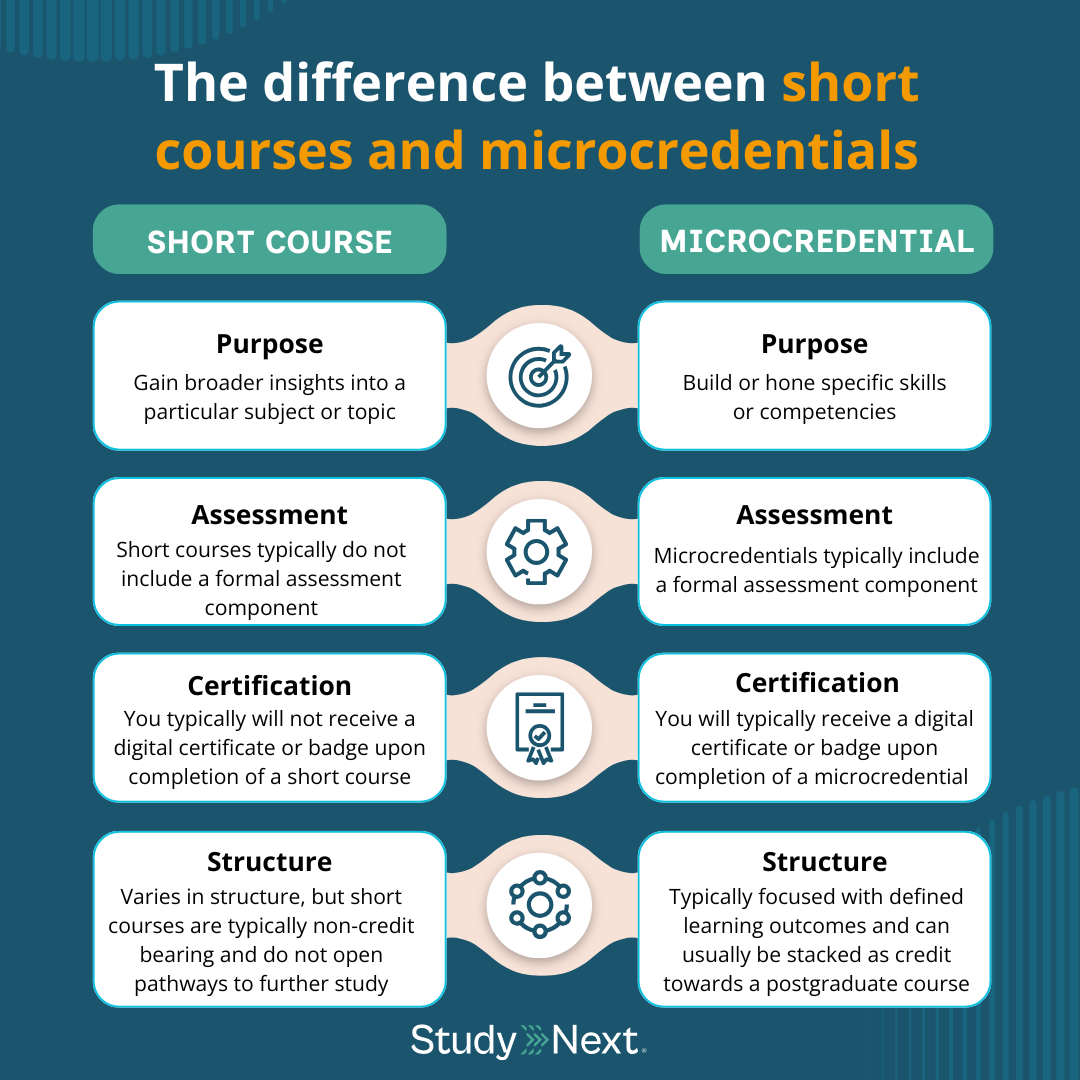
Compared to microcredentials, short courses typically cover a wider breadth of topics and are broader in nature. They also typically don’t include an assessment, and upon completion, you won’t receive a digital badge or certificate to signify your achievement.
The table below outlines the key differences between microcredentials and short courses:
Should I do a short course or a microcredential?
If you’re looking to complete a course for general upskilling or personal interest, aren’t too keen on completing an assessment and are fine with not receiving a formal certification, a short course would likely be the right fit.
On the other hand, if you’re looking to improve specific skills or competencies and are after something that carries formal recognition and may contribute towards further study, a microcredential may be the more suitable choice.
How to choose the right microcredential
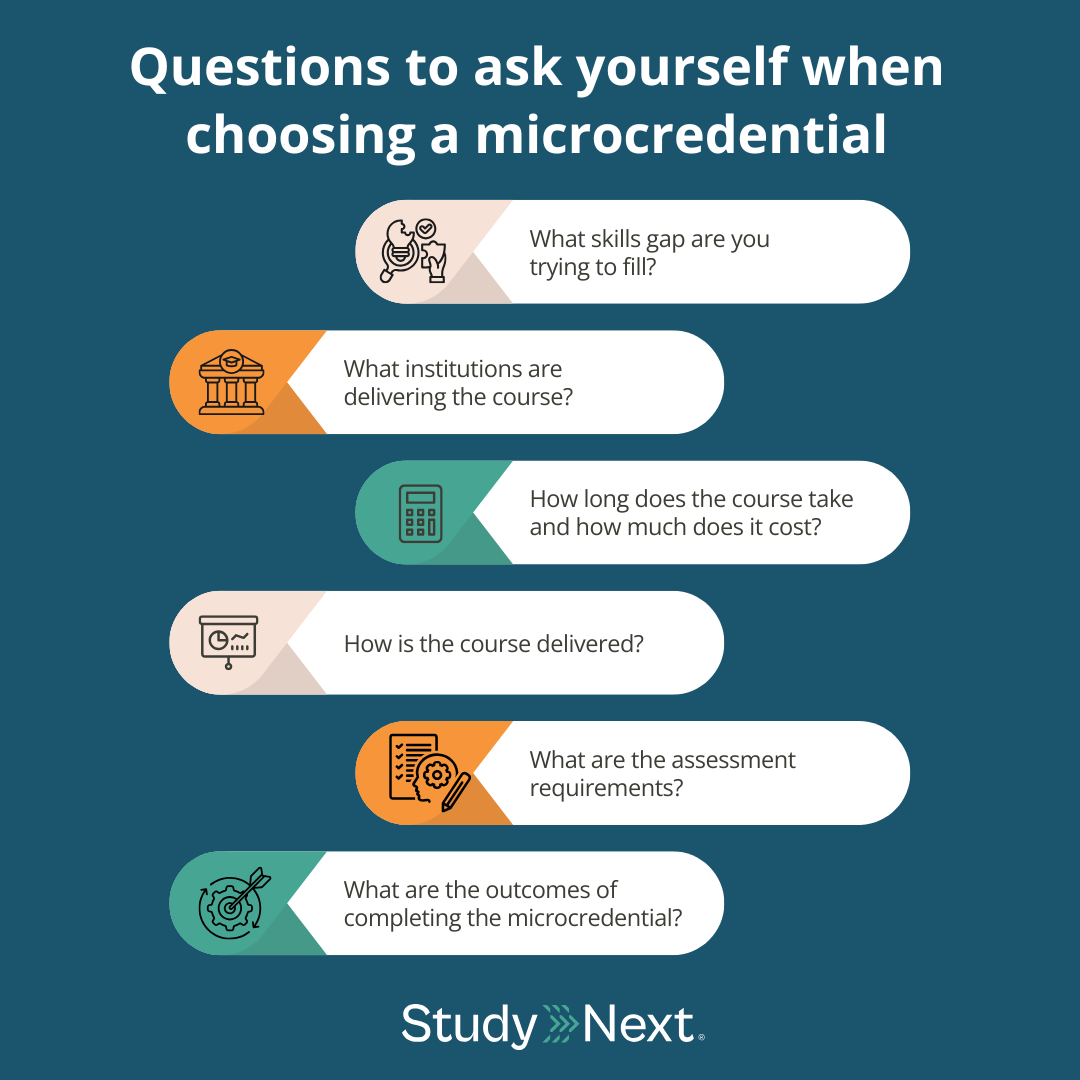
With so many options available, here are some questions to consider when making your decision:
What skills gap are you trying to fill?
Microcredentials help with acquiring specific skills or competencies, so you’ll want to have an idea of the capability gap you’d like to address in your current role. For instance, if you’re looking to develop a more robust skill set in business analytics, you’ll want to look for a microcredential that will provide you with skills in areas such as Excel and Tableau. Once you’ve nailed down the skill gap you’re trying to fill, it’s a lot easier to narrow down the microcredentials that fit the bill.
What institutions are delivering the course?
Ideally, you’d want to consider microcredentials from recognised universities, industry bodies or professional associations as they carry more weight and credibility. This can be especially helpful if you plan to list the credential on your resume and LinkedIn profile.
How long does the course take and how much does it cost?
While microcredentials don’t take as much time as a postgraduate course, completion time can still vary anywhere from a few hours to a few weeks. Before enrolling in a course, you’ll want to ensure that it fits with your current lifestyle and commitments.
Similarly, costs can vary between microcredentials and there aren’t financing options such as FEE-HELP or HECS-HELP, so you’ll want to make sure you’ve taken into consideration how you’re going to fund the course.
How is the course delivered?
Microcredentials are delivered in a range of formats. While the majority are delivered online to cater to busy professionals, some are delivered face to face and others offer a blended format consisting of self-paced learning and live workshops. You’ll want to pick the format that you’re most comfortable with, particularly one that works best with both your learning style and schedule.
What are the assessment requirements?
Microcredentials typically come with assessments that you’ll need to complete to earn your digital badge or certificate of completion. Assessments vary between courses and may include completing a report or reflection or presenting a project or business plan.
Prior to enroling, it’s worth reviewing the assessment requirements so you know what’s involved and can determine whether the type of assessment is something that’s relevant and applicable to your current role.
What are the outcomes of completing the microcredential?
Microcredentials are structured, with institutions usually listing what you’re going to learn and what you’ll get out of the course on their website. Even though institutions might have similarly named microcredentials, the learning outcomes can be quite different so you’ll want to make sure you’re reviewing them thoroughly to ensure the course ticks off your goals.
Are microcredentials recognised by employers?
Yes, microcredentials are increasingly recognised by employers. According to a survey conducted by Coursera, as reported by the Australian Financial Review, 86 per cent of employers said that holding a microcredential would strengthen an applicant’s job application and three in four employers believed microcredentials help new staff perform their job to a higher standard. These statistics show that microcredentials are looked upon favourably by employers and recognised as a commitment to ongoing learning and staying current in your field.
In addition, institutions are constantly updating their offerings in response to changing market demands, so the microcredentials on offer tend to be closely aligned with the skills that employers are looking for. By completing a microcredential in these areas, there’s a higher possibility of being hired or promoted, as you’re signalling to employers that you’re actively upskilling in areas that are timely and relevant to the job market.
On the flip side, to some employers, a microcredential may not carry the same weight as a postgraduate degree. It is, however, still formal recognition that you’ve upskilled in a certain area and are committed to your professional development, which still holds merit.
Get started with these microcredentials
If you’re interested in completing a microcredential, here’s a selection of microcredentials currently available on the StudyNext catalogue. The courses below are ordered by shortest to longest duration:
| Course | Institution | What you’ll learn | Best for | Delivery mode | Duration | Price |
|---|---|---|---|---|---|---|
| Negotiation and Influence for Success | CPA Australia | Approaches and strategies that can be used during a negotiation | Finance professionals such as financial accountants and auditors | Online | Four hours | $520 |
| Leader as Coach | University of New South Wales | Gain insights from the Sydney Swans and build your coaching capabilities | Senior and emerging leaders looking to improve their leadership skills | Face to face | Two days | $3,950 |
| Project Management Excellence | University of New South Wales | Learn essential project management principles, approaches and tools | Project managers, mid to senior level leaders and executives | Face to face | Two days | $3,950 |
| Data-Driven Leadership | University of New South Wales | Discover the tools and frameworks required to harness data for strategic decision making | Professionals looking to improve their data fluency | Face to face | Two days | $3,950 |
| Geopolitics and Business Sprint | University of Sydney | Gain an understanding of global power dynamics and create a strategic toolkit for adapting to geopolitical disruption | Executives, leaders and managers | Online | 2.5 weeks | $1,295 |
| Leading Complex Projects Sprint | University of Sydney | Learn how to navigate diverse stakeholder ecosystems, manage change and drive project success | Leaders and managers managing large-scale projects | Online | Two weeks | $1,395 |
| AI Dexterity Sprint | University of Sydney | Learn how generative AI works and discover how to configure it to create high quality and effective outputs | Leaders and managers who want to learn how to work effectively with generative AI | Online | Two weeks | $1,095 |
| AI Product Manager | RMIT University | Learn foundational AI concepts, how to apply AI in product management and evaluate its effectiveness | Emerging and aspiring product managers and professionals in a technology-adjacent role | Online | Four weeks | $750 |
| Cyber Security Risk and Strategy | RMIT University | Learn how to prevent cyber attacks and create an incident response plan | Mid-senior managers, consultants, IT professionals and entrepreneurs | Online | Six weeks | $1,900 |
| Marketing Analytics and Insights | RMIT University | Learn how to use tools such as Google Analytics, Tableau and Adobe Analytics | Marketing professionals and early to intermediate level marketers | Online | Six weeks | $1,900 |
| Data Visualisation and Business Intelligence | University of Auckland | Learn how to use data visualisation and business intelligence tools including Python, SQL and PowerBI | Professionals who want to accelerate their career or pivot into data-driven roles | Online | Nine weeks | $960 |
Build industry-relevant skills with a microcredential
Microcredentials won’t replace a degree and they’re not trying to as they’ve got their own place in the education world. What they offer is a fast, flexible and cost-effective way to build skills that you can apply immediately.
If you’re interested in pursuing a microcredential, take a look at the full list of short courses and microcredentials on offer on the StudyNext website. Thinking of pursuing a postgraduate course instead? StudyNext has over 1,600 courses across various disciplines from 40+ reputable Australian institutions.