In This Article
- Can you do an MBA without a bachelor’s degree?
- What are the typical MBA entry requirements?
- Why are there such strict MBA entry requirements?
- Pathways to an MBA without a bachelor’s degree
- MBAs that don’t require a bachelor’s in Australia
- Advantages and considerations of doing an MBA without a bachelor’s degree
- Tips for applying for an MBA without a bachelor’s degree
- Start your MBA journey
MBAs have been growing in popularity with an increasing number of business professionals viewing them as a smart investment. An MBA can take your career further by providing you with the practical leadership and management skills required to navigate today’s business landscape.
While a bachelor’s degree is the most common entry requirement into an MBA, not every student who gains admission and successfully graduates holds an undergraduate qualification. If you have experience in a business environment or hold alternative qualifications, you may still be eligible to pursue an MBA without a degree. This article explores how.
Yes, you can do an MBA without a bachelor’s degree. A bachelor’s degree isn’t the only measure of competency and many universities and institutions will accept students without an undergraduate qualification.
Common alternative pathways include having several years of professional work experience, enrolling in a graduate certificate which provides direct entry into an MBA or achieving a strong GMAT or GRE score to showcase academic readiness.
What are the typical MBA entry requirements?
The entry requirements for an MBA course will vary depending on the university or institution, but as you start exploring courses, you’ll discover that requirements may include:
- Completion of a bachelor’s degree or postgraduate degree in a related or unrelated discipline (dependent on the university or institution)
- A minimum level of relevant work experience (generally at least three years), some universities or institutions may also require applicants to have at least one year of supervisory or management experience
- Excellent English language skills
- Details of professional referees
- A statement relating to your personal goals and how you can contribute to your MBA course
- Attending an interview
- Demonstrating academic excellence either from previous studies or high scores in the Graduate Management Admission Test (GMAT) or Graduate Record Examination (GRE)
Some universities will require all of these, while others will only require a few of them. What is considered a related field and relevant experience will depend on the university. For the MBA at the University of Newcastle, for instance, related fields would include accounting, business, commerce, economics, finance, human resource management, industrial relations, management or marketing.

Refine your leadership and strategic management capabilities through flexible online study, strengthening your ability to lead organisations and make informed business decisions.
Why are there such strict MBA entry requirements?
MBA courses are designed to build upon existing professional experience and hone real-world business skills, equipping students with the capabilities to lead in today’s dynamic environment. As a result, education providers want to ensure that students who undertake the course are at a similar stage in their careers, bringing comparable levels of professional experience and maturity to the cohort.
An MBA is an advanced course that draws heavily on case-based and experiential learning, with the expectation that students can contribute to discussions from day one. With much of the learning happening through peer-to-peer engagement such as group projects, case study discussions and class debates, education providers want the confidence that applicants have the analytical foundations along with soft skills such as communication, teamwork and time management to engage with the rigorous coursework.
Studying an MBA also requires significant time and financial investment, so universities and institutions have a strict selection process to ensure that students accepted into the course have the commitment and discipline required to complete the course.
Pathways to an MBA without a bachelor’s degree
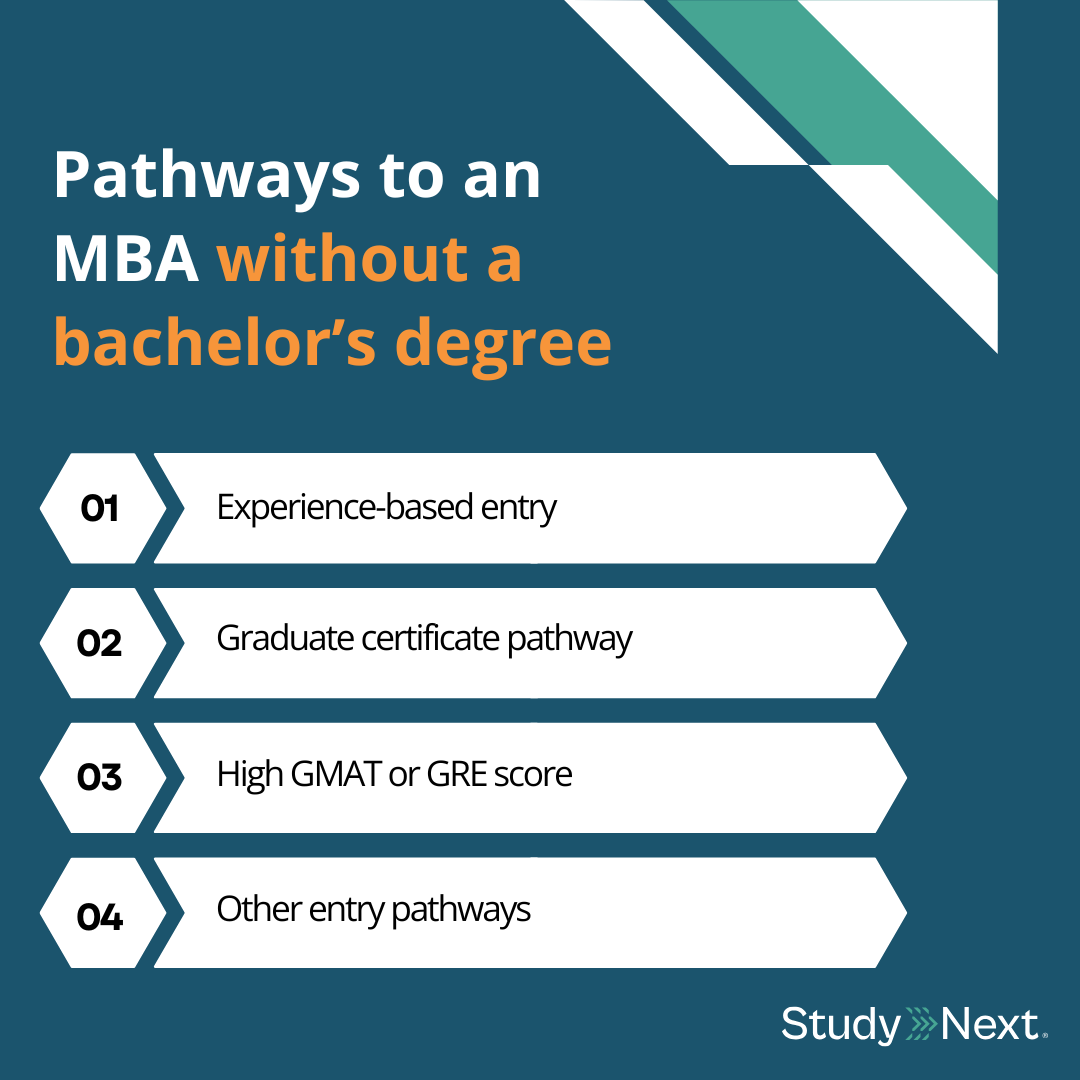
Not having a bachelor’s degree doesn’t necessarily close the door on an MBA. Most universities and institutions offer alternative pathways, these include:
Experience-based entry
If you have significant professional experience, it’s likely you’ll meet the entry requirements for an MBA. The years of experience required will vary depending on the education provider and some may also require a portion of that experience to be at a managerial level. The Master of Business Administration (Advanced) at Torrens University, for instance, considers applicants who have at least five years of work experience, of which three years need to be managerial.

Develop advanced business leadership and strategic management capability through this on-campus MBA, combining contemporary business education with an extended elective program to prepare you for senior leadership and organisational decision-making.
Graduate certificate pathway
If the MBA you’re interested in doesn’t offer experience-based entry, completing a Graduate Certificate in Business Administration at the same university can serve as a stepping stone into the program.
At RMIT University, for instance, while their MBA requires a bachelor’s degree, their Graduate Certificate in Business Administration considers applicants with a minimum of five years full-time equivalent work experience. Upon completion of the graduate certificate, students can continue on to the MBA and receive 48 credit points of advanced standing, equivalent to one semester of full-time study.


Learn how to approach and solve real problems in a global business context.

Blends global industry connections with innovative, real-world learning to empower future leaders with practical skills and strategic insight.
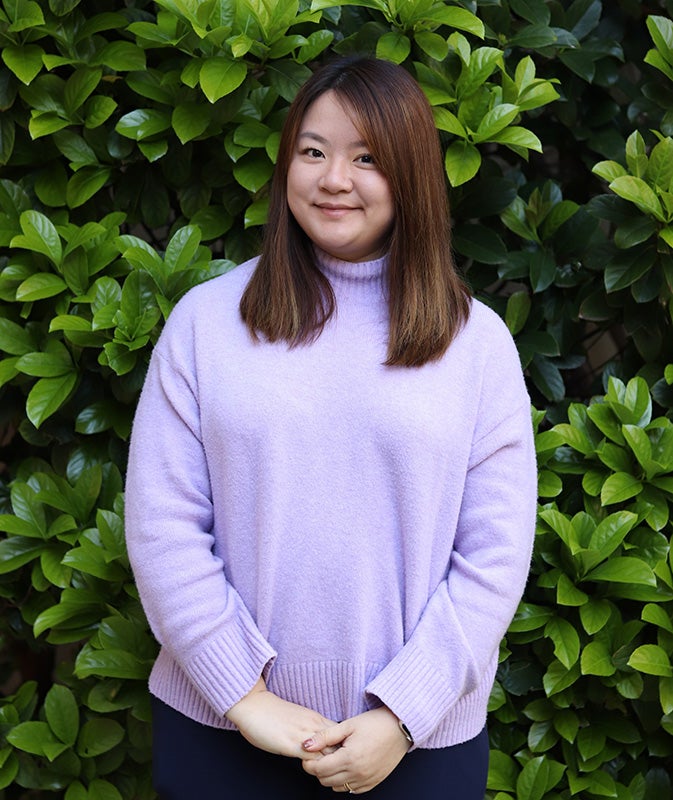
Queensland brand director and business owner Stephanie Quinn, an MBA holder and member of MBAus, used her work experience to gain entry to an MBA. Stephaine honed and developed her business skills while working for a major supermarket and a regional bank, but she wanted a qualification to back up her experience.
“Working in quite a traditional corporate landscape, I was often asked what I studied at university,” Stephanie says. “As an 18-year-old, I dropped out in the first year of a Bachelor of Business. Instead of a university degree, I got experience in leadership and finance.”
Stephanie felt that to climb the corporate ladder even further, she needed a qualification. “Since I was 17, I have moved in and out of leadership or management roles in different companies. A lot of the MBA courses I looked at allowed students to enter through experience rather than requiring an undergraduate degree.”
She started her studies with a graduate certificate, which she could then use to gain entry to an MBA.
High GMAT or GRE score
Some education providers will accept a strong GMAT or GRE score as part of the entry requirements (though this is rarely considered in isolation) and you’ll typically need to demonstrate a few years of relevant work experience alongside it. The Master of Business Administration (Health Management) at Adelaide University, for instance, considers applicants who have completed the GMAT with a score of 500 or higher, along with a minimum of two years of relevant work experience.


You’ll be equipped with the expertise to navigate the complex and evolving landscape of healthcare management.
Other entry pathways
Though less common, some education providers may consider informal or non-formal learning as part of their assessment. Some may also consider applicants who hold full membership with a recognised professional body and have substantial work experience. The MBA at the University of Wollongong, for instance, considers applicants who hold full membership with a qualifying professional body alongside a minimum of five years of relevant full-time professional or managerial experience.

Develop your strategic decision-making skills, undertake a real-world business project and hone your personal effectiveness as a responsible leader.
It’s also worth noting that not every applicant will fit neatly into a single pathway and that’s okay. Many universities are willing to assess applications on a case-by-case basis, so even if you don’t meet these exact requirements, it’s worth reaching out to the education provider directly to see if they’d be willing to consider your application.
MBAs that don’t require a bachelor’s in Australia
Here are some examples of MBAs that offer alternative entry pathways:
Master of Business Administration at Southern Cross University
This self-paced online MBA can be completed in two years part-time. There are no exams and instead, you’ll learn through quizzes, videos and interactive presentations. You can connect with academics and fellow students through the online platform and balance study and work with their unique learning model. You’ll diversify your skill set and complete units which include Digital Marketing, Strategy and Case Analysis and Global Business.
Alternative entry requirements: At least five years of professional managerial experience
Intakes: May, July, August and October 2026
Delivery mode: Online
Duration: Two years part-time

Offers flexibility, allowing students to balance study, work and life commitments without compromising their educational progress.
Master of Business Administration at Victoria University
Designed to prepare you for today’s complex workplace, this online MBA offers a bespoke learning experience with six intakes throughout the year and flexible study options you can fit around your lifestyle. Examples of core units you’ll study include Financial Analysis and Marketing Management and you’ll round out the course with a practical, multi-faceted capstone project.
Alternative entry requirements: Complete the university’s Graduate Certificate in Business
Intakes: January, March, May, July, August and October 2026
Delivery mode: Online
Duration: Two years part-time


Learn practical business principles from reputable industry experts, using real-world case studies to prepare you for today's complex workplaces.
Master of Business Administration (Part-time) at Melbourne Business School
For those looking to balance study with work, this MBA is built around your schedule, not the other way around. With four intakes a year and flexible study options, you’ll complete core subjects including Managing People, Business Strategies and Financial Accounting. Ranked #1 MBA in Australia in the QS Global MBA Rankings 2026, it’s one of the most prestigious MBAs you can pursue on a part-time basis.
Alternative entry requirements: A minimum of six years of documented full-time professional experience
Intakes: March, June and September 2026
Delivery mode: Face to face
Duration: Two years part-time

A flexible, top-ranked MBA with study options that make it easier than ever to get started.
Master of Business Administration at La Trobe University
Developed and delivered in partnership with industry leaders Mercer and Victorian Equal Opportunity and Human Rights Commission, this MBA is built on the Principles for Responsible Management Education (PRME). With five specialisations to choose from (cybersecurity in business, data analytics, digital health, governance and international management), you can tailor the program to align with your career goals and areas of interest.
Alternative entry requirements: Applicants with more than eight years of relevant managerial experience may be considered for professional entry
Intakes: March, May, September and November 2026
Delivery mode: Online
Duration: 18 months full-time or the part-time equivalent


Engage in learning to enhance your business skills and cultivate essential human abilities.
Master of Business Administration at the University of Southern Queensland
Gain the skills required to become a strategic, executive business leader with this MBA. You’ll be guided by lecturers with extensive experience and complete units such as Shaping Organisational Policy, Analysing Business Data and Mobilising Your People. You’ll also complete two capstone courses where you will put your research and analytical skills into practice.
Alternative entry requirements: Complete the university’s Graduate Certificate of Business Administration which provides an articulation pathway into the MBA
Intakes: February, June and September 2026
Delivery mode: Online
Duration: 18 months full-time or the part-time equivalent

The MBA provides the tools to advance your career while delivering value and innovation to your organisation.
AGSM Master of Business Administration (Finance) at the University of New South Wales
Learn from internationally renowned academics in a degree designed to accelerate your path to a career in finance. Ranked #1 in Australia by the Financial Times Global MBA Rankings 2026, this flexible, part-time MBA can be completed entirely online. You’ll complete core courses such as Corporate Finance and Accounting and Financial Management alongside prescribed electives including Global Finance and Mergers and Acquisitions.
Alternative entry requirements: A minimum of six years of professional work experience
Intakes: June and September 2026
Delivery mode: Distance, face to face or online
Duration: Two to four years part-time

Strengthen strategic financial decision-making through a flexible MBA that combines advanced business leadership with finance expertise.
Master of Business Administration at Curtin University
In this MBA, you’ll build fundamental skills across financial management, economics, business leadership and organisational strategy, with the option to specialise in business administration, digital finance or leadership. As part of the Aberdeen-Curtin alliance, you can also choose to study optional units online with the University of Aberdeen.
Alternative entry requirements: A relevant graduate certificate or graduate diploma with a course weighted average of 65 per cent and a minimum of three years of relevant work experience
Intakes: May and September 2026
Delivery mode: Face to face or online
Duration: 15 months full-time or the part-time equivalent

Strengthen your strategic, financial and leadership capabilities while tailoring your MBA through a specialisation in business administration, digital finance or energy transition.
Master of Business Administration at Deakin University
Gain the skills to lead high-performing teams and champion transformation with this MBA. You’ll complete mandatory core units such as Leadership and Professional Development and Financial Decision Making and choose from 19 specialisations ranging from artificial intelligence for business to management consulting and marketing technology.
Alternative entry requirements: Completion of a graduate certificate or higher in a related discipline and at least three years of relevant work experience or completion of a graduate diploma or equivalent
Intakes: July and November 2026
Delivery mode: Online
Duration: 18 months full-time or the part-time equivalent

Strengthen your strategic and enterprise-level thinking to lead people, navigate complex business challenges and create sustainable value across organisations and industries.
Master of Business Administration at the University of the Sunshine Coast
Covering the latest trends in business, this MBA places you in a collaborative learning environment where you’ll share real-life management challenges and apply problem-solving strategies alongside your peers. You’ll complete units such as Marketing in a Global Environment and a Business Capstone Project, with the option to specialise in areas such as cybersecurity, advanced business studies or international business.
Alternative entry requirements: Complete the university’s Graduate Certificate in Business Administration
Intakes: April, August and October 2026
Delivery mode: Face to face or online
Duration: 18 months full-time or the part-time equivalent


Can be completed either on campus or online.
Master of Business Administration at Griffith University
Designed with flexibility in mind, this MBA can be completed either full-time or part-time to suit your schedule. The course also includes an international exchange component, giving eligible students the opportunity to gain experience at one of Griffith’s partner universities abroad. Universities include the University of Arizona, the University of Liverpool, the University of Hong Kong, Copenhagen Business School and more. Alternatively, the university offers a two-week intensive European Summer School for Advanced Management (ESSAM) program for those looking to explore business in an international setting.
Alternative entry requirements: Completion of the university’s Graduate Certificate in Business Administration or Graduate Certificate in Leadership and Management
Intakes: July and November 2026
Delivery mode: Face to face or online
Duration: 12 months full-time or the part-time equivalent


Learn how to make bold decisions, inspire high-impact teams and drive positive change.
Advantages and considerations of doing an MBA without a bachelor’s degree
Advantages
Having extensive real-world experience
Gaining entry into an MBA through experience means you’ve spent years in the workforce sharpening your business acumen, whether through leading teams, managing projects or building a business from the ground up. The insights you’ve gleaned and lessons you’ve learned will make it easier to contextualise your learning, enrich classroom discussions and help you build a stronger professional network.
Skip years of undergraduate study
Doing an MBA without a bachelor’s degree means skipping three to four years of undergraduate study. Even if you need to complete a Graduate Certificate in Business Administration first, it’s typically a six-month commitment, a fraction of a traditional undergraduate degree.
Gain a formal qualification
Regardless of the path you take, you’ll graduate with one of the most respected postgraduate business qualifications in the world. An MBA can help elevate your career and equip you with the tools to become a more effective and influential business leader.
Considerations
Adjusting to an academic setting
If it’s been a while since you’ve been in an academic setting, returning to study while working can be a significant adjustment. The reading load, assessment requirements, group projects and pace of an MBA can be intense and take some getting used to.
A more rigorous application process
Applying through experience-based entry can be a more demanding process. Universities and institutions may request additional documentation such as a detailed employment history and a statement of service from your current and previous employers.
Potential gaps in theoretical foundations
Even though your work experience can offer you an advantage when it comes to completing an MBA, you may still find yourself missing some of the theoretical foundations that a bachelor’s degree provides. Undergraduate study helps to build skills in areas such as research and academic writing, and without that foundation, it may make the leap into an MBA more challenging.
Tips for applying for an MBA without a bachelor’s degree
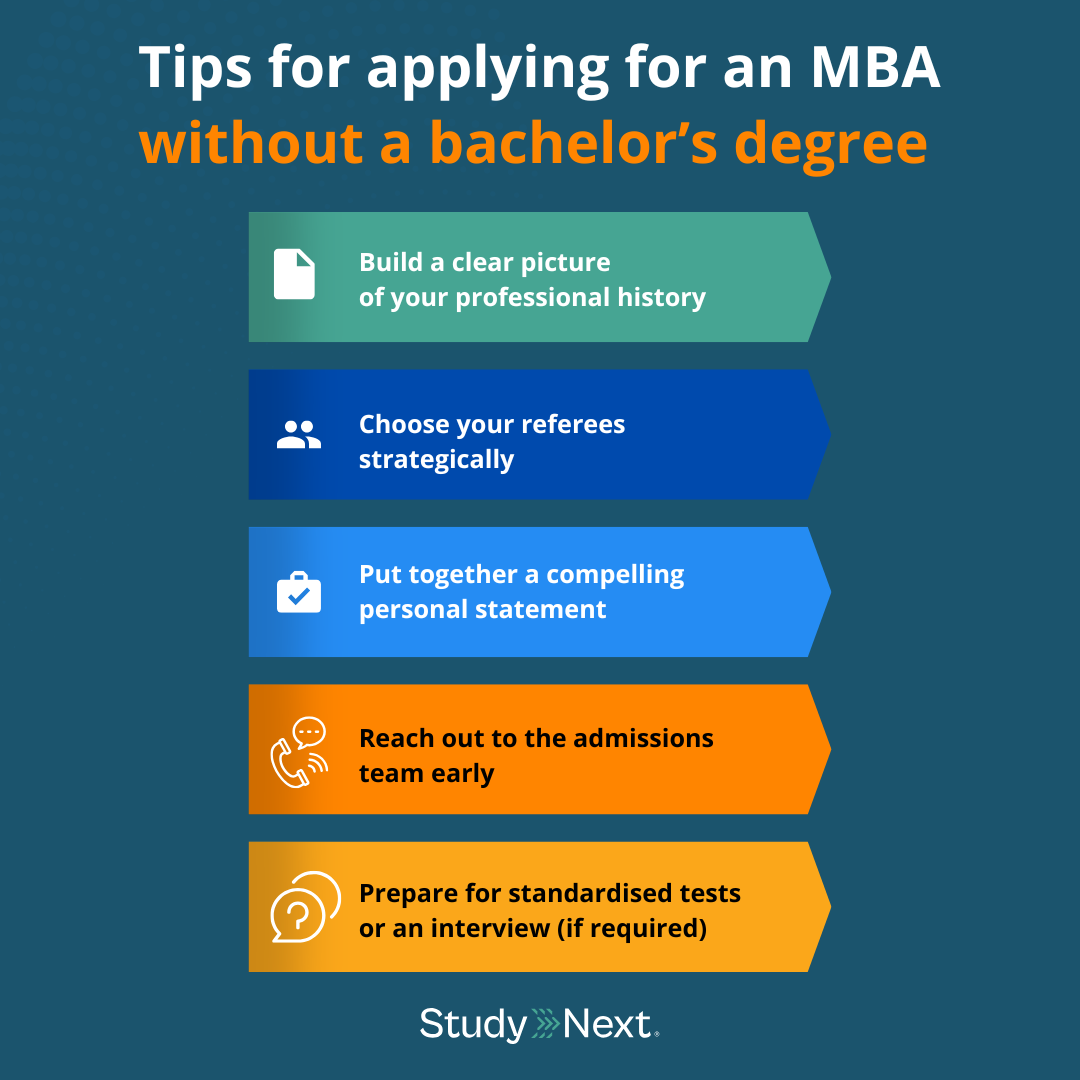
Build a clear picture of your professional history
If you’re applying through experience-based entry, your application will need to highlight your professional experience and show that you’re ready to meet the demands of the program. Most universities and institutions will outline their specific requirements, such as a detailed CV or a statement from your employer outlining your position, time in the role and responsibilities.
To set yourself apart from the competition, however, it’s worth providing more than the stipulated requirements. Gather evidence of your achievements, professional development and any informal learning such as mentorship or participation in internal leadership programs. The more robust your application is, the stronger your case.
Choose your referees strategically
Since your application leans heavily on professional credibility rather than academic standing, your referees matter. Rather than choosing the most senior figure, choose people who can speak directly to your skills, strengths and readiness for postgraduate study. You’ll want to pick individuals who know your strengths and weaknesses and are able to articulate the skills and qualities you’ll be able to bring to the program.
Put together a compelling personal statement
Most universities and institutions require a personal statement outlining your goals and how you plan to contribute to the MBA. Don’t be shy about highlighting your achievements (yes, it’s okay to brag). Beyond your professional background, draw on the transferable skills you’ve developed through your experience and back them up with concrete examples. Be clear about why you’re pursuing an MBA, what unique perspectives you bring and how you’ll contribute to the cohort.
Reach out to the admissions team early
If you’re not sure if your background meets the entry requirements, most universities are happy to answer any questions you have. Reaching out early gives you the chance to clarify expectations and address any gaps.
Prepare for standardised tests (if required)
If the MBA you’re applying for requires a GMAT or GRE score, don’t leave your preparation to the last minute. Give yourself at least three to four months to study for the GMAT or GRE and take mock exams to gauge your readiness level and ensure you’re ready for exam day.
Prepare for an interview (if required)
Many universities and institutions include an interview as part of the admissions process. This is your opportunity to bring your application to life. During your interview, share your leadership experience, professional journey and motivations. You’ll want to speak confidently and assertively to demonstrate that you’re able to hold your own in a room of high-calibre professionals.
Start your MBA journey
Still not sure if you're ready to study an MBA? Like Stephanie, you might surprise yourself. “I vividly remember leaving my interview for the MBA course, convinced I was not smart enough to study a graduate certificate. Yet, I graduated from the MBA course with a distinction.
"If you’ve been in business or leadership environments for a few years, an MBA will help you put the puzzle pieces together and grow your confidence. It gave me the skills and understanding to speak with senior leadership and heightened my understanding of strategy.”
A bachelor’s degree isn’t always a prerequisite for postgraduate study. If you’re ready to upskill or advance your career, the StudyNext catalogue features a wide range of MBAs that don’t require a bachelor’s degree along with other postgraduate business courses and short courses that you can pursue without an undergraduate qualification.