
In This Article
- What is Australia’s unemployment rate?
- What are the main types of unemployment?
- Which jobs and industries are most at risk?
- Which jobs and industries are less likely to be at risk?
- Is your job at risk?
- What are some signs your job may be at risk?
- Ways to take control of your career
- What should you do if you lose your job?
- Future-proof your career with a postgraduate or short course
News about layoffs, restructures and cost-cutting has become a regular occurrence in Australian headlines and it can all start to feel a little unsettling. Questions you might have started asking yourself include, “Is my job at risk?” or “What can I do to protect my career?”
In this article, we take a closer look at Australia’s current unemployment rate, which industries and roles are most and least likely to be affected, whether your job is at risk and what you can do to future-proof your career.
What is Australia’s unemployment rate?
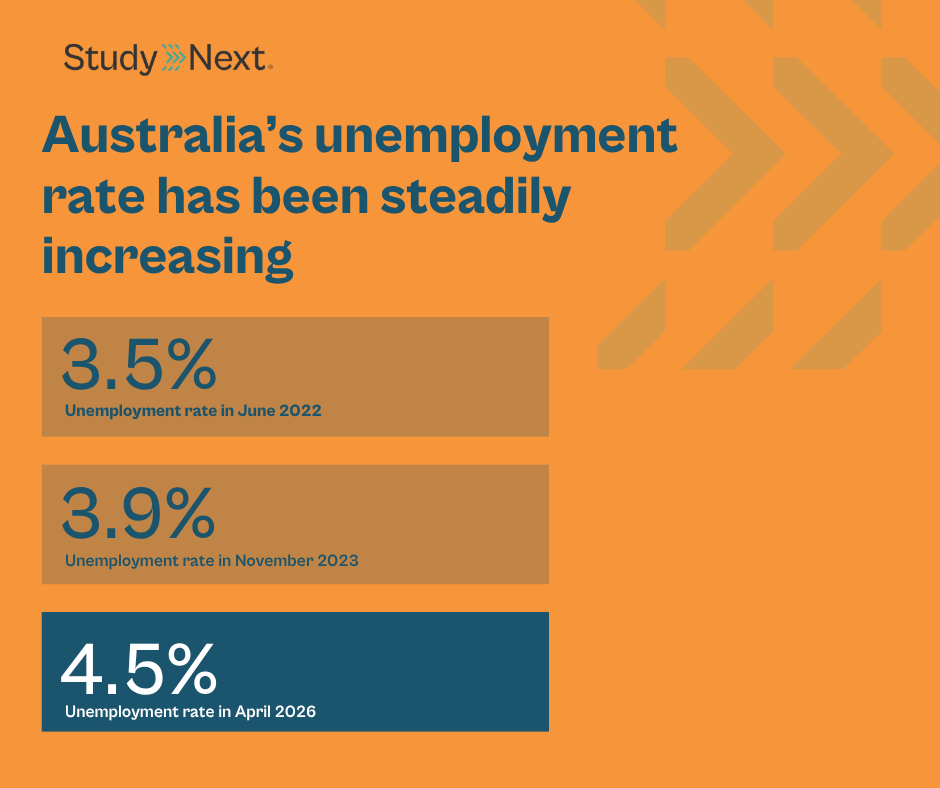
According to the ABS, Australia’s unemployment rate has been steadily climbing since June 2022. Back then, the seasonally adjusted unemployment rate sat at 3.5 per cent before rising to 3.9 per cent in November 2023 and reached 4.5 per cent as of April 2026. While it’s nowhere near the 7 per cent peak recorded in May 2020 during the COVID-19 pandemic, it’s still 0.8 per cent higher than it was in mid-2022.
Additional key statistics from the ABS
- Out of all the states and territories, Tasmania, Victoria and the Northern Territory recorded the highest unemployment rates of 4.8 per cent
- The underemployment rate (which measures individuals who are employed but working fewer hours than they'd like), has decreased slightly from 6.2 per cent in December 2022 to 5.8 per cent in April 2026
- The seasonally adjusted employment-to-population ratio held at 63.7 per cent as of April 2026, not far off the 64.3 per cent recorded in November 2022
What does this mean?
While the unemployment rate has crept up since 2022, it isn’t a cause for alarm. Compared to the period between 2016 and 2021, unemployment rates are lower now compared to what they were then. The federal government’s 2026 to 2027 budget also forecasts the rate to remain broadly steady through to 2027, barring any major external shocks. Ongoing tensions in conflict areas and rising fuel prices, however, are among the factors that could shift that outlook.
Despite this, Australians remain anxious. A poll conducted by the Australian National University in March 2026 found that financial stress among Australians is at a record high, with respondents placing the probability of losing their job at 26.8 per cent.
While these may be uncertain times, the best way to describe where Australia’s job market sits right now is that it’s creaking, not cracking. That said, forward-thinking goes a long way. Taking proactive steps such as mapping out your career, developing in-demand skills and strengthening your network can put you in a much better position in the future.
What are the main types of unemployment?
There are a few different types of unemployment and these include:
Structural unemployment
Structural unemployment occurs when there’s a mismatch between the skills a worker has and the types of jobs available. An example would be an administrative worker with skills in data entry, document processing and diary management. While these roles were once widely available, many organisations are increasingly turning to artificial intelligence to automate these tasks, making these roles harder to come by.
Cyclical unemployment
Cyclical unemployment typically stems from changes in economic activity. When economic conditions slow, consumer spending falls and businesses hire less, cut hours or reduce headcount to manage costs. Sectors such as retail and hospitality tend to feel the effects of cyclical unemployment the most, as demand for their services is closely tied to consumer spending confidence.
Frictional unemployment
Frictional unemployment is often voluntary and temporary. Examples include someone who’s currently moving between jobs, an individual relocating to a new city and searching for employment or a recent graduate that’s looking for their first role.
Seasonal unemployment
Seasonal unemployment occurs when demand ramps up during certain times of the year and scales back when those periods end. An example is retail stores taking on additional casual staff to manage the Christmas rush. Once the holiday period wraps up, that demand disappears and those roles typically do too.
Technological unemployment
Technological unemployment is when someone loses their job as a direct result of technological change. An example could be a manufacturing worker who operates machinery on a production line being made redundant when the company invests in automated equipment that performs the same tasks faster and at a lower cost.
Which jobs and industries are most at risk?
Some jobs and industries are more vulnerable than others, whether due to technological change, economic volatility or a combination of both.
Hospitality and food services
According to CreditorWatch, one in ten hospitality businesses in Australia shut down over the past 12 months, with South Australia recording the highest closure rate at 10.8 per cent, followed by Queensland at 10 per cent and Victoria at 9.9 per cent.
This is a classic example of cyclical unemployment at play, where ongoing cost-of-living pressures have led to reduced discretionary spending, leaving many hospitality businesses caught between rising operating costs and weakening consumer demand.
Retail
Retail is facing a similar dynamic. Softening consumer spending, combined with the ongoing shift to e-commerce has put sustained pressure on the industry. According to the Australian Bureau of Statistics, retail trade recorded one of the largest percentage decreases in 2024 to 2025, falling 0.4 per cent.
Administration and clerical roles
With the rise of AI, administration and clerical roles are increasingly exposed to technological unemployment. According to a report by the Parliament of Australia, clerical and administrative workers were around 14 times more likely to lose their jobs due to AI compared to other occupations.
Manufacturing
Manufacturing is another sector feeling the impact of technological change. Research commissioned by Pearson found that industries like manufacturing are particularly vulnerable to automation. As automation technologies continue to advance, many workers in these industries are finding themselves having to retrain or look for work elsewhere.
Which jobs and industries are less likely to be at risk?
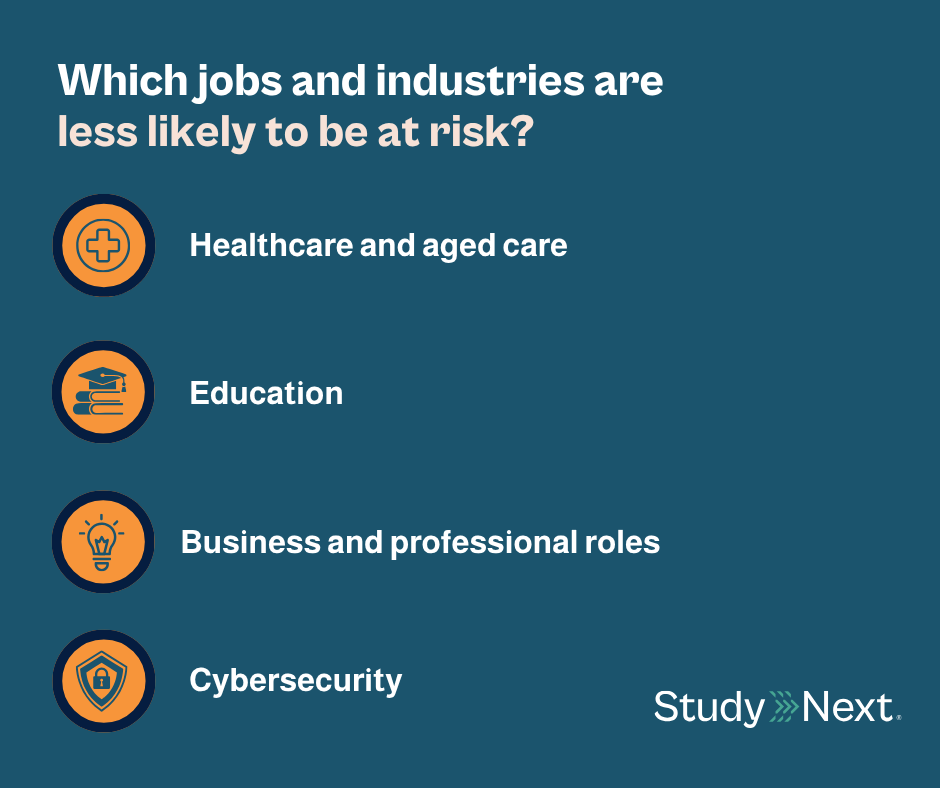
There are certain jobs and industries that are less likely to be at risk, largely due to strong demand. These include:
Healthcare and aged care
The World Health Organisation projects a shortfall of 11 million health workers globally by 2030 and Australia is no exception. Roles such as social workers, physiotherapists and speech pathologists continue to be in high demand, driven by factors such as a growing ageing population and rising rates of chronic health conditions. If you’re interested in pivoting into the healthcare industry, take a look at the range of postgraduate healthcare courses in the GlobalHealth Education catalogue to get started.
Education
According to the Australian Education Union, Australia ranks among the worst-performing OECD countries for teacher shortages. The OECD Teaching and Learning International Survey (TALIS) found that 58 per cent of principals in public schools in Australia report a shortage of qualified teachers, with shortages sitting significantly above the OECD average.
If you’re looking to pursue a teaching career, the Master of Education at La Trobe University can help you jumpstart your career as a teacher. The course consists of core subjects including Educational Systems and How Humans Learn, with the option to specialise in areas such as language and literacy, inclusion and diversity and leadership and management.

Engage with curriculum reforms and design educational programs and understand how to use data to inform evidence-based practice.
Business and professional roles
Roles such as financial analysts, change managers and management consultants continue to be in demand, driven by ongoing digital transformation and the specialised expertise these professionals bring.
If you’re looking to move into these areas, a graduate certificate such as the Graduate Certificate in Change Management at Victoria University is one way to build expertise in a specific area. Otherwise, an MBA such as the Master of Business Administration at the University of Technology Sydney, can give you broader business fluency and position you to take the next step in your career.


Gain skills to navigate ambiguity in your organisation and to successfully lead change as an iterative and innovative process, rather than a reactive process.


Learn contemporary approaches to innovative and sustainable business practices, driven by social values as well as global responsibility.
Cybersecurity
Cybersecurity roles continue to be in high demand, with shortages recorded across multiple states and territories. According to Jobs and Skills Australia, roles such as cyber security engineer, cyber security architect and cyber security operations coordinator are in shortage across almost all states and territories in Australia.
A good way to build foundational knowledge in the field is through a graduate certificate. The Graduate Certificate in Cyber Security at the University of Melbourne, for example, can be completed online in eight months and covers how to leverage AI and automation to develop solutions to cybersecurity challenges.


Gain a deeper understanding of the current and future cyber landscape, including the close connection between AI and cyber, with this innovative and future-focused course.
Is your job at risk?
A rising unemployment rate doesn’t automatically mean your job is at risk. As covered earlier, the 4.5 per cent figure is still lower than it was in previous years and it’s a national figure that gives a broad overview of the labour market.
Rather than looking at the current unemployment rate and thinking, “it’s increasing, so my job must be at risk,” it might help to assess your own situation by asking yourself a few questions.
How is the industry you work in performing?
A good starting point is to look at whether the industry you’re in is growing or contracting. If you’re working in healthcare, for example, the outlook is positive and the industry has one of the highest projected employment growth rates over the next five and 10 years.
On the other hand, industries like retail trade and agriculture, forestry and fishing have some of the lowest projected employment growth rates over the same period. If you’re in an industry that’s contracting, it may be worthwhile to consider pivoting into a higher-growth field.
It’s also worth having a chat with recruiters in your field. Since their role involves working closely with companies to source and place candidates, they should have a solid read on which roles are in demand and what employers are looking for. You may also want to keep an eye on job ad volumes as a dip in advertised roles across your sector is often an early indicator that hiring sentiment is softening.
What is your employer’s financial position like?
A company that’s performing well financially is generally less likely to be looking at retrenching staff, whereas the reverse is also true. If the company you work for is publicly listed, it’s required to publish audited financial reports on a regular basis, which can give you a clearer picture of the company’s financial health and profitability.
If it’s privately held, it can be a bit harder to gauge, but town halls and management updates may offer some useful insight into how the company is tracking. You might also be able to piece things together based on whether the company’s client base is growing, contracts are being renewed or new projects are coming through the door.
How in-demand is your role?
If your role is currently one of the jobs in high demand, there’s less of a chance that your job will be at risk. According to Jobs and Skills Australia, some roles that are in shortage across all Australian states and territories include civil engineer, cyber security engineer and taxation accountant.
What are some signs your job may be at risk?
Other than industry and role outlook, there are a few other signs that may point to your job potentially being at risk. Keep in mind that this serves more as a guide and just because some of these apply to you doesn’t mean your job is on the line.
Company changes
If you’ve noticed that your company has stopped backfilling roles, is cutting budgets or putting a freeze on spending, it’s usually one of the first signs that redundancies may be on the horizon. It typically signals that the business is under financial pressure and is looking at ways to reduce costs.
Other signs might include the company flagging financial difficulties through internal communications or redundancies being made in related departments. New management, mergers or acquisitions can also bring a level of uncertainty, as new leadership may come with a mandate to review structures and headcount.
Shift in workplace dynamics
If things are feeling a bit off at work, it might be worth taking a closer look at the signs. Some things to look out for include:
- Getting less work than usual
- Being left out of projects you’d normally be across
- Finding yourself excluded from meetings you’d typically attend
- Your leader or colleagues becoming more distant
- Feeling like you’re being kept out of the loop
- No longer having discussions about career progression
Ways to take control of your career
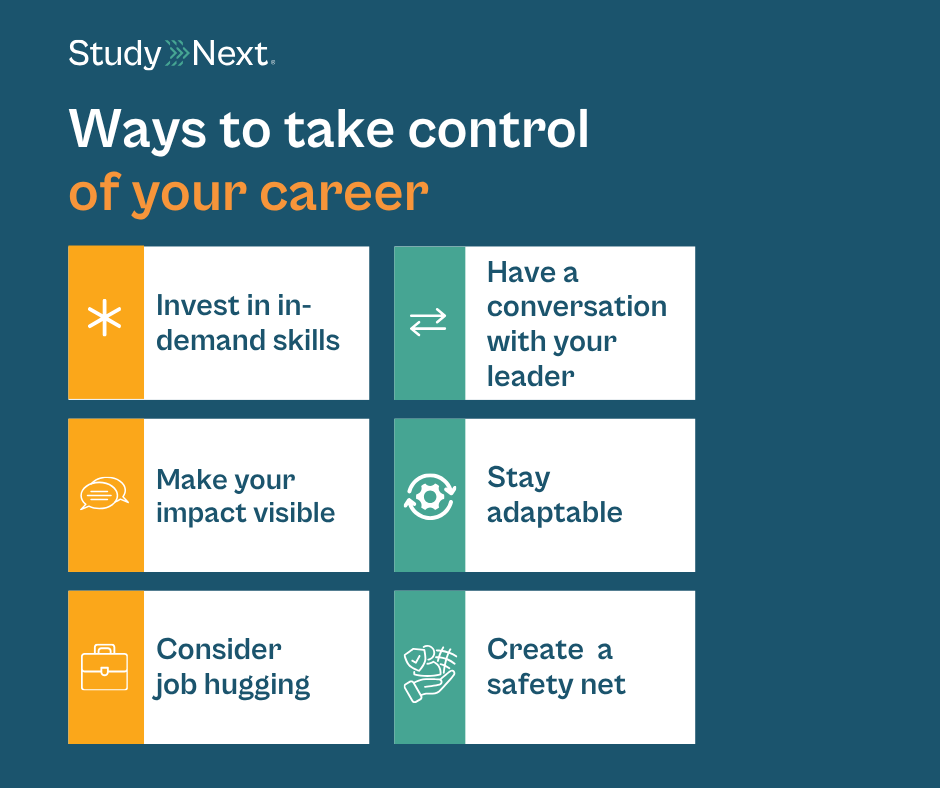
Finding out your job might be at risk, or even just suspecting it, can be an unsettling feeling. Rather than sitting with that uncertainty, here are some practical ways to get ahead.
Invest in in-demand skills
According to the Hays 2025 Skills Report, soft skills such as communication, strategic thinking, time management and adaptability are among the most in-demand skills in the workplace. These skills are required across virtually every industry, can’t be automated by AI and are transferable across a wide range of roles.
In addition to soft skills, being well-versed in how to use AI tools effectively is becoming increasingly important as technology continues to reshape the way we work. Sharpening your skills in this area can go a long way in helping you remain competitive.
Try this approach: While you can hone soft skills by practising them at work, taking a short course or microcredential is another great way to build them. The University of New South Wales, for example, has a two-day short course, The Authentic Communicator: Activating Presence, which covers communication techniques across areas such as leadership presence, strategic storytelling and structuring meetings.


Develop your communication techniques, allowing you to lead with presence and increase your impact in any scenario.
If you’re looking to upskill in AI, RMIT University’s Developing AI Strategy course covers how to identify AI opportunities, integrate AI solutions and build a strategic roadmap. Developed in partnership with Amazon Web Services, the course can be completed in six weeks online.


Discover the implications of artificial intelligence (AI) on your business and learn how to build an AI strategy to keep ahead of the curve.
Make your impact visible
Don’t assume your leader is across everything you contribute. Getting into the habit of advocating for yourself and sharing your achievements can make a difference to how you’re perceived during periods of change.
Try this approach: Before your next one-on-one, take a few minutes to document your recent wins and quantify your results. During the conversation, share some of those highlights with your leader and mention any projects you’re keen to get involved in or take ownership of.
Consider job hugging
The opposite of job hopping, job hugging, is when you deliberately choose to stay and invest in your current role and organisation. Benefits include financial security, less job-search stress and greater credibility and trust within the organisation.
Try this approach: Fundamentally, job hugging involves staying engaged, upskilling and seeking opportunities for growth at work. Some ways to do this include applying for your company’s professional development programs, seeking out a mentor within your organisation and volunteering for projects in other departments.
Have an honest conversation with your leader
If things are feeling off at work and you're anxious about the stability of your role, one of the most useful things you can do is have a conversation with your leader.
Try this approach: Set up some time for a one-on-one chat with your leader. During the conversation, you could raise that things have felt a bit different lately and ask if there’s anything you should be aware of or anything you could be doing better. This may naturally lead to a more candid discussion about your role, performance and standing within the organisation.
Stay adaptable
Employees who are willing to take on new responsibilities, learn adjacent skills or step into cross-functional projects tend to be seen as more valuable.
Try this approach: Let your leader know that you’re open to cross-training and willing to step outside of your usual remit. Actively seek out new projects, put up your hand when opportunities arise and make a point of asking for regular feedback.
Create a safety net for yourself
No role is guaranteed to last forever, so it’s worth thinking ahead while you’re still in your current position. Also known as career cushioning, it’s the practice of preparing for what’s next without actively job searching.
Try this approach: Some ways to build a safety net include exploring side hustles, growing your network by attending industry events or joining relevant professional groups and continuing to develop your skills. If you’re looking to strengthen your broader business acumen across areas like financial literacy and marketing, for example, you may want to consider pursuing an MBA.
The University of Canberra’s MBA is designed to sharpen your business skills and prepare you to tackle real-world business challenges. It’s also one of the first online MBAs to include an Australian Institute of Company Directors (AICD) qualification.


Study where business, government and policy meet
If an MBA feels like too big a commitment right now, a graduate certificate is a great way to build skills in less time. The Graduate Certificate in Business at Southern Cross University can be completed in eight months online, covers units such as Business Analytics and Management Communication and has six intake dates throughout the year, so you can start whenever it suits you.

Offers a flexible, future-focused pathway for professionals to elevate their strategic thinking and leadership skills without pausing their careers.
Seek advice
If you’re unsure about your next step, whether that’s figuring out how to upskill or working out what to do if you feel your role may be at risk, speaking with someone who can help you think it through can make a difference.
Try this approach: If you have a mentor, consider reaching out to them. Set up some time, give them a brief overview of where things are at and come prepared with specific questions such as how they’ve navigated similar situations, what skills they’d prioritise in your position or whether they have any contacts they could connect you with.
At StudyNext, our Education Consultant, Catriona, can also help with choosing the right course or helping you work out next steps in career progression, career change and upskilling. To get started, book a complimentary call with her here.
What should you do if you lose your job?
Losing your job can be a disheartening experience and it’s completely okay to take some time to process how you’re feeling before diving into the next steps. When you’re ready, some actions worth taking include understanding your legal entitlements under the Fair Work Act, updating your resume and figuring out what your next career move might look like.
As difficult as it might feel at the moment, losing your job isn’t the end of the road. For many, redundancy ends up becoming the catalyst for their next career opportunity. If you’re not sure where to start, our article on the six critical steps to take after a job redundancy walks you through how to navigate the process and begin the next chapter of your career.
Future-proof your career with a postgraduate or short course
While a rising unemployment rate is worth paying attention to, it doesn’t automatically mean that your job is at risk. What it is, however, is a good reminder to strengthen your position and make sure you’re as prepared as possible should circumstances change.
Upskilling is one of the most effective ways to boost your career. Get started today by exploring the wide range of postgraduate courses and short courses available on the StudyNext catalogue.