
In This Article
If you’ve noticed that most meetings, strategy discussions and performance reviews seem to revolve around data, you’re not imagining it. Data permeates almost every part of the business world and the question, “What does the data say?” is commonly heard in the workplace.
If you’re looking to influence strategic decisions, craft business strategies and position yourself as a competent leader, being well-versed in the language of business analytics is no longer optional.
In this article, we’ll break down what business analytics is, why it matters, the skills you can gain from studying it and why upskilling in this area is a strategic move for your career.
What is business analytics (and why it matters more than ever)
Business analytics is functionally the ability to transform data into clear and actionable insights. These findings help organisations with aspects such as forecasting, decision-making, understanding why something has happened and determining the next steps needed to succeed.
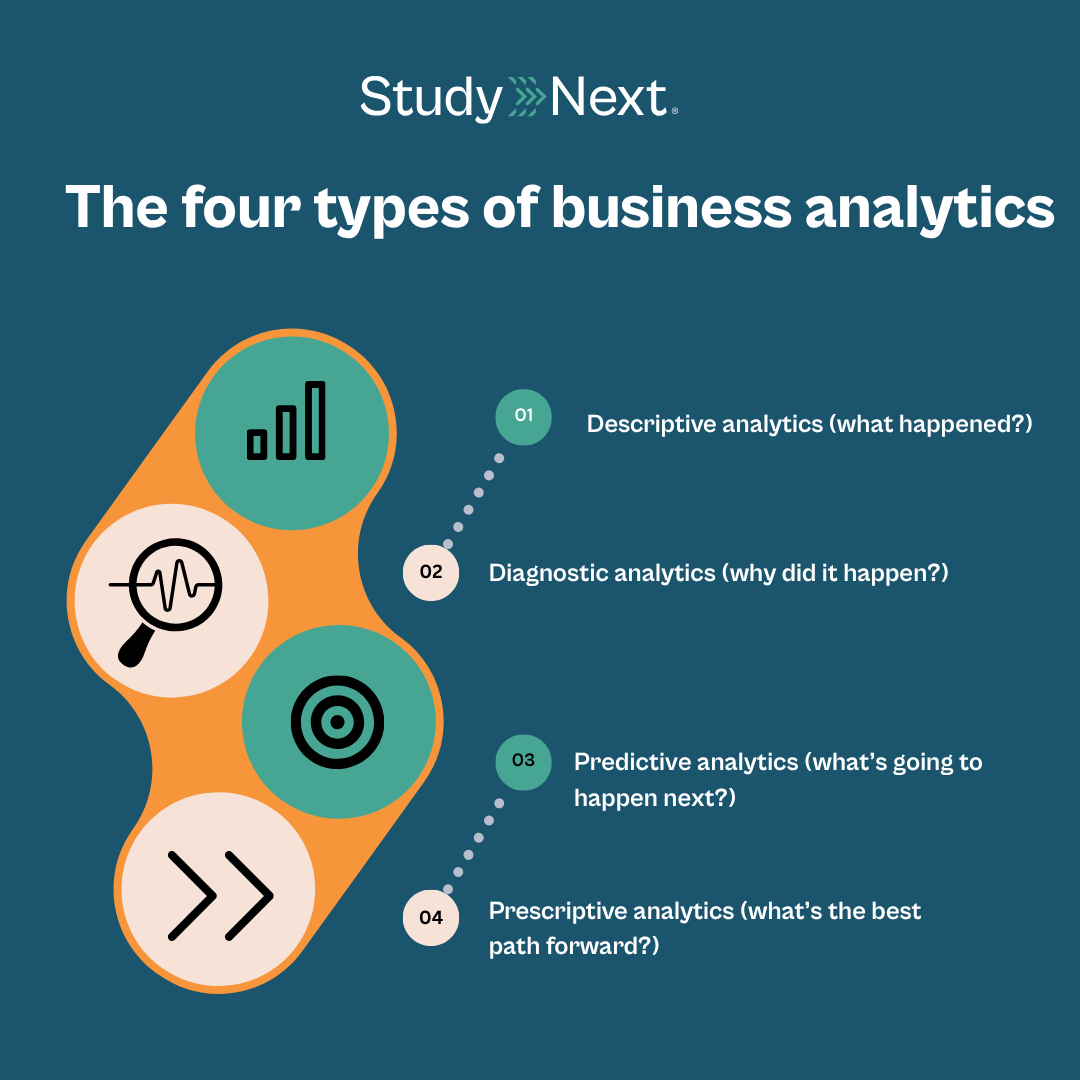
There are four types of business analytics that companies typically use to improve decision-making. To illustrate this, we’ll use the example of a company analysing the performance of its e-commerce website.
Descriptive analytics (what happened?)
Descriptive analytics is typically the first step and involves using current and historical data to identify patterns and trends within a business. In this case, the company might take a look at the data and realise that sales from their e-commerce website have decreased by 15 per cent in comparison to the previous quarter.
Diagnostic analytics (why did it happen?)
Then, they’d aim to understand why this happened by identifying the root cause. In this case, the company would delve deeper into the data to figure out what might have caused the 15 per cent drop in sales. Once they’ve determined the reason, they can then formulate the solution.
Predictive analytics (what’s going to happen next?)
After which, the company would mine existing data and identify patterns to predict what might happen in the future. Based on the data, for example, they might produce more of a certain product, knowing that it tends to perform better on the e-commerce website during a certain season.
Prescriptive analytics (what's the best path forward?)
The final component is prescriptive analytics, which involves determining the next best course of action based on existing information and resources. Based on everything the company has gathered so far in this instance, for example, they might decide to adjust pricing algorithms on the e-commerce website based on forecasted demand.
Why has business analytics become a universal business language?
With digitisation, artificial intelligence and the rise of new technologies, data is now woven into practically every industry and organisation. It’s a part of marketing campaigns, operational workflows, customer service interactions and more.
Almost every function within a business generates data, so the ability to be fluent in business analytics is imperative. It allows you to make smarter decisions, work more efficiently and unlock opportunities for growth.
To put this into context, consider these two leaders, one who embraces business analytics and one who doesn’t.
Leader A
When presented with reports and data, they’re comfortable digging deeper, analysing it for patterns and trends to build a cohesive picture. Questions they may ask include, “What does this trend tell us about where things are heading?” or “Why did this campaign outperform others?” They’re able to use their business analytics skills to evaluate options, solve problems and recommend actionable solutions.
Leader B
When presented with reports and data, they struggle to look beyond the numbers in front of them. They can see that a metric has gone up or down, but don’t have the skills to understand why, what it means for the business or what to do about it. As a result, decisions tend to be based on intuition or what’s worked in the past and they rely heavily on others to interpret and make sense of the data for them.
What’s the difference between data analytics and business analytics?
There tends to be confusion between the two because both data and business analytics revolve around using data to drive business performance. Data analytics, however, tends to be more technical and the focus is around sorting, cleaning and categorising data to uncover patterns and insights.
Business analytics, on the other hand, considers both data and other aspects of a company’s operational profile. Data is just one piece of the larger puzzle and business analytics is about putting all the different pieces together to identify opportunities, inform strategy and determine next best steps.
Considering a career path in business analytics or data analytics? Learn which career path is right for you here.
Why is studying business analytics a strategic move for your career?
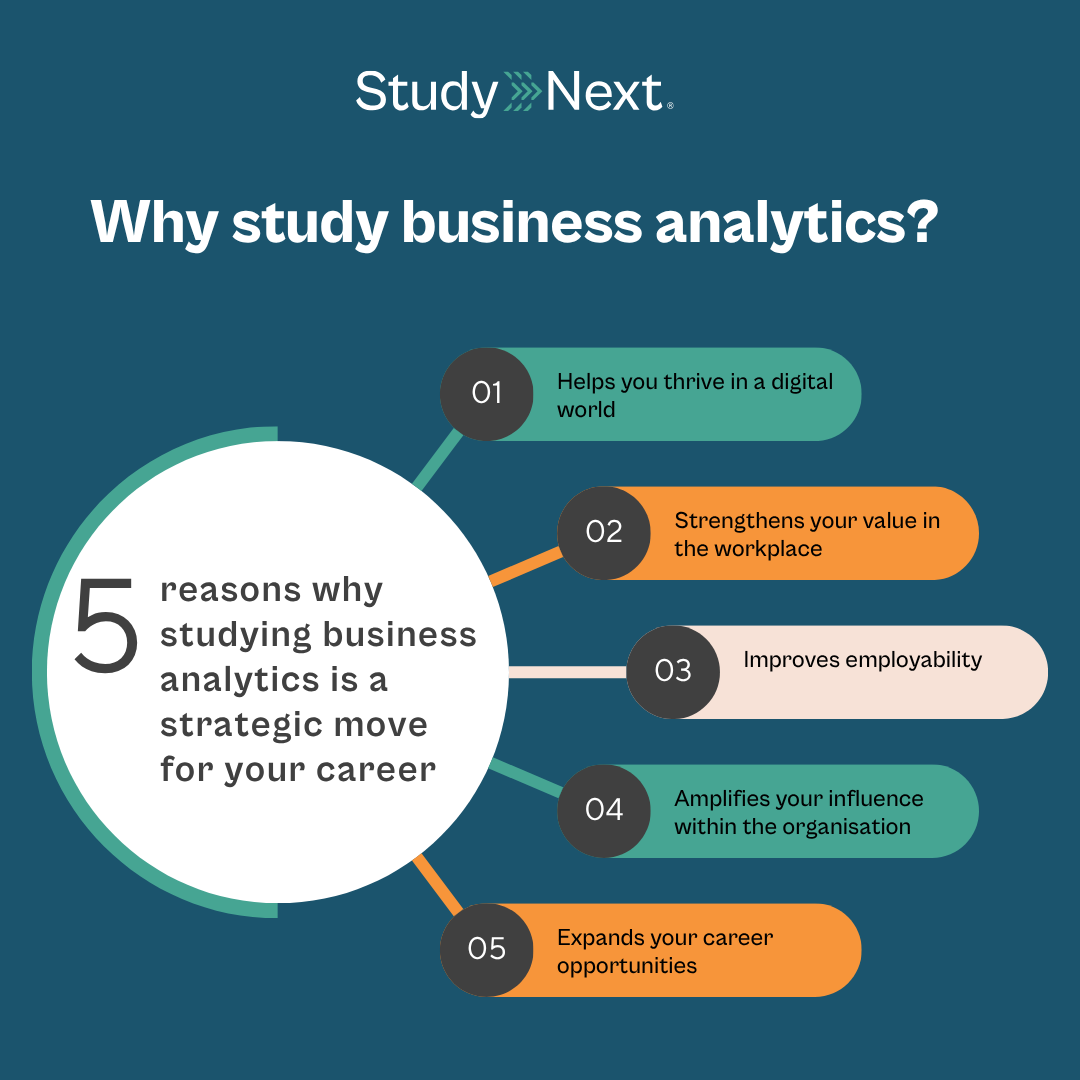
What are the benefits of equipping yourself with business analytics skills? Let’s take a closer look.
Helps you thrive in a digital world
In today’s technologically driven world, two forces making waves are artificial intelligence (AI) and big data. Both go hand-in-hand, with organisations increasingly using AI to analyse big data, speed up the decision-making process and improve efficiency.
Having knowledge in both AI and business analytics will help you stay ahead in these fast-moving times. Many postgraduate business analytics courses incorporate an AI element, giving you the opportunity to develop skills in both areas at once. The Master of Business Analytics and AI Strategy at RMIT University, for instance, covers how AI and business analytics play an important role in the business environment. As part of the course, you’ll cover units such as AI and Analytics for Business Applications and Predictive and Prescriptive Analytics in Business.


Connect data, analytics and AI to unlock better business solutions.
Strengthens your value in the workplace
Gaining an in-depth understanding of business analytics can help you make better decisions in the workplace. Instead of relying on intuition, you’ll have the ability to back up important strategic decisions with quantitative data and approach them with greater clarity and confidence.
You also won’t need to wait on others to interpret data or insights for you, allowing you to take the reins in influencing business decisions and creating positive change. Over time, this could also make you a strong and viable candidate for senior leadership positions within the organisation.
Improves employability
There continues to be a growing demand for individuals who have the ability to combine technical expertise with business acumen to enable evidence-based decision making. Equipping yourself with skills in both business and data will position you well in a world where data literacy is fast becoming one of the most sought-after skill sets in the market.
According to LinkedIn Skills on the Rise 2026, some of the fastest-growing skills in Australia include AI, machine learning and data intelligence. Having knowledge in business analytics shows employers that you have what it takes to navigate and succeed in an increasingly data-driven world.
Amplifies your influence within the organisation
Developing expertise in business analytics can also make you a more influential figure at work. During a meeting with stakeholders, for instance, rather than just suggesting solutions based on opinions, you’ll be able to substantiate your arguments and recommendations with data, making it easier to get buy-in and drive outcomes.
Being able to communicate complex datasets to diverse stakeholders through clear data storytelling also helps drive organisational alignment, positioning you as an indispensable asset within the business.
Expands your career opportunities
Business analytics skills are transferable across multiple industries and sectors. The analytical frameworks you learn can be applied in a wide range of contexts, making you a versatile asset to organisations across finance, healthcare, marketing and more.
If you’re looking to pivot careers in the future, business analytics capabilities can also open the doors to new roles. These include positions such as business intelligence analyst, business analyst, business systems analyst, market research analyst and more.
The skills you can gain from studying business analytics
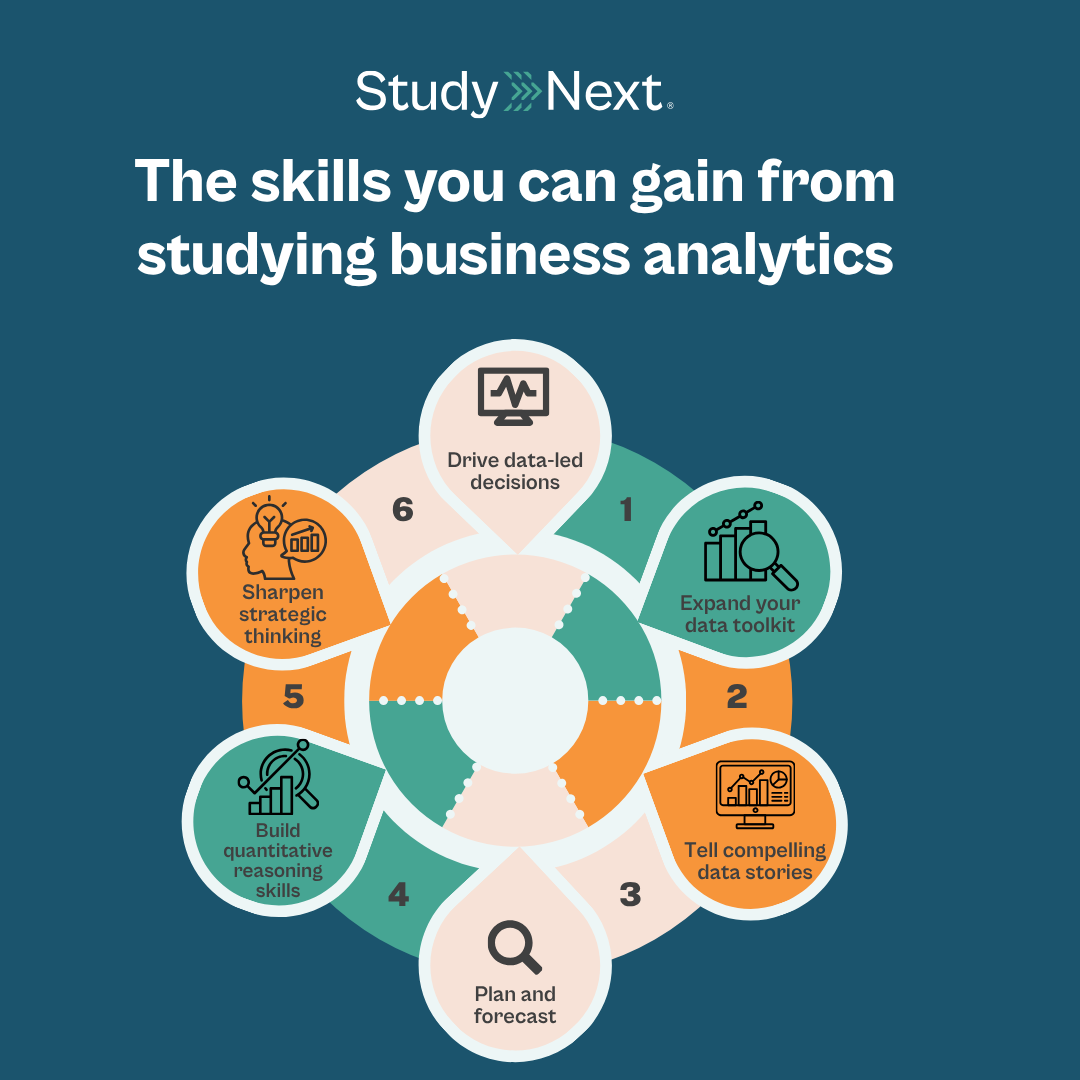
If you’re curious about what skills you can gain from completing a business analytics course and how they translate to your day-to-day work, here’s a closer look:
Expand your data toolkit
Before studying business analytics: You’re familiar with Excel and use it regularly to work with data, but your knowledge of other tools is fairly basic. You’re not yet comfortable using platforms like Tableau, Python or AI-based analytical techniques, which can limit your ability to handle more complex datasets and drive high-impact business decisions.
After studying business analytics: While the specific tools and techniques you learn will vary depending on the course you choose, you’ll likely learn advanced analytical frameworks and gain hands-on experience with statistical software and data visualisation platforms. Areas you could develop a greater understanding in include Python, Tableau, Power BI and SQL.
How to get started: The Graduate Certificate in Applied Business Analytics at Melbourne Business School can be completed online in eight months. Through this course, you’ll develop foundational analytical concepts alongside the essentials of programming, mathematics, probability and statistics. You’ll also have the opportunity to collaborate with subject matter experts and gain access to the Institute for Digital Innovation and AI.


Build practical analytics skills through four focused subjects, studied online one at a time with optional on-campus tutorials in Melbourne.
Learn how to tell compelling stories through data
Before studying business analytics: You’re looking at data and have noticed that customer satisfaction scores have dropped by five per cent over the past month. You decide to investigate further, but are unsure which data points are relevant and what they reveal. You’re also unsure of how to present your findings in a way that resonates with stakeholders.
After studying business analytics: You’re able to investigate different data types and sources, determine which data is relevant to the question you’re trying to answer and extract the right information. From there, you build a visualisation in Tableau and construct a Tableau story that walks stakeholders through the data, analysis and insights you’ve found.
How to get started: The Business Analytics and Visualisation course at RMIT University can be completed in six weeks online. It’s a great short course to consider if you’re looking to build skills in business analytics, and by the end of it, you’ll have a solid foundation and the ability to communicate your findings through data visualisation with Tableau.

Learn the foundations of business analytics by familiarising yourself with Excel and tell compelling stories through data visualisation with Tableau.
Plan and forecast with confidence
Before studying business analytics: You understand that predicting future outcomes is important for business planning, but you’re not sure how to go about it in practice. You’re aware that tools and techniques exist to help with forecasting, but lack the knowledge of how to use them.
After studying business analytics: You have a solid grasp of the key concepts and techniques used in prescriptive and predictive analytics. Armed with this knowledge, you have a clearer understanding of how to interpret prediction outcomes and factor in the implications that come with them, including their limitations and level of accuracy.
How to get started: The Graduate Certificate in Business Analytics at RMIT University can be completed online in eight months part-time. Core units include Digital Strategy and Predictive and Prescriptive Analytics in Business, giving you practical, applicable skills in forecasting and data-driven planning.

Become a savvy leader who can understand, interpret and communicate data in their decisions.
Drive data-led decisions
Before studying business analytics: When it comes to making decisions, you rely heavily on the information others provide you, anecdotal evidence or gut instinct. Without the skills to analyse data yourself, it can be difficult to build a strong case for a particular course of action and you may find yourself deferring to others or going with what’s worked in the past.
After studying business analytics: You’re able to use business analytics frameworks, techniques and tools to collect, analyse and manage data yourself. You’ll also have the skills to model different scenarios, quantify risks and build a robust, evidence-based case to support important business decisions with confidence.
How to get started: The Graduate Certificate in Business Analytics at the University of New South Wales is a great entry point into the field, with Commonwealth supported places (CSPs) available to help reduce the financial load. The course has a flexible structure and includes core units such as Coding for Business and Introduction to Business Analytics that will provide you with a foundational understanding of how data can be leveraged to support decisions and enhance performance.


Develop practical business analytics capability to transform data into actionable insights that support informed decision-making across contemporary business environments.
Build on your quantitative reasoning skills
Before studying business analytics: You’re presented with data and information, but struggle to interpret what it’s actually telling you or how to apply it to real-world problems and business decisions. You’re also unfamiliar with tools like Python and are unsure of how to use it to analyse business data.
After studying business analytics: You’re able to identify patterns and trends using descriptive and inferential statistics to pinpoint problems or uncover areas of opportunity. You’re also comfortable using mathematical concepts, statistical techniques and tools such as Python to evaluate numerical data and make data-driven decisions.
How to get started: The Graduate Diploma in Applied Business Analytics at Melbourne Business School can be completed in 16 months full-time. As part of your core units, you’ll build foundational skills in data analysis and fundamental programming. Examples of units you’ll complete include Data Platforms for Analytics, Programming for Analytics and Advanced Business Analytics: Machine Learning.

Develop end-to-end business analytics capability through eight online subjects, studied sequentially with optional on-campus tutorials.
Sharpen your strategic thinking
Before studying business analytics: You’re able to identify that a problem exists and are able to gather requirements and implement what’s been asked of you. In this context, however, you’re more of an order-taker than a strategic advisor, not necessarily because you don’t want to dig deeper or challenge the status quo, but because you’re not sure where to start or which questions to be asking.
After studying business analytics: You’re able to step back from the problem and see the bigger picture. Rather than just reacting to what the data shows on the surface, you’re able to connect the dots, identify underlying issues, spot opportunities and determine the best course of action. Strategic thinking becomes second nature as you intentionally and logically evaluate information to make informed decisions.
How to get started: The Graduate Certificate in Business Analytics at the University of Technology Sydney is a 12-month part-time course that will hone your strategic thinking skills. You’ll complete four units including a Studio 1: Foundation unit, where you’ll apply the skills developed in your core subjects to real-world analytics settings, identifying business problems and exploring data-driven solutions.


A unique feature of the Business Analytics program is the inclusion of studios, where students apply the technical skills they develop onto real-world projects.
Which business analytics course should I do?
If you’re weighing your options, here’s a breakdown of how the different types of business analytics courses compare and which might be the right fit for you.
Short courses or microcredentials
Short courses and microcredentials are a good option if there’s a specific area of business analytics you’d like to focus on. Examples include honing your data visualisation skills or acquiring foundational knowledge in SQL and Python.
In comparison to postgraduate courses, short courses and microcredentials are more targeted and efficient. They’re typically conducted online, cost less and can be completed in a shorter period of time. They’re a practical choice if you’re looking to upskill quickly without a significant time commitment.
Some business analytics short courses and microcredentials to consider include:

Acquire foundational skills in SQL and Python and deliver powerful analysis and predictions for your team or business.

Learn to apply data-driven decisions to drive business value and develop practical, highly sought-after skills.
Graduate certificates
A graduate certificate is ideal if you’re new to business analytics or have a basic understanding of the concepts and are looking to build a more solid foundation. Unlike short courses or microcredentials that focus on a specific skill, a graduate certificate will provide you with a more well-rounded overview of the field.
You’ll cover the foundational concepts of business analytics, which typically includes data wrangling, visualisation and tools such as Python and Tableau. Some institutions also offer the flexibility to select electives, so you can tailor your study to the areas that interest you most.
Some graduate certificates in business analytics to consider include:


Discover how to address business challenges using data-driven solutions.


Gain the analytical and problem-solving capabilities to interpret business data, evaluate alternatives and recommend informed solutions across a range of organisational settings.


Study 100% online and unlock data-driven insights for your business, making agile decisions.
Graduate diplomas
If you’re looking to go a step further and dive deeper into business analytics, a graduate diploma will help you develop more advanced knowledge in the area. Instead of just covering the foundational concepts, a graduate diploma might explore areas such as supply chain analytics, customer analytics, people analytics and more.
Graduate diplomas in business analytics are available both face-to-face and online and it’s a good option for those who are looking to gain a more comprehensive understanding of the field.
Some graduate diplomas in business analytics to consider include:

Acquire valuable new skills and gain advanced knowledge in business, programming, data engineering and artificial intelligence.


Gain a deeper understanding so that they can confidently assess ethical and security issues.


Develop practical business analytics skills to analyse data, uncover insights and support better business decisions.
Master’s
A Master of Business Analytics is suitable if you’re looking to pivot into a business analytics role or gain a thorough, in-depth understanding of the discipline. Entry requirements tend to be more stringent, with many courses requiring a bachelor’s degree in a relevant field, which may include commerce, mathematics, physics, information systems, engineering or science.
The course is more rigorous and is ideal for those looking to immerse themselves in the discipline and develop the skills and knowledge needed to become leaders in their organisation. You may also be required to complete an internship or capstone project as part of the course. A master’s may cover areas such as big data analytics, advanced data analytics, financial analytics, decision modelling and more.
Some master’s degrees in business analytics to consider include:


Develop advanced business analytics capability through this online master's degree, building the skills to interpret data, apply emerging technologies and deliver evidence-based solutions that support strategic business decision-making.


Gain essential skills to undertake real-world business analytics tasks on big data business problems.


Turn complex data into business impact through hands-on training in Python, SQL, Tableau and Excel, with no previous coding experience required and accreditation from the Australian Computer Society.


Equip your decision-makers with valuable insights to foster innovation and achieve sustainable growth and success.
Master this business language with a business analytics course
In a world where data is driving decisions across most industries, having fluency in business analytics is only going to work in your favour. To gain or strengthen your skills in the area, explore the extensive range of business analytics courses available on the StudyNext catalogue. You’ll also find courses across a range of related topics, from artificial intelligence and data analytics to leadership, business and more.