
Australia’s richest people are often viewed through the lens of net worth, rankings and billion-dollar valuations. To get where they are today, however, many have had to take calculated risks, overcome failures, spot opportunities and challenge industry norms.
In this article, we’ll take a look at five Australian billionaires who didn’t inherit their fortunes. Instead, they’re self-made Australian billionaires who built their wealth through a combination of bold decisions, deliberate career moves and sheer tenacity. We’ll explore the career moves that defined their journeys, what you can learn from them and ways to build these capabilities.
5 of Australia’s richest people and how they built their wealth

Drawing from the Australian Financial Review’s 2026 Rich List, these individuals are among the wealthiest people in Australia. Each built their wealth from the ground up, navigating setbacks and obstacles that they had to overcome in order to succeed.
Melanie Perkins, co-founder and CEO of Canva
Wealth: $17.56 billion (combined with co-founder and husband Cliff Obrecht)
Background
Melanie Perkins is one of the youngest self-made woman billionaires on the AFR Rich List. Born in Perth, she had an entrepreneurial spirit from a young age and started selling handmade scarves at shops and markets across Perth at the age of 14. It was while she was pursuing a degree in communications, psychology and commerce and working part time as a tutor teaching graphic design that the seeds for Canva were planted.
Key career moves
Spotted a problem and built a solution
Watching her students struggle with clunky design tools like Adobe Photoshop, Melanie saw a problem and wanted to create a solution that would simplify the design process. In 2007, she co-founded Fusion Books with Cliff Obrecht, a software platform that allowed high school students to create their own yearbooks without needing any special software.
Pitched relentlessly until someone said yes
With Fusion Books gaining traction, Melanie and Cliff began searching for investors to back their next venture, Canva. She was rejected by more than 100 venture capitalists, but refused to stop pursuing the idea, continuing to refine her pitch and approach with every “no”.
Did what was required to keep moving forward
A turning point came when Melanie briefly met investor Bill Tai at a conference in Perth. He invited her to San Francisco to pitch her idea. Her vision was impressive enough that he invited her to MaiTai, his exclusive retreat for investors and kitesurfing enthusiasts. Even though she didn’t know how to kitesurf and had a fear of the deep sea, she learned so she could keep building the relationships and network she needed to take Canva forward.
What they built
Canva is now an online design and publishing platform with over 220 million monthly active users. Its mission is to empower everyone in the world to design anything and publish anywhere. To date, more than 30 billion designs have been created on Canva across 190 countries.
Andrew Forrest AO, founder and executive chairman of Fortescue Metals Group
Wealth: $15.93 billion
Background
Andrew Forrest (nicknamed “Twiggy”) was born in Perth and graduated from the University of Western Australia with a degree in economics and politics before launching his career as a stockbroker. In 1995, he founded Anaconda Nickel. While things were smooth sailing at first, the relationship with joint venture partner Glencore eventually fell apart and he was forced out of Anaconda Nickel in 2001.
Key career moves
Bounced back from setbacks
Even after being pushed out of his own company, Andrew remained convinced that China’s growth would spark a mining boom in minerals like iron ore. He went on to buy up shares in a small mining company called Allied Mining and Processing, eventually renaming the company to Fortescue. With an audacious goal of breaking the BHP and Rio Tinto duopoly, Fortescue opened its first mine, Cloudbreak, in 2006, followed by Christmas Creek in 2008.
Built infrastructure at record-breaking speed
Within the span of just two years, Andrew had built a processing plant and constructed more than 760 kilometres of railway line connecting the two mines to Herb Elliot Port.
Predicted the China boom
Andrew’s bet on China paid off. The price of iron ore rose from USD $13 per tonne in 2003 to over USD $180 per tonne in 2011, propelling Fortescue into one of Australia’s most valuable companies.
What they built
Today, Fortescue is a global green technology, energy and metals company with a pipeline of exploration projects across Africa, Latin America and Australia. The company has set an ambitious target to run its Australian iron ore operations on green energy and achieve real zero terrestrial emissions by 2030.
Robin Khuda, founder and CEO of AirTrunk
Wealth: $2.43 billion
Background
Born in Bangladesh, Robin moved to Australia at the age of 18 and pursued an accounting degree at the University of Technology Sydney. He later completed an MBA in finance at Manchester Business School in the UK, alongside additional executive programs in corporate strategy and mergers and acquisitions at Harvard Business School and Wharton.
Key career moves
Built a wealth of experience
Before founding AirTrunk, Robin held leadership roles at major technology companies, including Fujitsu and Singtel Optus. He was also a founding member of NEXTDC and its subsidiaries. During his three-year tenure there, he helped grow the business from a startup into a successful ASX-300 listed company.
Took the leap into entrepreneurship
In 2015, Robin made the bold move into entrepreneurship, establishing AirTrunk in Sydney. The idea came from a gap he had identified in the market and he set out to pioneer hyperscale data centres in the Asia Pacific region.
Overcame near-impossible odds
Shortly after setting up AirTrunk, Robin secured a contract to build a $400 million data centre in mid-2016, but financing the project proved extraordinarily difficult. To keep the business going, he had to dip into his superannuation funds and, at one point, even sought insolvency advice from his lawyer.
What they built
Today, AirTrunk is one of the fastest-growing technology companies in the world. In 2024, the business was sold to private equity firm Blackstone in a landmark deal worth $16.11 billion. In 2026, AirTrunk opened a new Singapore headquarters, announced its expansion into India and its plan to develop two new data centres in Malaysia.
Sam Prince, founder of Zambrero
Wealth: $1.97 billion
Background
Born in Scotland, Sam and his parents moved to Canberra, Australia when he was three years old. He began his tertiary education at the age of 16 at the Australian National University before going on to Fgraduate with a Bachelor of Medicine and Bachelor of Surgery from Monash University in Melbourne.
Key career moves
Spotted a gap in the market
The idea for Zambrero came about while Sam was working part-time at a Mexican restaurant to pay the bills during his medical studies. His intuition told him there was an opportunity to bring something fresher and more modern to the Mexican food scene in Australia.
Took a calculated risk
At just 21 years old and with $16,000 in savings, Sam launched the first Zambrero in 2005. He continued to balance growing the business with completing his internship at the Canberra Hospital, working through aspects such as branding, operational processes and Zambrero’s website while still in medical training.
Recognised the window of opportunity
Part of Sam’s success came down to timing. He saw a gap in Australia’s Mexican food market in 2005 and moved quickly to fill it, just a year before Guzman y Gomez was founded.
What they built
Zambrero is now Australia's largest Mexican restaurant franchise, with more than 350 restaurants across Australia, New Zealand, the UK, Ireland and the US. Through its Plate 4 Plate initiative, the company has also donated millions of meals to people in need around the world.
Nick Molnar, co-founder of Afterpay
Wealth: $1.18 billion
Background
Born and raised in Sydney, Nick grew up working in his family’s jewellery business. While pursuing a Bachelor of Commerce at the University of Sydney, he started selling excess stock from the family’s jewellery supplier on eBay and quickly became the country’s top jewellery vendor on the platform.
Key career moves
Pursued an opportunity
Before starting Afterpay, Nick noticed there was a gap in the market for an online jewellery retailer. He approached Ice.com about the potential for online jewellery retail in Australia and, with backing from Mark Carnegie Venture Capital, secured the Australian and New Zealand rights to bring the brand to the local market.
Acted on a mentor’s push
While working as an investment analyst under Mark Carnegie, founding partner of Australian private equity firm M.H. Carnegie & Co, Nick was encouraged to expand his ventures further. He shared that it was Mark who gave him the push to launch his own jewellery website and pursue his ideas full-time.
The catalyst behind Afterpay
As a millennial himself, Nick recognised that his generation had a clear aversion to credit cards and compounding debt. Acting on this insight, he launched Afterpay with co-founder Anthony Eisen in Australia in October 2014, offering an alternative that allowed shoppers to pay in interest-free installments.
What they built
Following its launch, Afterpay rapidly expanded into international markets including the US, UK, Italy and Spain and was offered by more than 100,000 merchants globally. In August 2021, Afterpay was acquired by Block in a deal worth US$29 billion. Today, the platform serves more than 24 million customers worldwide.
What you can learn from these Australian billionaires
Though each of these Australian billionaires had different paths that led them to success, there are common themes that emerge across each of their stories.
Seize opportunities that come your way
A common thread amongst all of these Australian billionaires was their ability to spot opportunities (particularly gaps in the market) and act on them. Robin, for example, anticipated the explosive growth of cloud computing and capitalised on this by building hyperscale data centres.
Sam, on the other hand, realised the concept for his first Zambrero store worked and acted on the opportunity by selling his first franchise within 18 months and expanding interstate. If he hadn’t done so, Zambrero may not have become the global Mexican restaurant franchise it is today.
Be willing to persist in the face of setbacks
Some of the best success stories often begin with failure and every billionaire on this list has encountered setbacks along their entrepreneurial journey. Instead of letting these setbacks deter them, however, they pushed forward.
Andrew, for example, faced significant scepticism from Australian investors and analysts when he first set out to create “Australia’s third force” in iron ore. Instead of letting it discourage him, he pushed forward and built Fortescue into one of Australia’s largest mining companies. Nick has also shared that he refers to the key moments he failed as “failure milestones”. While difficult to overcome at the time, during a graduation speech he made for the University of Sydney, he said they always made sense to him in hindsight, especially when he realised that there was a chance to turn failure into opportunity. H3:
Adapt and iterate as you grow
Innovation and the drive to keep improving is an ethos that’s shared by these Australian billionaires. Only by adapting and iterating can you stay relevant in a changing market and remain competitive.
With Canva, Melanie and her team shared that in those early days, they’d speak to their customers, learn what they wanted and iterate on it quickly. It was through that customer feedback that they were able to continually improve and evolve the product.
At Fortescue, the company continues to transform under Andrew’s leadership, particularly in the sustainability space. In 2020, the company established Fortescue Future Industries with the goal of developing green electrons, green hydrogen and green technology at scale to replace fossil fuels forever.
Surround yourself with the right people
The people you work alongside and meet can have a massive influence on your career. While networking is one component, it also involves finding the right mentor, building the right team and hiring individuals who believe in your vision.
Andrew, for instance, has often pointed to the team he built at Fortescue as the reason behind its success, emphasising that hiring people with determination and a shared belief in the mission matters more than hiring on cleverness alone. Sam, on the other hand, has often sought advice from experienced entrepreneurs and has previously shared that he was lucky to have been mentored by individuals ranging from Nobel Prize winners to some of Australia’s greatest business minds.
Ways to build these capabilities
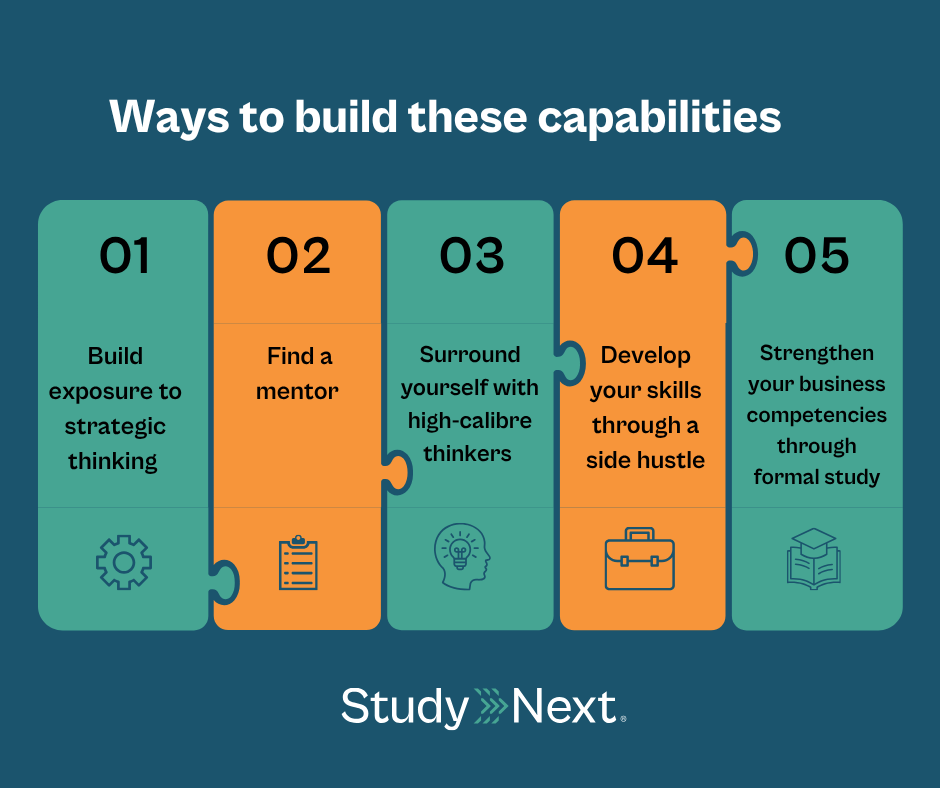
If you’re looking to build these capabilities and forge your own path forward, here are some ways to start:
Build exposure to strategic thinking
Strategic thinking is the ability to evaluate information thoughtfully and logically before making decisions. Strategic thinking is critical because it allows you to anticipate change, navigate ambiguity and make more effective decisions. It also enables forward thinking and helps you make informed decisions that aid long-term planning.
Try this: If you’re looking to build exposure to strategic thinking, some ways to do so include putting your hand up for planning or strategy work at your organisation and listening to business podcasts to understand how founders and entrepreneurs approach complex business problems. Postgraduate or short courses can also help you hone your strategic thinking skills. Some courses to consider include:
Strategic Problem Solving at RMIT University
This six-week online course is designed to build your critical thinking and problem-solving skills. Over six weeks, you’ll practise identifying problems and breaking them down into issue trees. You’ll also learn how to synthesise findings, gather insights and analyse data and information to strengthen your strategic capabilities.


Accelerate career growth by strengthening strategic thinking and developing effective problem-solving approaches that help drive success.
Graduate Certificate in Business at the University of Canberra
This online course is ideal for anyone looking to improve their core business skills, including decision-making and problem-solving. You’ll complete units like Strategic Management and Innovation to sharpen your strategic thinking skills, alongside an Applied Industry Project where you’ll be required to demonstrate your ability to problem solve, self-manage and show adaptability and initiative in planning, decision making and evaluation.


Build core business capabilities in decision-making, finance, marketing, workforce management and strategy while developing the analytical skills to respond to complex organisational challenges.
Find a mentor
If you’re looking for someone who can act as a sounding board and provide professional guidance, you might want to consider finding a mentor. A good mentor can offer encouragement, constructive feedback and advice based on real-world experience, helping you accelerate your own development.
Try this: Start by looking at your existing professional network and identifying someone whose qualities you’d like to emulate. This could be a former manager, a current manager or even someone from another team or department in your organisation. Then, reach out to them and ask if they’d be willing to meet for a coffee or virtual catch-up. Brief, low-commitment conversations are typically the best way to get started.
While you can also look for mentors through professional associations, alumni networks or networking events, you’re likely to have more success with people you’re already interacting and working with. If you’re trying to get on the radar of someone you admire, consider following them on LinkedIn and engaging thoughtfully with what they share.
Surround yourself with high-calibre thinkers
You’ve probably heard the phrase “you are who you surround yourself with” and the same principle applies here. Your inner circle plays a significant role in shaping your mindset, so if you want to succeed, you’ll want to surround yourself with individuals who hold you to a higher standard than you hold yourself.
Try this: Put yourself in environments where ambitious, capable people gather. Some examples include joining an industry association and attending their networking events, or attending conferences in your field.
Completing a postgraduate course like an on-campus Master of Business Administration (MBA) is also a great way to connect with individuals from various backgrounds and disciplines and build relationships with industry professionals through industry talks, seminars, workshops, career fairs and other on-campus events. Examples of MBAs to consider include:
MBA at Melbourne Business School
Offered both online and on campus, this MBA is ideal if you want to meet diverse individuals from various professional backgrounds while gaining skills across areas such as operations, marketing, finance, leadership and business strategy.

Accelerate your leadership and management development through MBS’s immersive, full-time MBA in Melbourne, combining 13 core subjects with six electives.
MBA at the University of Technology Sydney
Accelerate your business career with this MBA, where you’ll study alongside like-minded professionals and grow your professional network. You’ll complete units like Finance for Managers and Strategic Management and have the option to major in areas such as business analytics, digital finance, human resources or finance.


Fast-track your career and become an influential, strategic, in-demand leader of tomorrow.
Develop your skills through a side hustle
A side hustle is a low-risk way to develop highly transferable real-world skills. Examples of skills you could gain include time management, financial planning, problem solving, self-discipline and resilience. It’s also a great way to turn something you’re passionate about into a potential source of income.
Try this: Start by figuring out what area you’d like to start a side hustle in. Some popular ideas include freelance writing, home baking or starting a craft business. Take a look at a full list of side hustle ideas and how to get started here.
Strengthen your core business competencies through formal study
Completing a microcredential, short course or postgraduate course is a smart way to strengthen business competencies like marketing, finance and data analytics. It’ll also help you stay across what’s happening in today’s digital landscape and develop transferable skills in areas such as leadership, adaptability, communication, strategic thinking and critical thinking.
Try this: Some examples of courses to consider include:
Data-Driven Leadership at the University of New South Wales
This two-day microcredential is ideal if you’re looking to enhance your data fluency to drive better business outcomes. You’ll learn how to understand the data landscape and lead confidently with data.


Leverage data to improve decision-making and drive results.
Graduate Certificate in Business Administration at Adelaide University
If you’re looking to build foundational skills in the business world, this online course covers areas like leadership, marketing, accounting and finance. It also includes an Entrepreneurial Mindset unit that explores all aspects of entrepreneurship, including core concepts and theory, innovation and viability.


Discover your leadership potential by exploring your own leadership story, philosophy and areas for improvement.
Executive Master of Business Administration at RMIT University
This face-to-face course is suitable for experienced professionals looking to equip themselves with the strategic knowledge and leadership skills required to propel their career forward. You’ll study areas like advanced strategies, financial management and global marketing, with the option to choose from a range of specialised minors including arts management, health leadership, strategic artificial intelligence and business analytics and more.

Redefine your career with a course that emphasises leadership, corporate strategy, design thinking for business and innovation.
Chart your own path to success
These five remarkable billionaires have had extraordinary career journeys, with their fair share of highs and lows along the way. Each of them, however, learned from their mistakes, persevered through setbacks, built their networks and continuously developed their skills. If you’re interested in building your business and management skills, take a look at the full list of courses available on the StudyNext website. Courses are available across a range of topics, including entrepreneurship, business analytics, management and finance.
If you need help choosing the right education path, our Education Consultant, Catriona, is here to help. She can support you in comparing study options, understanding entry requirements and thinking through career progression and upskilling. To get started, book a complimentary professional development strategy call with her.