
In This Article
- Should you delay or fast-track your postgraduate studies as a new parent?
- Why can postgraduate studies be a dilemma for new parents?
- Why postgraduate study is possible for new parents
- When you should fast-track your postgraduate studies
- When you should delay your postgraduate studies
- Key factors to consider before deciding to accelerate or postpone your studies
- Checklist: Are you ready to start studying as a new parent?
- 6 easy tips for new parents navigating postgraduate studies
- Short courses: Alternatives to postgraduate studies
- Explore flexible learning options that fit your family life

While raising a baby can come with its own set of challenges, some parents see this period as an opportunity to invest in their professional growth by beginning postgraduate studies. However, is pursuing advanced education during the early stages of parenthood actually feasible?
This article explores both the challenges and possibilities when considering postgraduate study as a new parent. You’ll gain insight into when fast‑tracking your studies can be beneficial and when postponing may be a better option. We also provide you with key factors to consider when making your decision, along with practical strategies to help you manage your studies more effectively if you choose to pursue them now.
So, should you delay or fast-track your postgraduate studies as a new parent?
As a new parent, you may choose to accelerate your postgraduate studies if you want to maintain career momentum and have strong support in place. On the other hand, delaying may be the better option if you’re feeling overwhelmed or don’t have the resources you need.
Every new parent's situation is unique, which means there's no one universal answer to whether you should pursue postgraduate study during this stage of life. Some parents may find that starting their postgraduate studies helps them stay intellectually engaged, while others may feel that pausing is necessary to focus on the demands of early parenthood. Recognising your priorities and resources can help you determine whether advancing your studies now or postponing them is the right choice for you and your family.
Why can postgraduate studies be a dilemma for new parents?
For new parents, starting postgraduate studies can feel like a dilemma, with financial pressures, time commitments, shifting priorities and mental capacity playing a significant role. This may lead you to prioritise raising your child over pursuing study at this stage. Find out more below:
Financial pressures
The cost of raising a child is already substantial, covering essentials like food, clothing and healthcare. For families with young children, childcare may add major financial pressure to household expenses. When a partner has stepped away from work and is facing reduced income during their parental leave, it may leave a bigger financial strain for the family. In this situation, the added costs of tuition fees, textbooks and study materials can make postgraduate study feel unrealistic for many new parents.
Time commitments
Postgraduate programs generally require consistent effort and focus. However, new parents need to manage feeding schedules, sleep deprivation and other challenges that come with navigating life with a baby, especially during the first few months. Finding time for dedicated study can be difficult, as caring for an infant often leaves less energy for keeping up with lectures and complex coursework.
Evolving priorities
The ambitions and priorities of new parents may look different before and after welcoming a child. While they still have professional goals they want to achieve, the timeline for these objectives may evolve to accommodate the realities of parenthood. New parents may choose to delay professional development efforts, such as further study or training, to focus on being present during the early months of caring for their infant.
Mental capacity
Maintaining mental wellbeing can be a significant concern for new parents who are considering postgraduate study. Balancing academic obligations with the constant responsibilities of caring for a baby can make it difficult to remain engaged and motivated, increasing the risk of burnout. Without adequate rest and a strong support network, this pressure may not only affect academic performance but also take a toll on overall wellbeing and family life.
Why postgraduate study is possible for new parents
For new parents who feel equipped and supported, combining caregiving duties with postgraduate study can be achievable. Factors like the government’s parental leave scheme, employer assistance, flexible course options and a renewed sense of purpose can make advanced study a viable choice during early parenthood. Learn more in the following section:
Longer paid parental leave
The Australian Government’s expanding Paid Parental Leave scheme offers new possibilities for eligible parents who are considering studying while on parental leave. From 1 July 2026, families will be entitled to up to 130 days of government‑funded leave, providing a longer period away from the workplace to focus on their personal lives.
The Parental Leave Pay is currently set at $189.62 per day or $948.10 for a standard five‑day week, reflecting the national minimum wage. Securing this financial aid not only helps ease the transition into early parenthood but also makes it more feasible for parents to work on their professional growth before returning to the workforce.
Employer support
Besides government-funded leave, many organisations provide their own paid parental leave schemes to further assist new parents. Depending on organisational policies, employers may offer study leave, tuition assistance or flexible working arrangements for employees pursuing relevant qualifications once they return to work. These measures can help make a big difference for parents who want to invest in professional development without compromising family responsibilities. However, keep in mind that these benefits can vary significantly between employers, so it’s important to review your company’s policies or speak directly with your HR team to understand what support options may be available to you.
Flexibility of courses
Many universities provide online postgraduate programs, allowing parents to study without the need to commute to campus. These courses often feature flexible modules, enabling learners to engage with material when it’s convenient for them. Designed primarily for busy professionals, parents can benefit from this flexibility by completing coursework during their baby’s nap times or during short breaks throughout the day. This can make postgraduate study a feasible option for those who want to invest in their career growth while navigating the early period of parenthood.
Sense of purpose
Becoming a parent often renews a sense of purpose, as many parents prioritise wanting to provide a secure and comfortable future for their child. This may inspire them to set clearer professional goals and invest in opportunities that strengthen their ability to meet these parental responsibilities, including studying at the postgraduate level. With limited free time, parents often bring a heightened discipline to their studies. Having a focused mindset and newfound motivation can make it possible for new parents to excel in their postgraduate studies.
When you should fast-track your postgraduate studies
For many new parents, starting postgraduate studies sooner can be a smart move, as it may help you maintain career momentum and make the most of parental leave. Having a strong support network and access to employer or government support can also make studying more manageable during this stage of parenthood. Explore what these opportunities can look like:
If you want to maintain career momentum
Focusing solely on caregiving may sometimes lead to a loss of career momentum, making the transition back into the workforce more challenging. Pursuing postgraduate studies offers a way for you to stay intellectually engaged and on track with your professional goals.
Because your time is more limited as a new parent, it often becomes more valuable, enabling you to channel your energy into meaningful pursuits. By advancing your studies during early parenthood, you may be able to maintain career progression and work towards building long-term stability that benefits both your professional trajectory and your family’s future.
If you want to leverage parental leave
While caring for a baby can be demanding in the early stages, parental leave temporarily removes the structure of the typical nine-to-five routine. As your child begins to settle into longer and more consistent sleeping patterns, you may have more time that can be used productively.
Studying while on maternity leave or parental leave can be a productive way to make meaningful progress towards a qualification before returning to the workforce. By the time you return to work, you may already be well into your studies, positioning yourself for faster career progression. This approach can also demonstrate your commitment to both professional growth and family responsibilities to employers, highlighting your excellent self-management skills.
If you have a strong support network
Having a reliable support system can often make a big difference when considering postgraduate study as a new parent. This support may come from a partner who can take on caregiving duties during your study sessions, parents or family members who are willing to lend a hand or access to reliable childcare services. They can help free up your time and provide peace of mind, allowing you to focus on your studies without constantly worrying about your child’s wellbeing.
If you’re able to utilise employee benefits
Depending on where you work, you may have access to benefits like study leave or tuition assistance that can make postgraduate study more achievable after returning to the workforce. In Australia, you have the right to request flexible working arrangements with your employer, which can help you manage your time significantly as a student and a parent. Under the Fair Work Act 2009, full-time and part-time employees who have been with the same company for at least 12 months are legally entitled to make this request. This law specifically applies to parents or carers of a school-aged child or younger.
As a new parent, you can leverage this provision to negotiate arrangements like adjusted hours or remote work once your parental leave ends, providing you with better flexibility to focus on your studies.
If you’re eligible for government resources
If you’re looking to accelerate your postgraduate studies while raising a child, it’s important to explore whether you qualify for government financial assistance. One option is the Parenting Payment scheme administered by Services Australia, which provides fortnightly support to eligible parents. From 20 September 2025, single parents can receive up to $998.20 per fortnight, while partnered parents may receive up to $726.50. This financial support can serve as a valuable buffer, helping you balance both caregiving responsibilities and academic commitments.
You may also be eligible for support with child care costs. To qualify for the government’s Child Care Subsidy, you must care for a child aged 13 or younger who isn’t in secondary school, use an approved child care service, be responsible for child care fees and meet other requirements. The amount of subsidy you get generally depends on your personal circumstances.
By identifying and securing the support available to you as a new parent, you can better position yourself financially to manage other expenses during this period, including tuition fees and the additional costs that come with postgraduate study.
When you should delay your postgraduate studies
You may consider delaying your enrolment if your current circumstances aren’t suitable. For example, you may be feeling overwhelmed by the early stages of baby care or facing significant financial strain. Choosing to be fully present for your child’s early years or waiting until you can dedicate yourself fully to study are also valid reasons to delay. Find out what each of these entails:
If you’re overwhelmed with the early phase of baby care
If you’re dealing with the exhaustion of sleepless nights, the challenges of feeding or the possibility of postnatal anxiety or depression, this may not be the right time to pursue advanced study. According to a 2024 web report by The Australian Institute of Health and Welfare, around one in five mothers experience mental health conditions during the perinatal period, suggesting how common these challenges are. Whether experienced by you or your partner, this can affect the overall wellbeing of your family.
In this situation, your physical and mental health need to come first. Academic work requires sustained energy and focus, so attempting to push through when you’re constantly tired may end up hurting both your health and your academic performance.
If you’re facing significant financial pressure
Starting postgraduate studies while navigating the early stages of parenthood may place a heavy strain on your finances. Since you need to cover the essential and unexpected costs of caregiving, committing to educational expenses like tuition fees may not seem viable. Taking on study loans at this stage may also lead to unnecessary debt. Instead, it may be better to wait until your household has regained enough financial stability for you to consider pursuing advanced study.
If you want to be present in your child’s early years
The infant and toddler years often pass quickly, and many parents may want to prioritise being present during this stage. It’s perfectly reasonable to pause your academic journey for now, as advancing your studies can be done at a later time in your life.
If you want to fully focus on your studies
Postgraduate studies often require a high level of concentration and commitment. If you feel that balancing these demands with the responsibilities of early parenthood can compromise the quality of your work, you should consider delaying your enrolment. By waiting until you can fully dedicate yourself to your studies, you’ll be better positioned to excel academically. This can also help you avoid stretching yourself too thin and ensure that both your family life and your education receive the attention they deserve.
Key factors to consider before deciding to accelerate or postpone your studies
Before deciding whether to fast-track or delay your studies, it’s important to consider factors like your financial situation, family support, workplace flexibility, personal wellbeing, career goals and your child’s needs. Each of these may play a role in influencing your decision. Explore more below: Financial situation:
With your current financial circumstances, reflect on whether you can cover tuition costs without straining your household budget. You can also explore various potential sources of financial support that can help ease the burden of your educational expenses, such as scholarships, employer support or government assistance. If you’re eligible, you may also consider postgraduate programs that offer Commonwealth supported places. Securing this government subsidy can significantly lower your tuition fees.
Family support: If you’re leaning towards fast-tracking your studies, it’s essential to ensure you have reliable support from your partner or family in caring for your child. Talk with your partner about whether they’re willing to take on more of the caregiving responsibilities while you focus on your coursework. You may also reach out to nearby relatives who can provide childcare occasionally. The saying “it takes a village to raise a child” becomes even more relevant when you’re balancing parenthood with professional growth.
Workplace flexibility: Check with your employer to find out whether your organisation provides benefits such as paid parental leave or study benefits for employees furthering their qualifications. These forms of support can significantly ease the challenges of studying while working and parenting.
Personal wellbeing: Postgraduate study is a long-term commitment, so ask yourself whether you’re mentally and physically ready to take on this educational pursuit, alongside raising a child. Beyond your readiness, consider how your course workload may affect your overall health and ability to manage daily responsibilities.
Career goals: Reflect on the trajectory of your professional journey and assess how urgently you need a postgraduate qualification to progress. In some cases, the promotion you’re aiming for may depend on acquiring this credential. By reviewing the timeline of your future career milestones, you can determine whether you should pursue postgraduate studies now or later.
Child’s needs: Parenting demands generally evolve as children grow. For example, a parent with a three‑month‑old baby may be more inclined to postpone postgraduate studies than someone with a three‑year‑old. Each situation is unique, so it’s important to decide the right time to pursue further education based on your child’s needs.
Checklist: Are you ready to start studying as a new parent?
Studying with a baby requires careful consideration, so use our checklist to help you determine whether now is the right time to begin your postgraduate studies. Tally up the number of these scenarios that best reflect your current situation:
Personal readiness
- I’m confident in my ability to manage stress when balancing study and parenting
- I feel mentally and emotionally stable enough to take on a new commitment
- I have a clear sense of why I want to study and what I want to achieve
- I have strategies to stay disciplined even when I feel tired or distracted
Practical readiness
- I have a reliable childcare arrangement that allows me to concentrate on my studies
- I can afford tuition fees without causing a strain on my household finances
- My workplace offers flexibility and support for advanced study
- I feel confident in my time management skills to balance study, work and family life
Career readiness
- I have a specific career goal that this qualification will help me reach
- I understand the workload expectations of the program I’m interested in and how they can fit alongside parenting responsibilities
- I’ve considered how completing this qualification can help improve my ability to provide for my child
- Studying now rather than later can make a meaningful difference to my career timeline
Results
If you align with nine or more scenarios, your circumstances are well‑aligned and pursuing postgraduate studies now can be a strong choice. Aligning with five to eight of these scenarios suggests you may be ready, as long as you plan carefully. If you ticked fewer than five, it may be wise to give yourself more time before committing.
Keep in mind that there are no right or wrong answers, as this checklist only serves as a tool to give you insights that can help you decide on the best next step for you and your family.
6 easy tips for new parents navigating postgraduate studies
If you’ve decided to pursue postgraduate studies as a new parent, knowing how to balance work, study and family can feel overwhelming at first. However, with the right strategies in place, such as receiving support from your university, leaning on your support network and prioritising your wellbeing, it can become more manageable. You can also make your postgraduate experience better by creating a study schedule, setting up a dedicated learning space and studying in small, consistent blocks. Learn more below:
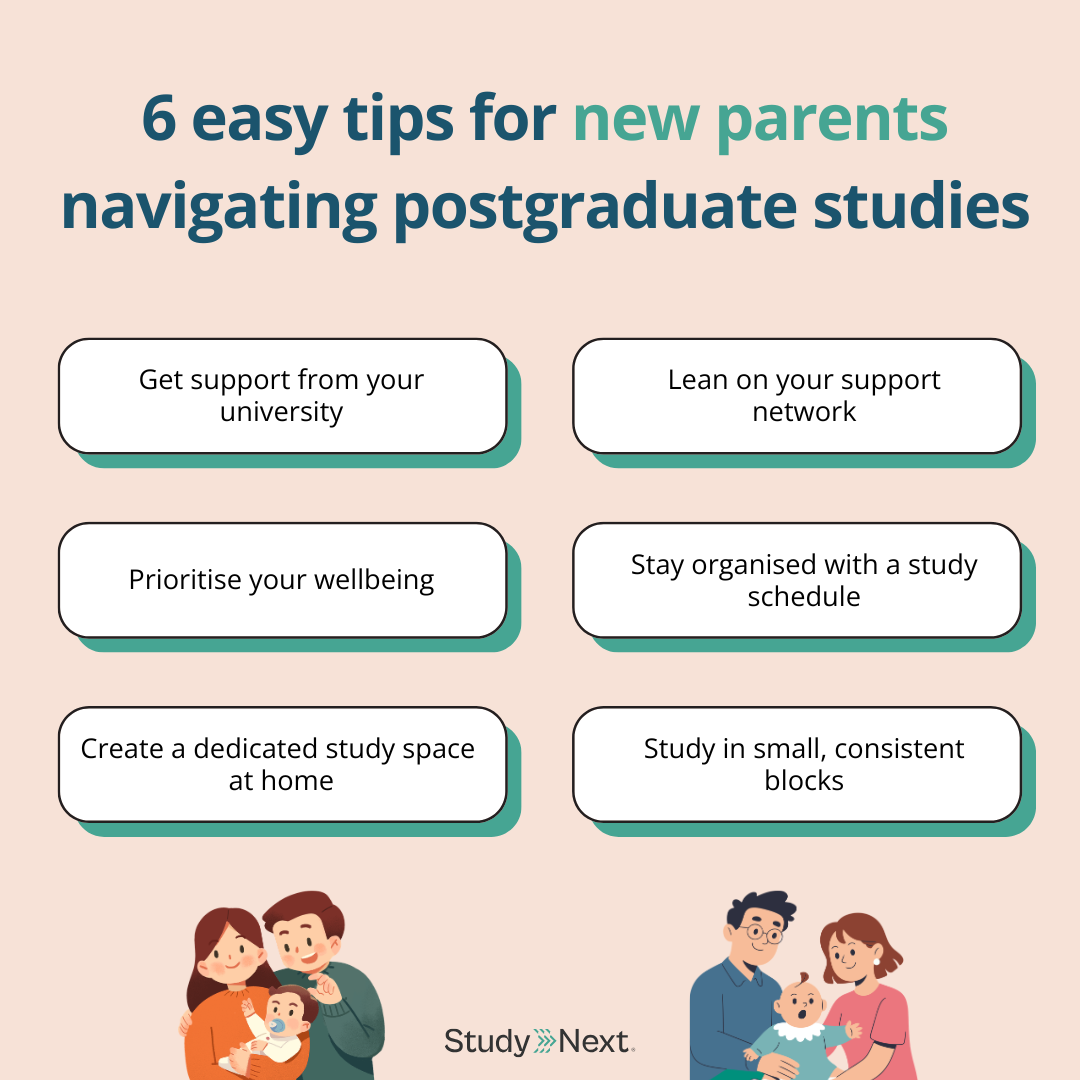
- Get support from your university
Many postgraduate programs are designed with busy professionals in mind, including parents. As a new parent, it can be helpful to inform your course coordinator or student support team about your circumstances. This allows them to guide you through your options and ensure the program structure suits your circumstances from the start. - Lean on your support network
Raising a child can feel overwhelming, especially for new parents balancing postgraduate studies at the same time. It’s important to remember that caregiving isn’t something you have to manage alone. Reach out to your partner, family or friends for support, especially if you need to share caregiving responsibilities. By leaning on your support network, you may have more time and energy to focus on your studies and reduce the risk of burnout. - Prioritise your wellbeing
While balancing parenting with postgraduate study often requires personal sacrifice, it’s important not to take on more than you can realistically manage. Amid your responsibilities as both a parent and a student, you need to make time for your own wellbeing. Engage in activities that help you recharge, whether that’s exercising, pursuing hobbies or spending time with friends. Prioritising self‑care can help you maintain the energy needed to succeed academically while raising your child. - Stay organised with a study schedule
Use your organisational skills to carve out study time around family routines. You can plan sessions during nap times or your partner’s days off so you can focus fully on your coursework. It’s important to highlight key deadlines in your planner to stay on track, especially when you’re juggling studies with caregiving demands. You can also share your schedule with your partner or family so they know when you’ll be busy with your studies, allowing them to step in and provide assistance. - Create a dedicated study space at home
When studying at home, setting up a dedicated workspace can make a big difference in staying engaged and productive. Choose a spot with plenty of natural light and remove any distractions to help you concentrate. You can also keep this area separate from caregiving responsibilities. Having a clear boundary between your role as a parent and a student helps you stay focused and get the most out of your study time. - Study in small, consistent blocks
As a new parent, it might be challenging to find long periods of uninterrupted study time. Instead, you should make the most of the brief moments of free time throughout the day by breaking your study into short, consistent blocks that align with your child’s routine. You can treat these smaller, productive periods as part of your routine, so studying becomes a regular habit. Consistently dedicating an hour to study each day can be more effective than waiting for the next opportunity for a long study session.
Short courses: Alternatives to postgraduate studies
If postgraduate study feels too demanding as a new parent but you still want to refine or learn new skills, short courses from reputable providers can be a great, flexible option. Many programs are available online, making it easier to study while caring for your child at home. Completing these courses helps you stay intellectually engaged and return to the workforce with practical skills, allowing you to pick up where you left off.
If you’re looking to strengthen your leadership and management skills, Queensland University of Technology offers an online Business Fundamentals: Managing People short course. This 10-hour program delves into the evolving role of managers and covers core principles, tools and strategies for managing people effectively. It’s designed for existing and aspiring managers, team leaders, professionals transitioning into leadership jobs and individuals looking to better understand the challenges of managing diverse teams in today’s workplaces.


Expand your knowledge and understanding of what managing people is all about.
Another leadership-focused short course you can consider is the University of Melbourne’s New Leader Development Program. This program is conducted online, allowing you to study from home and gain a formal certificate from one of Australia’s top business schools. Through weekly learning modules, interactive activities and live workshops, you’ll learn how to build confidence as a leader, interact and influence others effectively and identify the best leadership framework for your environment. This course also guides you in creating a personalised action plan to support your ongoing leadership journey.


Build the confidence and practical skills to influence others, lead teams and navigate your first leadership role.
Adjusting to life as a new parent means adapting to constant change, which is a valuable skill to have in the workplace. If you would like to improve this ability through formal study, you can enrol in the Navigating Change with Resilience short course offered by the University of New South Wales. Delivered online over three weeks, you’ll explore frameworks and practical methods for managing change and building resilience, enabling you to drive sustainable change for your team or company. This course is ideal if you’re leading a change project, boosting your resilience or seeking to encourage change for yourself or your team.


Navigate complex landscapes and lead teams through change and challenges with resilience.
To remain future‑ready, you can use parental leave to upskill in emerging areas and return to the workforce with in‑demand expertise, such as artificial intelligence (AI). If you’re looking for a short course to build fundamental expertise in this field, the University of Sydney’s online AI Fluency Sprint can help you develop an understanding of the opportunities, capabilities and challenges of AI. Conducted over two and a half weeks, you’ll also explore the ethical principles for AI deployment, develop practical use cases and transformational projects and gain insights into integrated work design. Completing this program will prepare you to interact confidently with AI stakeholders.


Accelerate AI understanding for informed business decisions and strategies.
Data analytics is another emerging area worth exploring to complement your business expertise. Building these skills often involves learning core programming languages, which you can do through short courses like RMIT University’s Business Analytics with SQL and Python. This online course teaches you how to extract, clean and examine data using SQL queries and Python functions to obtain insights and make predictions. You’ll also gain practical experience in data wrangling, analysis and communication by working with real datasets, developing forecasting models and applying data visualisation to make informed business decisions.


Acquire foundational skills in SQL and Python and deliver powerful analysis and predictions for your team or business.
Explore flexible learning options that fit your family life
Deciding whether to pursue postgraduate study as a new parent ultimately depends on your personal circumstances. If the timing is right, it can be a great investment in your professional growth at this stage of life. If you don’t believe it’s the right moment yet, there are still plenty of meaningful ways to continue developing your career while you adjust to parenthood.
Ready to return to study and explore your options? Discover flexible postgraduate courses and short courses offered by leading universities in Australia today.