
In This Article
- Can you build MBA skills without getting an MBA?
- How important are MBA skills?
- Common barriers to pursuing an MBA
- Core MBA skills you can build independently
- How to build your own MBA-inspired plan
- How does building MBA skills independently compare to doing an MBA?
- Is an MBA still worth it for some professionals?
- Enhance your business skills with MBA alternatives

An MBA is a popular choice for business professionals looking to advance their careers. However, given the significant time and financial commitment involved, it may not be a viable path for everyone. So what are the alternatives for those who want to develop their business expertise without enrolling in the program?
This article examines why MBA skills matter, the common barriers that prevent people from pursuing the degree and the various ways you can build these skills through alternative routes. We also provide insights into creating your own MBA-inspired learning plan, along with how developing these skills outside of an MBA may deliver comparable advantages for your professional growth.
Can you build MBA skills without getting an MBA?
Yes, it’s possible to build many of the skills typically developed in MBA programs through alternative learning pathways.
An MBA isn't the only path to building strong business skills. You can develop these competencies through a variety of alternatives, often at a fraction of the cost and time. Short courses, online learning platforms, specialised certifications and other postgraduate programs enable you to target specific business areas like finance, marketing and project management without committing to a full MBA degree.
Practical experiences taught in MBA programs can also be gained outside the classroom. Opportunities such as leading cross-functional projects or delivering presentations at work can contribute meaningfully to your professional development. By leveraging alternative learning methods and building hands-on experience, you may be able to develop MBA-level skills on your own terms.
How important are MBA skills?
MBA skills, which are competencies that are usually developed in an MBA, are generally valued across diverse industries and professions. These skills enable professionals to think strategically, guide teams, manage finances, navigate complex stakeholder environments and make informed business decisions. Individuals with this set of skills are usually highly sought after by employers across sectors. According to the Hays Skills Report 2025, hiring managers in Australia and New Zealand report notable gaps in leadership and management, communication and critical thinking or problem-solving within their organisations, all of which closely align with core MBA competencies.
For professionals looking to move into senior leadership, transition into a new field or launch their own business, mastering MBA skills can be a great way for them to get closer to achieving their career goals. These skills can offer a framework for understanding organisational operations, interpreting market behaviour and achieving meaningful results in the long run. Whether you're a mid-career professional looking to accelerate your growth or an emerging leader preparing to make a greater impact at work, developing these capabilities can help set you apart and offer you a competitive edge in today’s job market.
If you’re thinking, “What skills do you get from an MBA?”, our guide breaks down the key capabilities you can expect to develop during your studies.
Common barriers to pursuing an MBA
Some professionals may find that pursuing an MBA doesn’t align with their current circumstances for various reasons, including expensive tuition costs, significant time commitment, inability to fulfil admission requirements and unclear return on investment (ROI). An MBA may also not be suitable for those pursuing highly specialised professions. These factors may lead them to explore alternative ways to refine their capabilities or learn new skills. Find out more below:
Expensive tuition costs
Pursuing an MBA requires a significant financial investment, with costs varying widely depending on the institution and program format. In 2026, the cheapest MBA in Australia is offered by the Victorian Institute of Technology at $28,000, while the most expensive is the University of Melbourne’s Senior Executive Master of Business Administration at $157,608. For many professionals who are already managing other financial obligations, this amount of expenditure may discourage them from applying. Many MBA programs also raise their tuition fees every year, making it challenging for those who are holding off on advancing their studies for other priorities.
Significant time commitment
Many full-time MBAs take one to two years to complete, while part-time programs can extend to three or more years. For working professionals managing careers, families and other responsibilities, dedicating their limited time to formal study may feel overwhelming and cause stress. Even with universities offering flexible delivery options, the demands of an MBA program often require a major commitment that not everyone is able to make.
Unmet eligibility criteria
MBA programs often require applicants to have several years of professional work experience, along with an undergraduate qualification. If you don’t meet these requirements or you’re still early in your career, gaining entry to a reputable MBA program may not be immediately possible.
Unclear ROI
If you’re still uncertain about your long‑term career path, pursuing an MBA can feel daunting, as its benefits may not be immediately clear. Since you need to consider the significant financial and time investment required, as well as the opportunity cost of stepping away from work if you’re studying full-time, you may find it difficult to justify the commitment.
Unsuitable for specialised careers
Career paths in business vary widely, so an MBA may not be necessary for every professional. As a broad qualification, an MBA typically covers a wide range of topics rather than focusing on one area. For those seeking to advance into highly specialised roles without taking on managerial responsibilities, a specialised master’s degree may be a more suitable option. Exploring alternative postgraduate programs can help you find the best fit for your professional pathway.
Core MBA skills you can build independently
The key skills gained from an MBA usually span a wide range of competencies, including business acumen, financial literacy, marketing management and project management. MBA programs also help you develop vital soft skills like leadership, communication, stakeholder management and strategic thinking. You can find alternative ways to build these capabilities independently outside of an MBA program. Find out how below:
Business acumen
Business acumen is one of the most fundamental skills developed in an MBA. It involves understanding how business organisations can create competitive advantage, respond to market changes and make decisions that drive long-term growth and profitability. One of the most effective ways to build this skill is through direct exposure at work. Taking on stretch assignments, volunteering for cross-functional projects or participating in strategic planning meetings can provide valuable exposure to how a business operates. Staying up to date with the latest business news can also help sharpen your commercial awareness over time.
For a more structured approach, you can enrol in self-paced courses on online learning platforms, including Coursera, edX and LinkedIn Learning as well as books and podcasts. If you want to gain a formal qualification, you can explore diverse postgraduate programs and short courses focused on business or management offered by reputable universities.
You can consider studying the online Graduate Certificate of Business Administration at Deakin University to obtain insights into navigating global business challenges. This six-month program delves into strategic management, economic principles and financial decision-making, helping you build a solid foundation in business. The qualification can also serve as a pathway to the Graduate Diploma of Business Administration or Master of Business Administration, should you choose to continue your studies in the future.

Gain practical capabilities in strategy, finance and sustainable value creation while strengthening your confidence to contribute to complex organisational decisions.
The University of New South Wales (UNSW) offers a three-day Shaping Strategy to Create Value short course, which is designed to equip you with the capabilities to innovate your organisation and create new value propositions for your customers. Delivered in person, you’ll learn how to design a resilient strategy development process tailored to your environment, leverage innovation methodologies to determine strategic opportunities and utilise a variety of tools and frameworks to decide on the most effective approach.


Shape the future of your organisation.
Financial literacy
A strong grasp of financial principles is essential for many professionals, especially those aiming for business leadership roles. MBA programs typically cover diverse areas of finance, such as management accounting, corporate finance and financial decision-making. In the workplace, you can develop this skill by volunteering for finance-related responsibilities, such as budgeting, making financial forecasts or reporting expenses. These tasks can help you build familiarity with key financial concepts. You can also review your organisation’s financial reports as part of self-directed learning to further enhance your financial literacy. If you don’t have a background in finance, you can take free online courses covering fundamental topics to help you get started.
On the other hand, if you’re planning to advance your career in finance, you may benefit from obtaining professional certifications offered by relevant organisations like CPA Australia or the Chartered Accountants Australia and New Zealand. You can also build financial literacy outside of an MBA through other postgraduate programs and short courses in accounting and finance.
Macquarie University’s Graduate Certificate of Finance is designed to be accessible even for individuals with no prior finance experience. This online program is suitable for those looking to pivot into the finance industry or deepen their understanding of finance to advance in their current field. Through units such as Finance Principles, Quantitative and Economic Analysis, Case Studies in Applied Finance and Financial Statement Analysis and Modelling, you’ll develop a strong foundation in finance to complement your existing skill set.


Interpret financial data, assess economic influences and apply finance principles to support confident decision-making across a range of business and investment contexts.
If you’re looking for a more in-depth learning experience, the Graduate Diploma in Applied Finance at UNSW is ideal for professionals who want to upskill and acquire foundational financial knowledge to progress in their careers. This course is also well-suited for those aiming to pursue the Chartered Financial Analyst designation, covering diverse topics like portfolio management, corporate finance and equity valuation.

Advance your finance expertise through practical study in investment, valuation, risk and global markets, while gaining the analytical capability to make informed financial decisions across contemporary business environments.
Marketing management
Marketing management involves understanding how to develop and implement effective campaigns to promote a product or service, making it a core component of many MBA programs. This skill typically covers topics like consumer behaviour, brand strategy, market research and digital marketing. If you're looking to build this competency without formal study, you can put your hand up for marketing-related work within your current organisation. This may involve assisting with content creation or helping to analyse the performance of a recent marketing initiative. Volunteering your expertise to these projects can give you practical exposure to how marketing strategies are developed and executed.
You can also build your knowledge and obtain online certifications on these targeted marketing areas from various platforms like Google, HubSpot and Meta. Many universities also provide postgraduate programs and short courses in marketing for you to consider.
Swinburne University of Technology’s Graduate Certificate of Marketing offers the opportunity for you to gain specialised theoretical and practical expertise in marketing. You’ll study units like Opportunity Discovery, Creativity and Design, Data Empowered Marketing, Consumer Behaviour and Global Digital Marketing. After completing the course, you’ll be equipped with the capabilities to pursue diverse career paths in areas like digital marketing, advertising, consultancy, market research and corporate communications.

Develop practical and analytical marketing skills across consumer behaviour, digital marketing, data analysis and creative problem-solving.
You can learn how to leverage data to make smarter marketing decisions through the online Marketing Analytics and Insights short course at RMIT University. Conducted over six weeks, this program introduces essential tools like Google Analytics, Tableau and Adobe Analytics to equip you with the competencies to measure, examine and optimise marketing performance. You’ll also develop the skills to generate customer insights, deploy personalisation strategies and turn data into actionable marketing tactics.


Elevate your marketing career with hands-on experience in marketing analytics and use data to solve real-world business problems.
Project management
In an MBA, project management is a highly versatile skill that can be developed through case studies and group assignments that mirror the complexities of managing teams and resources. You can build this competency in other ways, such as volunteering to lead or coordinate a project at work. This can expose you to the real challenges of managing timelines, resources and competing stakeholder priorities. You can also shadow an existing project manager in your company or join project discussions to gain direct project management insights. Another way to develop this skill independently is by using free project management tools like Trello, Asana or Monday.com to organise your own workload.
Short courses, online learning platforms and professional certifications, such as the Project Management Professional from the Project Management Institute or PRINCE2, can also be a great way to build project management expertise. If you’re looking to obtain a formal qualification, there are plenty of graduate certificates, graduate diplomas and master’s degrees in project management you can explore from leading universities.
Curtin University’s Graduate Certificate in Project Management takes a broad approach to project management, making it applicable to projects across diverse industries such as engineering, education, health, commerce and information technology. Through units like Project Management Overview, Project and People, Project Cost Management and Project Planning and Schedule Management, you’ll gain a comprehensive understanding of managing projects from ideation to completion.

Enhance your project management skills with a 100% online course to gain a competitive edge in your career.
The Leading Complex Projects Sprint short course offered at the University of Sydney enables you to learn how to manage high-impact projects that deliver lasting value for both organisations and communities. Delivered online over two weeks, this program develops your abilities to craft practical strategies for leading complex initiatives in today’s business landscape. You’ll also understand how to assess project phases in detail, apply leadership approaches at each stage and establish project success measures that drive long-term value and social impact.


Enhance your skills in navigating complexity and creating value through big projects.
Leadership
Leadership, one of the most sought-after capabilities developed through an MBA, is the ability to inspire and manage teams, navigate organisational dynamics and drive performance under pressure. There are many practical ways for you to strengthen this skill, such as volunteering to lead projects at work, learning from mentors and participating in leadership development programs. If you’re looking to balance both theoretical knowledge and real-world application, you can find postgraduate and short courses that focus on leadership.
The in-person Graduate Certificate in Leadership at the University of Western Australia is designed to help you become an effective leader within your sector, profession and society. Open to students from all disciplines, this program also welcomes experienced professionals who don’t have an undergraduate degree. Throughout the course, you’ll explore your management and leadership style while gaining valuable insights into how to guide and inspire others.

Gain advanced knowledge in the field of leadership, as well as skills in motivating and inspiring others to resolve complex problems.
In the three-day Learning the Practice of Leadership short course at the University of Queensland, you can gain an understanding of your current leadership approach and develop an action plan to strengthen your skills. This face-to-face program includes practical leadership activities for you to build self-awareness, confidence and the ability to motivate others. Collaborating with fellow professionals, you’ll participate in exercises that can help expand your leadership capacity and tackle organisational challenges.

Gain foundational leadership tools to confidently guide others and achieve positive outcomes.
Communication
Strong communication is a vital skill for all professionals. An MBA provides many opportunities for you to enhance this competency, whether through presentations, business simulations and group projects that require you to articulate your ideas clearly and collaborate with others effectively. You can sharpen this skill by joining workshops, participating in public speaking programs like Toastmasters or enrolling in short courses that focus specifically on communication. Seeking feedback on how you communicate can also help provide valuable external perspective, allowing you to work on your areas for improvement.
The Authentic Communicator: Activating Presence short course is conducted in person at UNSW and delves into a wide range of communication techniques, such as managing your nerves, using body and vocal presence for impact and personalising your message according to diverse audiences. Covering themes like presence and authenticity, listening, storytelling and audience analysis, this two-day program equips you with practical strategies to structure meetings and articulate purpose clearly.

Develop your communication techniques, allowing you to lead with presence and increase your impact in any scenario.
Stakeholder management
Managing relationships with both internal and external stakeholders is an important capability in the business world, which is why it’s often included in many MBA curricula. It involves building trust while balancing competing stakeholder interests. Outside of an MBA, you can develop stakeholder management skills through hands-on experiences, such as participating in workplace projects that involve diverse stakeholders like vendors, clients and cross-functional teams, and through formal learning opportunities, including short courses designed to enhance stakeholder engagement.
Negotiation skills are essential when you’re managing stakeholders, especially in high-stakes business environments. If you’re looking to strengthen this capability, CPA Australia offers a Negotiation and Influence for Success short course. This online program explores a wide range of negotiating techniques to achieve mutually beneficial agreements. You’ll gain insights into influencing strategies to build consensus and deliver perspectives. This course also delves into conflict management, along with the core components of the negotiation process, including approaches for cross-cultural contexts.


Learn about various sources of power in the workplace, different influencing styles and strategies and barriers to influence.
Strategic thinking
Strategic thinking is the ability to analyse complex problems and develop strategies that can drive success in the long run. MBA programs often require you to examine case studies, engage in simulations and analyse real-world business challenges, helping you build a strategic mindset. If you’re not studying an MBA, you can improve this capability by keeping yourself informed with the latest developments and trends in the business landscape that may affect your role or industry, enabling you to anticipate challenges and opportunities. You can also discuss these issues with peers or mentors to sharpen your analytical perspective, which contributes to strong strategic thinking. Short courses in innovation and design thinking can also provide practical frameworks for developing long-term, future-focused strategies.
Queensland University of Technology offers a six-week Enterprise Leadership - Actioning Strategic Innovation short course, which explores design thinking, strategic innovation tools and effective communication for implementing new ideas. Ideal for team leaders, project managers and business executives looking to drive innovation within their organisations, this program provides practical knowledge to build a culture of innovation, apply design thinking and execute strategic initiatives.

Add value to your enterprise by constructing a toolkit to cultivate a habitual culture of innovation.
Another short course you can consider to improve your strategic thinking skills is UNSW’s Design Thinking and Experimentation. Conducted on campus over three days, this course integrates innovation, design thinking, business model design and experimentation to support organisational success. You’ll learn how to apply creative approaches to identify and lead new solutions and frame meaningful opportunities based on customer needs and data. Taking this short course can help you adopt a more customer-centric mindset that better positions you and your company in an era of constant disruption.

Develop new products and services while transforming your business model through a human-centered design approach.
How to build your own MBA-inspired plan
To design your own MBA-inspired learning plan, you should begin by determining your skill gaps, followed by setting your learning goals, choosing the right learning options, planning a realistic study schedule, building your professional network and applying what you’ve learned in practice. These steps can help you develop MBA‑level competencies until you can confidently demonstrate them in your role. Discover what each step entails below:
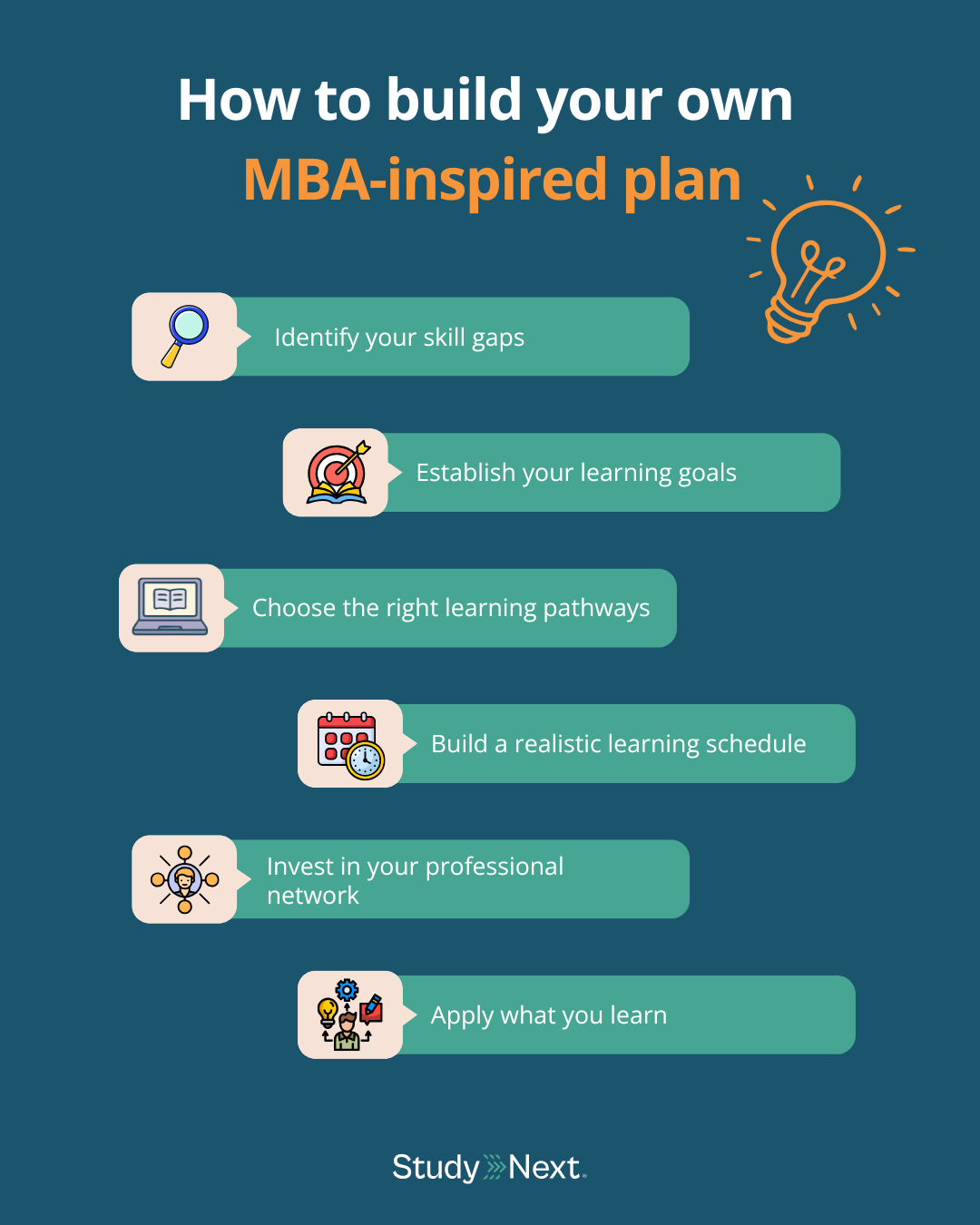
- Identify your skill gaps
Start by assessing your current capabilities to determine which skills you want to strengthen, particularly those that are commonly developed through an MBA. If you need a more objective evaluation of your competencies, you can request feedback from your manager, colleagues, mentors and trusted peers. You can also consider the skills required for the roles you're aspiring to and identify areas for improvement. Conducting this self-assessment can help you prioritise where to focus your time and energy. - Establish your learning goals
Once you've identified your skill gaps, you can set clear and specific learning goals. For example, if you’re looking to strengthen your financial literacy, you may aim to complete a graduate certificate in accounting within six months. Having defined goals gives your learning plan direction and makes it easier to measure progress. It can also help you evaluate whether your objectives are too ambitious or need adjustment to remain feasible. - Choose the right learning pathways
Depending on the skills you want to improve, you can explore different learning options to achieve your goals. Competencies like financial literacy and marketing management are often best developed through structured courses and certifications. On the other hand, soft skills like leadership and communication may be strengthened effectively through practical experiences, mentoring or workshops. Rather than relying on a single learning format, consider combining formal study, self‑directed learning and hands-on opportunities to create a well‑rounded development plan. - Build a realistic learning schedule
One of the advantages of independent learning compared to university study is flexibility. However, without structure, you could risk losing momentum. To keep yourself engaged and accountable, set aside time each week for study and professional development. This dedicated time should be treated with the same commitment as a formal program. You can also break your learning into manageable parts and set milestones to help you stay on track. - Invest in your professional network
A notable feature of an MBA program is the network it provides. While you may not have access to the same community, you can make up for it by actively building your own network. You can do this by attending industry events, joining professional associations, connecting with peers on LinkedIn and engaging in online communities relevant to your field. Building connections with professionals outside your sector can also expose you to diverse perspectives, similar to how MBA cohorts typically include people from different fields and backgrounds. - Apply what you learn
After completing your learning experience, look for opportunities to put what you’ve learned into practice in your current role, whether by successfully leading a project, presenting to important stakeholders or contributing to strategic planning processes. This can demonstrate tangible evidence of your newly developed competencies.
How does building MBA skills independently compare to doing an MBA?
It’s possible to develop strong business capabilities through other MBA alternatives and independent learning. While a formal MBA does provide certain experiences and advantages, many of these benefits can also be achieved through different pathways without enrolling in the postgraduate business program. Below are some of the common perks of an MBA, along with how non‑MBA pathways can provide comparable value:
Prestige and credibility
An MBA from a reputable institution often carries weight in many industries, especially for management roles, as it signals your business and leadership capabilities to potential employers. For many professionals, however, credibility can also be built through other degrees or industry‑recognised certifications. These qualifications demonstrate expertise in targeted areas and can be more relevant to specialised career paths.
Exclusive alumni network
MBA programs typically provide access to alumni networks that may lead to valuable professional opportunities, potential partnerships and mentorship. If you’re not pursuing an MBA, you can still gain professional connections by attending in-person networking events and leveraging social platforms like LinkedIn to engage with other professionals. Unlike MBA networks, which are tied to a single institution, these networks can be broader and span diverse industries.
Structured career support
Some universities offer dedicated career services and personalised coaching sessions for their MBA students. If you’re looking for career support outside of an MBA, you can still access valuable resources through professional associations and government resources for job seekers. Many universities also extend career services to students in other qualifications such as graduate certificates, graduate diplomas and master’s degrees, giving non‑MBA learners structured support to advance their careers.
Cohort‑based learning
MBA cohorts often foster collaboration through case studies and group projects. However, similar experiences can be found in other postgraduate programs and professional workshops. Similar to MBAs, these formats also encourage group work and cross‑industry collaboration, offering opportunities for you to learn from your peers.
Is an MBA still worth it for some professionals?
While building MBA skills independently is a credible and achievable path for many professionals at different career stages, there are certain circumstances where pursuing a formal MBA qualification may still be a strategic choice.
For example, if you’re aiming for a senior executive or C-suite role, you may find that the prestige and network of a reputable MBA program can provide you with a competitive advantage. If you’re thinking of making a substantial pivot into a new industry to change careers, you may also benefit from the comprehensive curriculum of an MBA, which is designed to provide both the business knowledge and credibility needed to enter a new field confidently.
Similarly, entrepreneurs looking to build or scale a business may find value in the network of potential collaborators, investors and business mentors an MBA provides. Those who have employer sponsorship or the financial capacity to invest in an MBA without significant personal sacrifice may also find that the ROI makes the program a worthwhile pursuit.
It’s worth noting here that those who benefit most from an MBA are typically individuals who are prepared to make the significant commitment the program demands. However, not all professionals are in this position, yet many still want to improve specific skills commonly developed in MBA courses. Building these competencies outside of this degree can be a more practical and accessible option, making upskilling possible for business professionals across a wide range of industries.
If you’re still wondering, “Is an MBA worth it?”, read our article exploring whether an MBA is the right investment for your career.
Enhance your business skills with MBA alternatives
For business professionals, continuously updating your skills is essential to remain relevant, especially in the workforce of tomorrow. While an MBA can broaden your expertise across diverse business areas and strengthen capabilities like leadership, communication and strategic thinking, it may not be the most suitable path for every individual.
Fortunately, many of the skills typically developed in MBA programs can also be gained through alternative learning pathways that align more closely with your career goals, including those offered by leading universities. Take the next step in your professional growth and explore a wide range of postgraduate business programs and short courses available in Australia.
If you're interested in acquiring skills that are commonly taught in an MBA without the commitment of the degree, speak to our Education Consultant, Catriona, about your options. She can help you determine whether a short course would benefit you or whether a graduate certificate or graduate diploma would offer better value. Book a obligation-free quick chat or professional development strategy call here.