
In This Article
- Which business school should you choose?
- University overview
- Business school rankings
- Course offerings
- Admission requirements
- Student experience and support
- MBA graduate outcomes
- Program costs
- Financial support
- MBS vs UNSW: Which business school is right for you?
- Pick the right business school that can set you up for success

When searching for the best business school in Australia, Melbourne Business School (MBS) and the University of New South Wales (UNSW) consistently emerge as two leading options for anyone pursuing a postgraduate business degree. But what sets these schools apart, and how do you decide which one is the right fit for you?
This article explores both institutions across key areas, including university rankings, course offerings, general admission requirements, student resources and program costs. Through this comprehensive university comparison, you’ll be better equipped to make an informed choice about where to study.
Which business school should you choose?
UNSW is the stronger choice if you’re looking for program variety and online flexibility, while MBS is more ideal if you place greater value on rankings and prestige.
MBS and UNSW are widely regarded as two of Australia's most prestigious business schools, each distinguished by unique strengths that have earned them both national and international recognition. When comparing these two institutions, it's essential to understand what you prioritise in pursuing your postgraduate business education to determine which school best aligns with your goals.
University overview
MBS
Established in 1963, MBS serves as the University of Melbourne’s graduate school in business and economics. Based in Carlton, Victoria, the institution is home to Australia’s top-ranked MBA programs, along with a diverse portfolio of postgraduate courses. Beyond degrees, MBS also provides short courses for in-demand topics like artificial intelligence (AI), data analytics and leadership. With dual recognition from the Association to Advance Collegiate Schools of Business (AACSB) and the European Foundation for Management Development’s Quality Improvement System (EQUIS), MBS ensures its courses are aligned with leading global standards.
UNSW
Originally founded in 1955 as the Faculty of Commerce, UNSW Business School has grown into one of Asia-Pacific’s leading centres for business education. Located in Sydney, New South Wales, it consists of seven disciplinary schools covering various fields, such as banking and finance, information systems and technology management, economics and marketing, research institutes and the Australian Graduate School of Management (AGSM). With accreditation from EQUIS and AACSB, it’s also Australia’s sole member of the Global Network for Advanced Management, alongside globally recognised institutions such as Yale University in the United States, Fudan University in China and INSEAD Business School in France.
Business school rankings
MBS
MBS consistently ranks as one of the world's elite business education providers, earning high positions across many prestigious global and national rankings. The school's recognition by the Australian Financial Review BOSS rankings is particularly notable, as it claimed the top position from UNSW, which had dominated the list for the previous three years.
Institution rankings
| Ranking | National rank | Global rank |
|---|---|---|
| Australian Financial Review BOSS Best Business Schools 2025 | #1 | N/A |
| QS World University Rankings 2026 | #1 | #19 |
| Times Higher Education World University Rankings 2026 | #1 | #37 |
Program rankings
| Ranking | National rank | Global rank |
|---|---|---|
| QS Global MBA Rankings 2026 | #1 | #31 |
| Financial Times Executive MBA Rankings 2025 | #1 | #84 |
| QS World University Subject Rankings 2026 - Accounting and Finance | #1 | #24 |
| QS World University Subject Rankings 2026 - Marketing | #1 | #38 |
| QS World University Subject Rankings 2026 - Business and Management Studies | #1 | #42 |
| QS World University Subject Rankings 2026 - Economics and Econometrics | #3 | #43 |
UNSW
UNSW maintains a strong presence in national and international business education rankings, demonstrating consistent excellence across its programs. Its dominance in online MBA rankings is especially prominent, securing top 10 positions globally and the number one spot in Australia across QS and the Financial Times rankings. The institution is also the only Australian business school to be featured in both the Financial Times lists included below.
Institution rankings
| Ranking | National rank | Global rank |
|---|---|---|
| Australian Financial Review BOSS Best Business Schools 2025 | #2 | N/A |
| QS World University Rankings 2026 | #2 | #20 |
| Times Higher Education World University Rankings 2026 | #5 | #79 |
Program rankings
| Ranking | National rank | Global rank |
|---|---|---|
| QS Online MBA Rankings 2026 | #1 | #4 |
| Financial Times Online MBA Rankings 2026 | #1 | #18 |
| Financial Times MBA Rankings 2026 | #1 | #48 |
| QS World University Subject Rankings 2026 - Marketing | #2 | #43 |
| QS World University Subject Rankings 2026 - Accounting and Finance | #3 | #29 |
| QS World University Subject Rankings 2026 - Business and Management Studies | #2 | #48 |
| QS World University Subject Rankings 2026 - Economics and Econometrics | #5 | #56 |
Course offerings
MBS
MBS focuses exclusively on postgraduate business education, offering programs such as MBAs, graduate certificates, graduate diplomas, master’s degrees and short courses. Below is a curated selection of MBS courses featured in StudyNext Australia’s course catalogue:
| Program type | Courses |
|---|---|
| MBA programs | |
| Graduate certificates | |
| Graduate diplomas | |
| Master’s degrees | |
| Short courses |
MBS delivers flexible MBA programs designed to suit a wide range of students, whether you prefer to study full-time, part-time or online as an early or mid-career professional. For those with more experience, the Executive MBA may fit their needs better. The Senior Executive MBA at MBS is the only global MBA in Australia tailored specifically for CEOs and senior executives.
MBS also offers an extensive portfolio of master's degrees across numerous business disciplines, such as business analytics, international business, economics and actuarial science. You can find various specialisations within the Master of Management, allowing you to focus on a field like entrepreneurship and innovation, supply chain management, marketing, accounting, finance or human resources. Besides postgraduate courses, this school provides a range of short courses of up to six weeks for professionals covering contemporary topics including data analytics, leadership, AI, strategy and digital marketing.
While many programs at MBS are delivered on campus, several are also available in online or blended formats, including the online MBA, Graduate Certificate in Business Administration, Graduate Diploma in Applied Business Analytics and Master of Applied Business Analytics. Some short courses, such as Leading Strategy with AI and Exponential Technologies, Digital Marketing Strategy and Leadership, New Leader Development Program and Data Analytics for Business Professionals, are delivered online, making them ideal for busy professionals wanting to upskill without the need to travel to campus.
When you complete a short course at MBS, you’ll acquire your certification in the form of a digital badge. This badge can be included in email signatures, digital resumes and on social media platforms like LinkedIn, X and Facebook. Every badge carries authenticated metadata that specifies the qualification and the process required to obtain it.
UNSW
UNSW delivers a comprehensive suite of postgraduate business courses through AGSM, including MBAs, graduate certificates, graduate diplomas and master’s programs. You can also find diverse short courses offered by this institution. Discover a selection of UNSW courses pulled from StudyNext Australia’s course catalogue below:
UNSW offers a wide range of specialisations within its MBA programs, allowing you to tailor your studies according to your career aspirations. This approach enables you to gain a strong foundation in business leadership while focusing on areas most relevant to your professional goals.
Besides MBAs, the institution provides an extensive selection of graduate certificates and graduate diplomas, opening pathways for those who may not be ready to commit to a full master’s degree but still want to enhance their skills and knowledge. The institution also offers many postgraduate programs in specialised fields, such as sustainable and inclusive business, social impact, capability management and decision analytics.
Many programs at UNSW are available online, accommodating students who want to balance study with work and personal commitments.
Many short courses are also delivered online, making them accessible to a wide range of professionals. UNSW’s short courses cover a broad spectrum of topics designed to meet the workforce demands of today and tomorrow, including in-demand areas like data, leadership and AI, as well as specific skills such as change management, negotiation and design thinking. Many of these short courses provide practical, career‑ready knowledge that allows you to upskill quickly.
Admission requirements
MBS
Entry into MBS's MBA programs requires you to hold an undergraduate degree along with demonstrated professional experience. The full-time and part-time MBA programs require at least two years of documented professional work experience, making them suitable for early to mid-career professionals. The Executive MBA is designed for more seasoned leaders and requires at least five years of management experience. If you’re a senior executive applying for the Senior Executive MBA, you need 10 years of management experience.
Most graduate certificate and graduate diploma programs at MBS require an undergraduate degree and two years of work experience. However, alternative entry pathways are available for specific courses. For example, the Graduate Certificate in Business Analytics accepts applicants with six years of work experience instead of an undergraduate degree.
Admission to MBS master’s programs generally requires an undergraduate degree, though the specific criteria may differ depending on the course. For example, the Master of Business Analytics requires a three or four-year undergraduate degree in a relevant discipline, including commerce, mathematics, physics, computer science, information systems, engineering or science, with a minimum weighted average mark (WAM) of 65 per cent.
Short courses at MBS are highly accessible, as most programs don’t have formal entry requirements. This allows professionals at any career stage to enhance their skills in specific areas without prerequisite qualifications.
UNSW
Admission to the MBA programs at UNSW usually requires either an undergraduate degree with at least two years of full-time professional work experience or a minimum of six years of professional experience.
For graduate certificates, you typically need a recognised bachelor’s degree in any discipline or at least three years of relevant work experience. Some programs have specific criteria, such as the Graduate Certificate of Commerce, which requires either an undergraduate degree with a minimum average grade of 60 per cent or five years of relevant work experience.
If you’re exploring graduate diplomas, you usually need a recognised bachelor’s degree with a credit average of 65 per cent or higher or relevant professional experience. For instance, the Graduate Diploma in Social Impact allows professionals without a bachelor’s degree to apply if they have at least five years of full-time relevant work experience in government, corporate or not-for-profit sectors. Some graduate diplomas, such as the Graduate Diploma in Financial Technology, also accept completion of a graduate certificate. You can apply for this course if you’ve completed the Graduate Certificate in Financial Technology with a WAM of 65 per cent or above.
While admission to master’s programs may vary by discipline, you generally need a recognised bachelor’s degree in a relevant field or completion of a graduate certificate or graduate diploma. Some programs also require professional experience. For example, entry into the Master of Taxation requires a bachelor’s degree in a related field with a minimum average of 65 per cent and two years of relevant full-time professional experience.
UNSW’s short courses typically don’t require prior study and are designed for professionals, managers and leaders who want to boost their capabilities and elevate their impact at the workplace.
Student experience and support
MBS
MBS's Career Services offers comprehensive support to help students build essential professional skills, expand their networks and advance their career prospects. Services include regular one-on-one coaching sessions, resume reviews, LinkedIn training, mock interview practices and access to industry events.
The school's unique Personal Effectiveness Program is specifically designed to help students understand and navigate the Australian job market. This program, which is integrated into the full-time MBA curriculum, focuses on critical skills such as networking, interviewing techniques and negotiation. If you’re enrolled in the part-time MBA and Executive MBA, you can get individualised guidance with MBS’s career coaches.
MBS fosters a vibrant community through regular networking events and specialised interest groups. For example, the MBS Alumni Entrepreneurs Club hosts events throughout the year that connect founders, operators and investors to share insights on building and growing ventures. The school also organises topic-specific panels for students to hear directly from industry experts. You can also take advantage of Community Social Hour events, which provide informal settings for peers, alumni and faculty members to engage in conversation without formal agendas.
As a member of the Partnership in International Management, which is a consortium of leading business schools worldwide, MBS offers full-time MBA, part-time MBA and online MBA students the opportunity to study overseas at partner institutions. Notable schools include Columbia Business School in the US, London Business School in the UK and Nanyang Business School in Singapore. These exchange programs allow students to experience different business cultures, collaborate on joint programs and build global professional networks.
Want to learn more about life on campus at MBS? Read this article to hear directly from an MBA student sharing their on-campus experience.
UNSW
The Career Accelerator @ AGSM and UNSW Business School offers personalised support and guidance to equip business students at UNSW with essential career development capabilities, a growth-oriented mindset and valuable industry connections. The team provides assistance in refining resumes, building career management competencies and connecting students with prospective employers. Through individual career consultations and access to extensive student resources, the Career Accelerator supports students throughout every stage of their professional journey.
The signature AGSM Industry Showcase offers a dedicated platform for students to expand their professional networks, explore career opportunities and engage directly with top Australian organisations. This showcase is launched annually in September with an in-person event in Sydney, followed by online and interstate sessions. Beyond this event, the school organises regular networking opportunities in Sydney and across Australia, connecting students with professionals across diverse sectors including consulting, finance, technology and healthcare.
UNSW also delivers regular career development workshops designed to build practical skills and industry knowledge. These sessions can help students discover and understand their professional strengths, engage with industry partners and explore sectors and roles using AI tools. Workshops are available throughout each term in both in-person and online formats, providing flexible access to students and equipping them with the competencies needed to excel in their chosen career paths.
MBA graduate outcomes
MBS
MBS’s strong reputation for excellence is reflected in the career outcomes of its MBA graduates. According to the business school, 94 per cent of its graduates secure roles that align with their career goals within three months of completing their program, demonstrating the institution’s effectiveness in preparing students for the workforce and the high value of its qualifications among employers.
MBS also highlights that the career satisfaction among its alumni members is exceptionally high, with 90 per cent reporting fulfilment in their current roles. This combination of outcomes reflects the school’s commitment to delivering not only world-class education but also long-term professional benefits for its graduates.
UNSW
Based on UNSW’s data from the Class of 2025, 87 per cent of MBA graduates at UNSW secured employment within three months of completing their degree, with 69 per cent reporting a salary bump compared to their pre-MBA income. This highlights the financial benefits and career advancement opportunities that come with this qualification.
UNSW MBA graduates are recruited across a diverse range of industries, with consulting representing 10 per cent of hires. Financial services and technology representing 20 per cent and media representing five per cent., demonstrating the extensive opportunities available to alumni. With rapid employment rates, salary growth and employability across industries, UNSW equips its graduates with lasting career value in an increasingly competitive job market.
Program costs
MBS
The cost of MBS programs varies significantly across course levels. Among the MBA options, the part-time MBA is the most affordable at $92,890, while the Senior Executive MBA is the most expensive at $157,608. This marks the widest fee range across all program categories. The on-campus, full-time MBA program, widely regarded as MBS’s most popular MBA option, is priced mid-range at $112,536.
Graduate certificates have similar pricing, with both the Graduate Certificate in Business Administration and the Graduate Certificate in Applied Business Analytics costing $21,232. For graduate diplomas, there’s a slight difference in fees between the two programs available at MBS. The Graduate Diploma in Applied Business Analytics is the more affordable option at $42,464, while the Graduate Diploma in Business Administration is the higher-priced course at $47,772.
Master's programs show significant cost differences depending on the field of study. The Master of Business represents the cheapest option at $49,600, while the Master of Management is the most expensive at $79,767. This fee variation reflects how program structure, duration and specialised content may influence overall costs.
Short courses are the most accessible in terms of cost. The Digital Marketing Strategy and Leadership program is the cheapest at $2,950, while the New Leader Development Program is the most expensive at $9,850.
UNSW
At UNSW, you can find clear ranges in tuition costs across program categories. For MBA courses, the AGSM Master of Business Administration (Cyber Security Leadership) is the most affordable MBA program at $68,040, while the standard AGSM Master of Business Administration is the highest cost option at $83,500.
Graduate certificates show a notable variation as well. The Graduate Certificate in Business is the least expensive at $20,500, whereas the Graduate Certificate in Business Analytics is the top-priced choice at $31,000. Within graduate diplomas, the Graduate Diploma in Professional Accounting costs $31,500, making it the cheapest option, while the most expensive program at this course level is the Graduate Diploma in Social Impact at $42,000.
Master’s programs demonstrate the widest range of all course types. The Master of Workforce Planning is the most affordable at $41,000, while the Master of Finance has the highest cost at $86,000.
Short courses represent the lowest-priced study option at UNSW. Navigating Change with Resilience is the lowest-priced program at $1,755, while Building an AI Strategy is the highest at $5,150. This range allows professionals to choose a short course that aligns with their learning goals and budget.
MBS vs UNSW: Price comparison
To highlight the pricing differences between MBS and UNSW, the table below compares the total course fees in 2026 for the same programs across both institutions.
| Course | MBS | UNSW |
|---|---|---|
| Master of Business Administration | $112,536 | $83,500 |
| Master of Business Administration (Online) | $92,890 | $71,280 |
| Master of Finance | $58,876 | $86,000 |
| Master of Business | $49,600 | $41,000 |
| Master of Management | $79,767 | $62,500 |
| Master of International Business | $79,767 | $86,000 |
Based on the pricing information above, neither university is consistently more expensive than the other. MBS’s MBA programs are priced higher than the ones at UNSW, while some master’s degrees at UNSW cost more than their MBS counterparts. When choosing between the two business schools, it’s important to compare fees on a program-by-program basis rather than assuming one institution is the more affordable choice.
Financial support
MBS and UNSW offer several pathways to help make the cost of postgraduate study more affordable. Both institutions offer FEE-HELP, which is a government loan scheme that allows eligible domestic students to defer tuition fees and repay them through the tax system once their income reaches the repayment threshold. Commonwealth supported places are also available for selected programs at both schools. While these subsidised placements are generally limited, securing one can significantly reduce your tuition costs.
Beyond government assistance, MBS and UNSW also provide a wide range of scholarships to help eligible students save on study expenses.
MBS vs UNSW: Which business school is right for you?
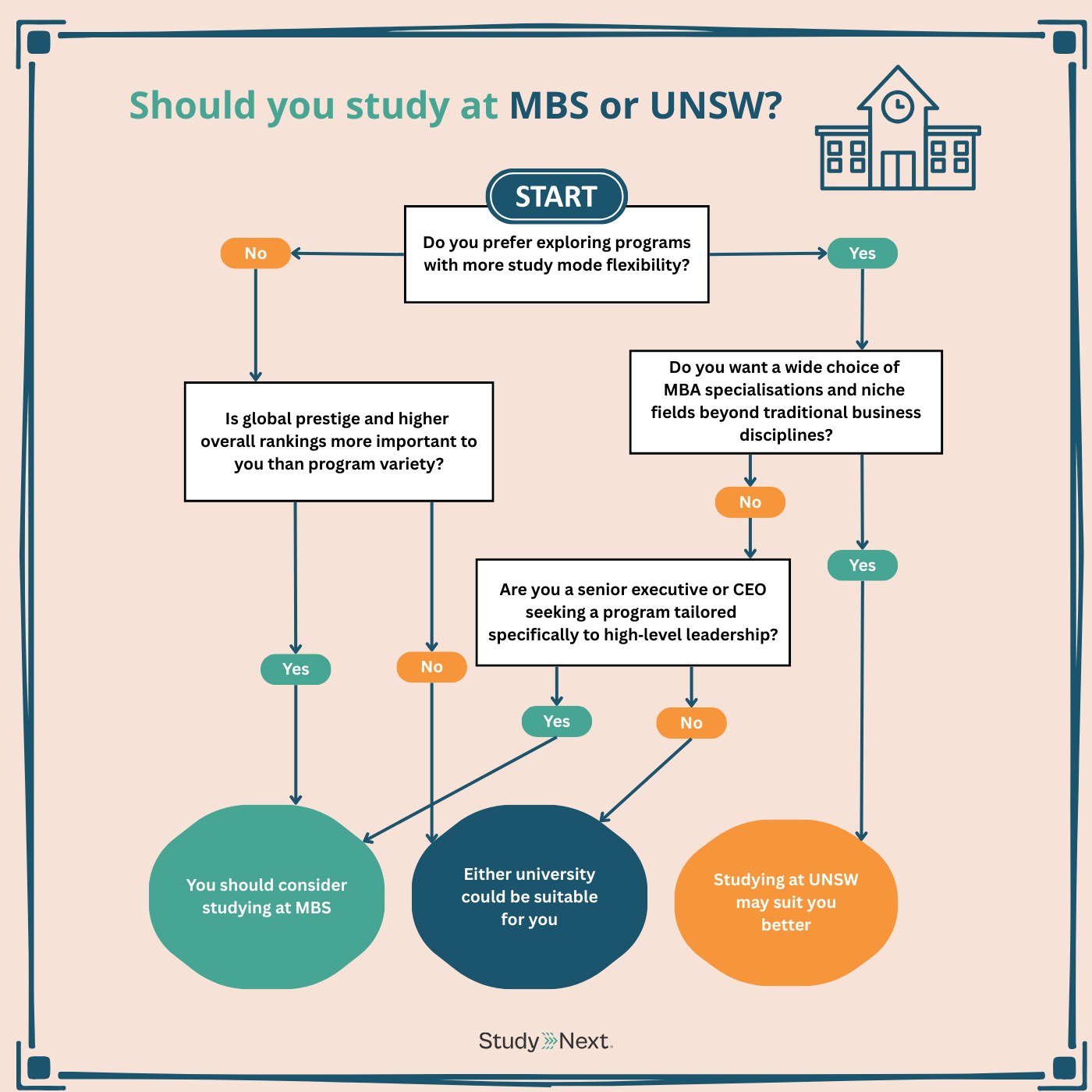
When deciding whether to study at MBS or UNSW, you should consider how each institution’s strengths align with your career ambitions and study preferences. If you prefer having a variety of specialisations across postgraduate options to choose from, UNSW may appeal to you more. For professionals valuing flexibility to juggle their studies with professional and personal obligations, this school also provides many courses in online mode, including its MBA program, which is ranked #1 in Australia according to the QS Online MBA Rankings 2026 and the Financial Times Online MBA Rankings 2026.
On the other hand, if studying at Australia's top business school by overall rankings is your priority, MBS has a clear advantage between the two business schools, having achieved higher positions in both the Australian Financial Review and Times Higher Education rankings recently. If you’re a CEO or a senior executive, MBS is the only institution in Australia to offer an MBA program designed for leaders with at least a decade of management experience.
Ultimately, your choice comes down to what you value in your postgraduate business education, whether you prefer breadth of specialisation, flexible study pathways or elite rankings. You should also consider other practical factors, such as location and program costs, to see which school may be the better fit for you.
If you’re looking for a starting point to guide your decision, you can take the quiz below:
Pick the right business school that can set you up for success
Both MBS and UNSW aim to support you in achieving long-term career success by offering top-quality business education, extensive student resources and financial support opportunities. Deciding which school to study at typically depends on your personal and professional priorities. Taking the time to explore and compare their courses in detail can help you make an informed decision. Discover diverse postgraduate business programs and short courses available at MBS and UNSW to get started.