In This Article
- What is ageism?
- What does ageism look like during a job search for mature-age individuals?
- Is age discrimination illegal in Australia?
- How mature-age workers bring value to employers
- Ways to overcome ageism in your job search
- Which industries are more open to hiring mature-age workers?
- Postgraduate and short courses that can help mature-age workers upskill
- Navigate ageism and build your career confidence
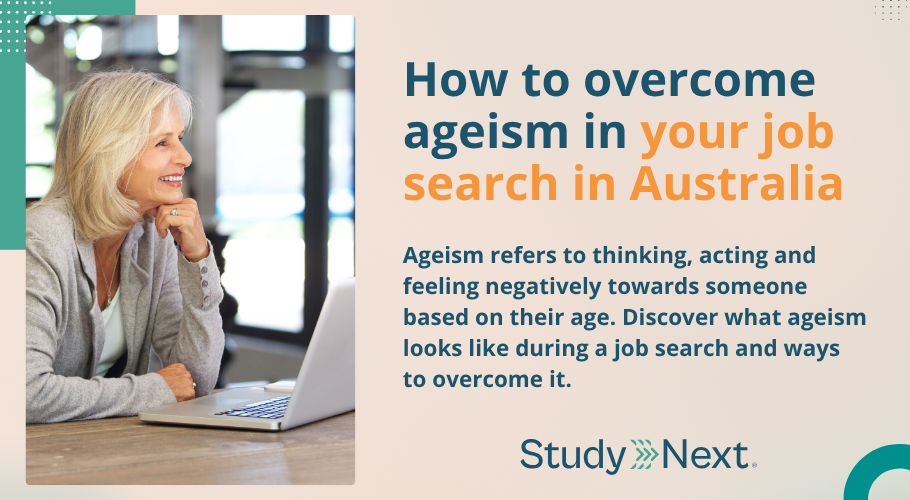
You’ve spent years working, gaining experience and building your skills, but somewhere along the way, you may have started to feel the job market becoming less welcoming. Perhaps your job applications are going unanswered, or you’ve noticed that interviewers seem more focused on your age than your experience.
If this sounds familiar, you might be experiencing ageism. In Australia, ageism remains a persistent issue, according to the Australian Seniors Series: Gen Seen Report 2024, 90 per cent of individuals over 50 feel they face stereotypes about their age.
In this article, we’ll break down what ageism looks like in a job search, why mature-age workers bring value to employers and how to overcome this stereotype.
What is ageism?
Ageism refers to thinking, acting and feeling negatively towards someone purely based on their age. According to the Australian Human Rights Commission, 71 per cent of Australians feel that age discrimination in Australia is common.
Examples of ageism include making inappropriate jokes about someone’s age, ignoring someone because of their age or rejecting someone for a position based on how old they are.
While ageism can affect people of any age, the term is most commonly used in the context of mature-age workers. The Australian Human Rights Commission highlights that 35 per cent of Australians aged 55 to 64 and 43 per cent of Australians aged 65 and above have experienced discrimination because of their age.
What are the types of ageism?
The Australian Human Rights Commission highlights that there are two types of ageism: direct age discrimination and indirect age discrimination.
Direct ageism is the easier of the two to spot. Examples include being told you’re not good with technology because of your age or being told you can’t do the job well because you’re older.
Indirect ageism is more subtle and often hides behind policies or rules that disadvantage older workers. An example could be a company requiring a physical test, such as mandating a fitness assessment for an office-based position that's unnecessarily difficult to deter mature-age individuals from applying for the role.
What are the effects of ageism?
Ageism can elicit a strong and negative emotional response. Anyone who experiences ageism can feel a sense of shame, anger or sadness. According to the World Health Organisation, ageism can also change the way we view ourselves and is associated with lifespans that are 7.5 years shorter, poorer physical and mental health and an increase in risky health behaviours.
What does ageism look like during a job search for mature-age individuals?
While it’s often assumed that ageism only happens during the application review stage, it can show up at any point in the job search process.
Here are some examples of what ageism could look like during the job search process:
Looking for jobs
Ageism can show up in the way a job advertisement is written. Most are subtle enough that they don’t read as explicitly age-related, but something about the wording may still put you off from applying. Examples include phrases like “looking for someone to join our young and dynamic team”, which insinuates a preference for a younger individual, or “digital native” which signals a preference for younger candidates who grew up with technology.
Application screening
This stage can be harder to spot because applicants don’t typically get visibility on why a particular application moved forward or didn’t. Research from the Australian Human Resources Institute (AHRI), however, has found that many employers are reluctant to hire workers under 24 or over 50, which can put mature-age applicants at an unfair disadvantage during the screening process, even before they’ve had a chance to demonstrate their suitability for the role.
Interview process
Ageism can also occur during the interview process, where factors such as your abilities or salary expectations may be judged based on age rather than your qualifications or experience. Examples include questions or comments about your ability to “keep up”, your willingness to report to a younger manager or assumptions about how long you plan to stay at the company before retiring. There may also be unnecessary questions about your age or pointed questions about your ability to pick up new digital tools.
Other forms of ageism that may occur during the hiring process may include being told that you’ll be “bored” or “underutilised” due to the amount of experience you have, or being steered towards a part-time or casual role based on the assumption that you’ll be retiring soon.
While it can be disheartening to be treated this way and it may feel like a heavy obstacle to overcome, there are still plenty of recruiters out there who want to hire mature-age workers. Read on to find out how to overcome ageism in your job search and which industries are more open to hiring mature-age workers.
Is age discrimination illegal in Australia?
Yes, age discrimination is illegal in Australia under the Age Discrimination Act 2004. The Act enforces that everyone, regardless of age, should have the same fundamental rights and that discrimination against individuals on the grounds of age should not occur in areas such as work, education, access to premises and the provision of goods.
The Act also includes a section on discrimination at work, which specifies that it is unlawful to discriminate against a person on the grounds of their age in areas such as determining who should be offered employment and the terms and conditions on which employment is offered.
If you believe you’ve experienced age discrimination during a job search or in the workplace, you can have someone such as a solicitor, advocate or trade union lodge a complaint with the Australian Human Rights Commission on your behalf.
According to the Commission’s 2023 to 2024 complaint statistics, the largest groups of complainants were aged 55 to 64 (20 per cent) and 65 to 74 (20 per cent). In total, 181 formal complaints related to age discrimination were lodged, with around 55 per cent of those concerning employment matters.
How mature-age workers bring value to employers
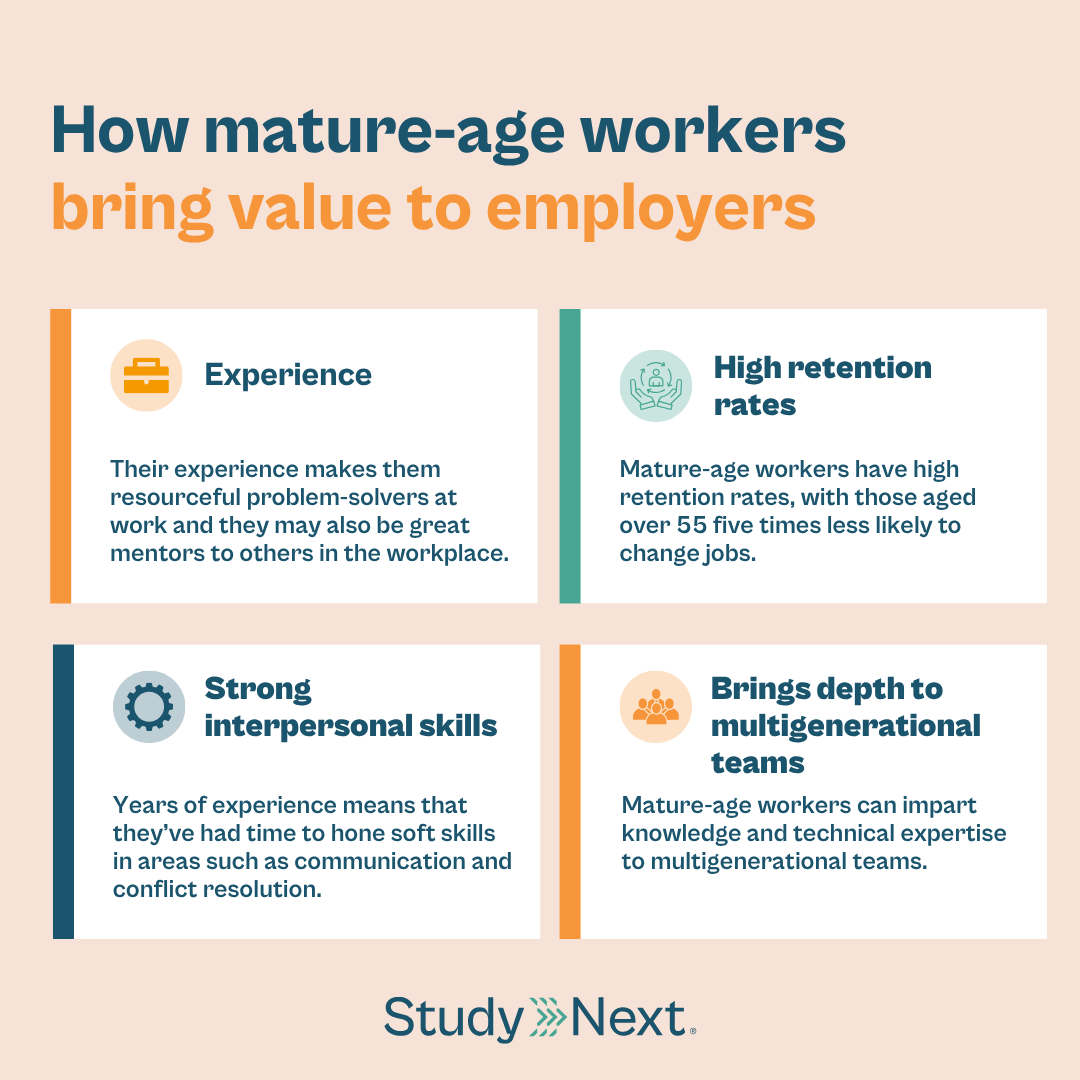
Despite the instances of ageism at play, many organisations recognise the value that mature-age workers bring to the table. Some of the strengths they offer include:
Experience
Mature-age workers often have a wealth of experience under their belt from the knowledge and skills they’ve gained throughout their careers. Their experience makes them resourceful problem-solvers at work and positions them well to act as mentors to others in the workplace.
Thanks to the resilience they’ve built up over the years, they’re also better equipped to handle pressure with composure, adapt to change and navigate workplace politics.
High retention rates
Data from SafeWork SA suggests that mature-age workers have high retention rates, with those aged over 55 five times less likely to change jobs in comparison to workers aged 20 to 24.
Lower turnover translates directly into lower costs, with the Australian Human Rights Commission highlighting that mature-age workers deliver an average net benefit of $1,956 per year due to factors such as lower rates of absenteeism and decreased costs of recruitment stemming from increased retention.
Strong interpersonal skills
With years of experience behind them and the opportunity to refine these skills over time, mature-age workers tend to have strong interpersonal skills in areas such as communication, emotional intelligence and conflict resolution.
Brings depth to multigenerational teams
Research by the Organisation for Economic Co-operation and Development (OECD) highlights that multigenerational teams bring a number of advantages. A team with varied ages can bring advantages such as enhanced organisational resilience, stronger productivity and the imparting of knowledge between team members, which creates a more robust team overall.
Ways to overcome ageism in your job search
While ageism can feel like an uphill battle, here are some ways to flip the narrative and defy these stereotypes:
Invest in upskilling and showcase your tech fluency
Defy the assumption: mature-age workers don’t have the skills today’s job market needs.
In this digitally-charged world, there’s no running away from fluency in technology and digital tools. Showing that you’re upskilling in this area signals that you’re future-focused and actively building your skills to stay ahead of the curve. AI literacy is currently a skill that employers are always looking for, so upskilling in this space is beneficial to your job search. Some courses to consider include:
AI Dexterity Sprint at the University of Sydney
As part of this two-week course, you’ll learn about all things AI, including its capabilities, challenges, how it can be utilised within an organisation and how people can work with AI to create value.

Learn how to prompt, customise and manage Generative AI tools and how to lead their responsible adoption across your team.
AI for Business at Melbourne Business School
This is an ideal course if you’re looking to develop a more in-depth understanding of the fundamentals of Generative AI. Spanning two days, you’ll learn the language of AI and large language models, discover how to optimise AI for targeted business solutions and build an AI strategy.

Build the knowledge and strategy to lead responsible Generative AI adoption.
If you’ve already got experience in AI, expertise in using technological tools or data fluency, it’s essential to highlight this within your resume and LinkedIn profile to showcase your technological prowess.
Update your resume (but not in the way you think)
Defy the assumption: mature-age workers have outdated resumes.
You’ve probably come across plenty of advice on how you should leave out older work experience or avoid sharing any information that might disclose your age. While there’s some truth to that, it’s less about dimming the experience you have and more about reframing it. Some ways to do so include:
- Instead of removing your older work experience, focus on selecting the roles that are most relevant to the job you’re applying for. You’d typically also want to keep your resume to no longer than two to three pages, so stick to that range to keep it scannable
- Make sure your resume has a design that’s easy to read and isn’t overly cluttered. It doesn't need to look like a graphic design portfolio, but it should feel clean and polished
- Unless your degree was completed within the past five years, leave the graduation year off. If you’ve done any recent short courses or postgraduate qualifications, however, make sure you highlight them as it signals your initiative to upskill
- Optimise for the job description by using language from the job listing in your resume
Remember that when it comes to your resume, it’s about marketing yourself in a way that stays true to who you are, while showing that you’ve upskilled and bring relevant knowledge and skills to the table.
Update your LinkedIn profile
Defy the assumption: mature-age workers aren’t active or engaged online.
LinkedIn is essentially a 24/7 digital resume, so making sure it’s up to date is vital. Have a current professional profile photo, a clear headline that says what you do and a summary written in the first person. You’ll also want to engage with content in your industry, post your own thoughts on industry trends or changes you’re noticing and connect with people working in roles or companies you’re interested in.
Reframe the narrative in interviews
Defy the assumption: mature-age workers lack the energy or adaptability to thrive in a new role.
During the interview, bring enthusiasm and energy into the conversation, highlight the achievements and projects you’ve led, share your passion for the role and be prepared to answer any skills-related questions.
According to the Hays 2025 Skills Report, soft skills such as communication, adaptability and time management are currently in demand, so make sure you’re calling these out in your interview with specific examples. You’ll also want to express your ability to be adaptable, whether that’s through learning new tools, switching between leading and following depending on what the team needs or stepping in where required to help lighten the team’s load.
Remain flexible
Defy the assumption: mature-age workers will only accept senior roles.
If you’re looking at pivoting industries or switching into a different part of the industry you’re currently working in, staying flexible can open up more opportunities. Be open to contract work, part-time roles or positions a step or two below your most recent title, especially if they offer you a chance to build skills in a new area or move you closer to your goals.
Seek advice
Defy the assumption: career advice is only useful for early-career professionals.
If you’re feeling stuck or unsure of how to proceed in your job search, it’s a good idea to seek advice. Many years of experience means you’re probably built up a robust network of professionals you can tap into. Use these connections to find out about available roles, ask if they’d be willing to give you a recommendation on LinkedIn or see if they have tips they’re happy to share.
The Department of Employment and Workplace Relations in Australia also offers a range of resources to support mature-age workers in their job search. If you’re 45 or older, the government offers a Career Transition Assistance program that helps individuals gain a better understanding of job opportunities in their local area and how to tailor their job applications.
At StudyNext, our Education Consultant, Catriona, can also help you make smarter decisions about your career and suggest courses that can close any skill gaps in your resume, helping you stand out from the rest of the pack. To get started, book a complimentary call with her today.
Which industries are more open to hiring mature-age workers?
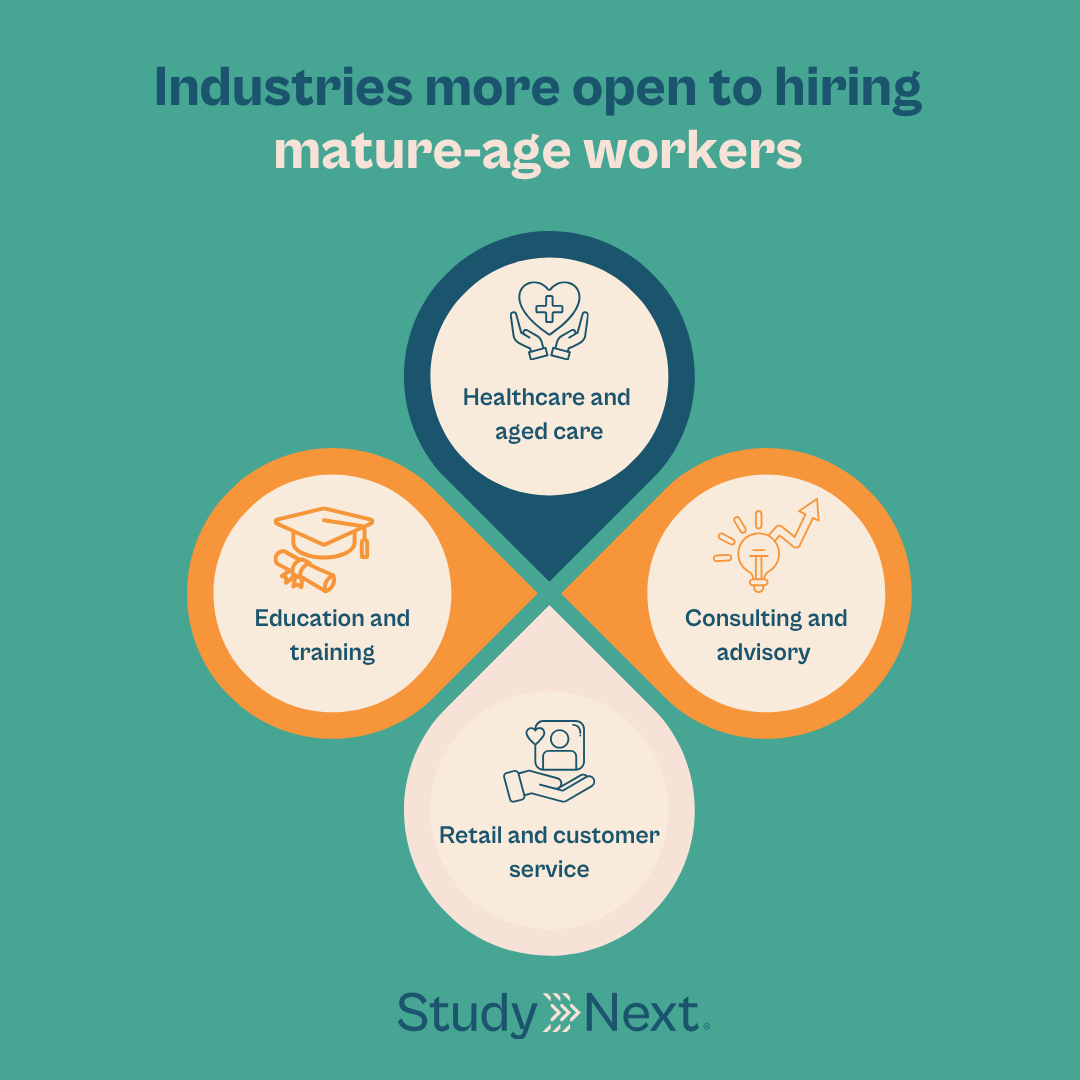
If you’re looking at pivoting industries, there are certain industries in Australia that lean towards hiring experienced professionals. These include:
Healthcare and aged care
According to the Department of Health, Disability and Ageing, the average age of healthcare professionals in Australia in 2024 was 42. Examples of healthcare professionals with a higher median age, according to Jobs and Skills Australia, include psychologists and psychotherapists at 42, podiatrists at 43 and registered nurses in aged care at 40. If you’re looking to pivot into healthcare, take a look at the range of postgraduate healthcare courses available in the GlobalHealth Education catalogue to get started.
Education and training
Schools, TAFEs, universities and corporate training providers typically hire mature-age professionals as part of their teaching and training workforce, drawing on the depth of experience they bring. According to Jobs and Skills Australia, the median age of vocational education teachers in Australia is 49, 48 for university lecturers and 46 for teacher’s aides. If you’re looking to jumpstart your career in teaching, you can take a look at the postgraduate education courses available in the StudyNext catalogue.
Consulting and advisory
Consulting firms across areas such as management consulting, financial consulting, human resources consulting or independent contracting tend to value experienced professionals who can draw on years of experience to hit the ground running with clients. According to Jobs and Skills Australia, the median age for management consultants is 42 and the median age for management and organisation analysts is 43.
If you’re looking to move into a consulting role, an MBA like the Master of Business Administration from Victoria University will equip you with the skills required of today’s senior business leader. You’ll complete units such as Financial Analysis and Marketing Management, as well as a Business Consulting Capstone. Don’t have a bachelor’s degree? There are plenty of Australian universities offering MBAs that don’t require one and accept work experience as an alternative entry pathway.

Learn practical business principles from reputable industry experts, using real-world case studies to prepare you for today's complex workplaces.
For a shorter option, you can complete the Graduate Certificate of Business Administration at Swinburne University of Technology online in six months and develop your skills in areas such as financial planning and decision making. You’ll complete units such as Emerging Technology and Technology and Innovation Immersion.

Develop business and management skills across emerging technology, innovation, entrepreneurship and customer experience through a four-unit online graduate certificate.
Retail and customer service
While this may not immediately be an industry that comes to mind for mature-age workers, there are plenty of organisations that value the experience, skills and life experience that mature-age individuals bring.
Bunnings, for instance, is known for creating an age-inclusive organisational culture. According to the Australian HR Institute, around 30 per cent of its store team members are aged 50 and older, while around 14 per cent are aged 60 and over, with its oldest employee being 93 years old.
Postgraduate and short courses that can help mature-age workers upskill
One of the most effective ways to counter ageism is to show prospective employers that you’re investing in your development. According to LinkedIn’s Skills on the Rise 2026, here are some of the fastest-growing skills in Australia, along with short and postgraduate courses that can help you upskill in those areas.
AI, machine learning and data intelligence
In this technological age, it’s important to build skills in areas such as data analysis, AI for business and analytics. Some courses that can help you upskill include:
Graduate Certificate in Data Science at RMIT University
This online eight-month part-time course is ideal for those looking to gain foundations in areas such as data wrangling, analytics and visualisation.


Gain essential data skills for future leaders.
Graduate Certificate in Applied Business Analytics at Melbourne Business School
Designed to fit around your professional commitments, this online eight-month course will give you strong foundations in business analytics. You’ll complete units such as Data Platforms for Analytics and Statistical Learning Foundations.

Build practical analytics skills through four focused subjects, studied online one at a time with optional on-campus tutorials in Melbourne.
Business Analytics and Visualisation at RMIT University
This online six-week short course is suitable for those looking to master essential business analytics tools to help them drive data-informed decisions. You’ll learn how to use tools like Excel and Tableau and learn directly from industry experts.

Learn the foundations of business analytics by familiarising yourself with Excel and tell compelling stories through data visualisation with Tableau.
Generative AI Masterclass at the University of Sydney
In this three-hour online course, you’ll learn how to use generative AI tools such as ChatGPT and Midjourney. You’ll also discover how to identify suitable use cases for generative AI in the workplace and use prompt engineering to create useful outputs.

Transform your work with this cutting-edge Generative AI tools workshop.
Discover the full suite of AI, business analytics and data analytics courses in the StudyNext catalogue.
Communication and relationship building
This area goes beyond interpersonal communication and also covers areas such as visual and brand storytelling and stakeholder collaboration. Some courses that can build your skill set in these areas include:
The Authentic Communicator: Activating Presence at the University of New South Wales
This two-day face-to-face course is ideal for those looking to improve their communication and presenting skills. Topics covered include listening, framing, audience analysis and storytelling.

Develop your communication techniques, allowing you to lead with presence and increase your impact in any scenario.
Graduate Certificate in Strategic Communication at the University of Technology Sydney
This online course can be completed in eight months and will teach you the skills required for intercultural communication and effective stakeholder engagement.


Develop skills in communication strategy, stakeholder engagement and intercultural and emerging communication practices.
Training, coaching and people development
Another skill area on the rise covers coaching, mentoring and learning. Some courses that can help you build skills in these areas include:
Graduate Certificate of Leadership at Deakin University
This online eight-month course will help you develop your leadership skills. You’ll gain a thorough understanding of leadership concepts and complete units such as Leadership Practice with Impact, Crisis Leadership and Innovation and Leadership.

Strengthen your ability to lead change, communicate direction and deliver strategic outcomes while applying contemporary leadership thinking to challenges from your own workplace.
Leader as Coach at the University of New South Wales
In this two-day face-to-face course, you’ll learn how to build coaching capability and strengthen leadership impact. This course is held at the Sydney Swans HQ, where you’ll also gain insights from the Sydney Swans on coaching and culture.

Discover how to unlock potential and drive performance through coaching.
Discover more leadership courses in the StudyNext catalogue.
Navigate ageism and build your career confidence
While ageism does happen, it shouldn’t be the deciding factor in your career. There are ways to push back against ageism in your job search and you’re already well-positioned to do so. You have the experience and a solid foundation that’s been built up over the years and upskilling will give you that extra edge with the skills recruiters are actively looking for.
If you’re looking to complete a short or postgraduate course from reputable Australian institutions, the StudyNext catalogue has over 1,000 courses across areas like business, digital marketing, global business and marketing to help you get started.